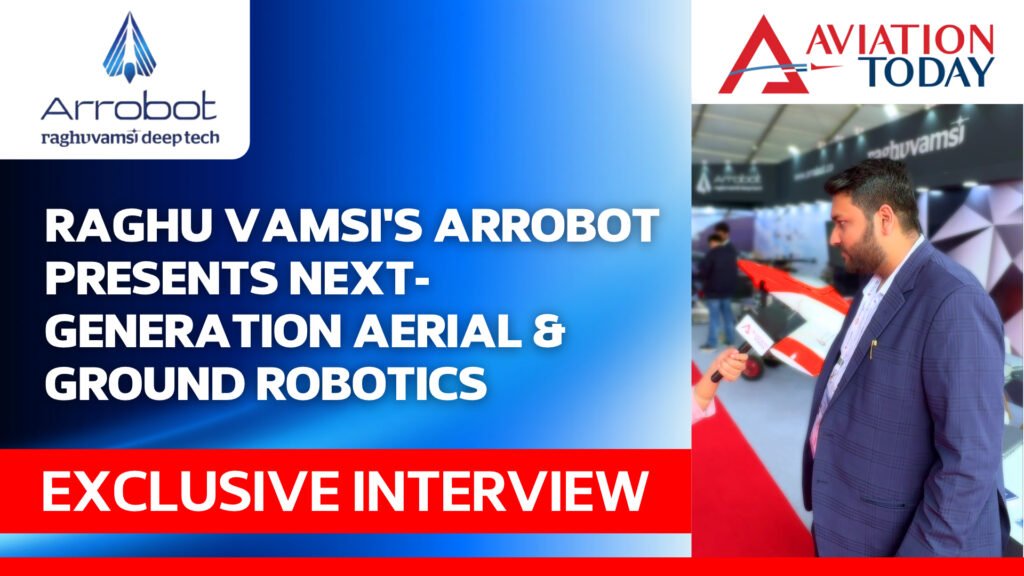
Hyderabad, India: Speaking to Aviation Today during Wings India at Begumpet Airport, Hyderabad, Deepak Jagnani, Director of Business Development at AeroBot, outlined the company’s latest advancements in indigenous autonomous systems for defence and civilian applications.
As part of the Raghavamsee Group, AeroBot designs, develops and manufactures unmanned aerial systems and robotic ground platforms entirely in India.
During the interaction, Jagnani highlighted the company’s indigenous micro turbojet engine technology, multiple drone platforms, autonomous robotic vehicles, and its commitment to the Government of India’s Make in India and Aatmanirbhar Bharat initiatives.
He also discussed AeroBot’s manufacturing capabilities, the future of India’s aerospace ecosystem, and the company’s vision of making India a global hub for defence and aerospace technologies.
Conversation In Details:
Aviation Today: Thank you so much for joining us at Wings India 2026. Could you please explain the technologies, innovations and products AeroBot is showcasing here?
Deepak Jagnani: Good morning everyone. My name is Deepak Jagnani and I am the Director of Business Development at AeroBot, a Raghavamsee Deep Tech company and part of the Raghavamsee Group.
At AeroBot, we design, develop and manufacture autonomous systems for both ground and aerial environments, catering to defence as well as civil applications.
On the unmanned aerial side, we develop three categories of drones: jet-powered drones, electric drones and IC engine-based drones.
For our jet-powered platforms, we manufacture our own indigenous micro turbojet engines. Using these engines as the core propulsion system, we have developed several platforms for the Indian defence sector, including target drones, decoy drones, stealth bomber drones and long-range kamikaze drones.
In the electric drone segment, we manufacture surveillance drones and tethered drones capable of providing continuous 24-hour surveillance. These systems are supplied for both commercial and defence applications.
On the IC engine side, we have platforms such as the RV Rudra, a hybrid system that uses electric propulsion for vertical take-off and landing while employing an IC engine for forward flight. This configuration provides greater endurance, higher payload capacity and extended mission range.
Apart from aerial platforms, we are also developing several robotic ground systems. One of them is the RV Rudra unmanned ground vehicle (UGV), designed for both defence and commercial use. For defence applications, it serves as an all-terrain autonomous vehicle equipped with 360-degree collision avoidance. It can autonomously navigate between designated points and carry payloads of up to 2.5 tonnes, making it suitable for a wide range of operational roles.
We also manufacture Autonomous Mobile Robots (AMRs) capable of transporting payloads of up to four tonnes for material handling applications. In addition, we have developed autonomous aircraft tugs and heli-tugs that can remotely control or autonomously perform aircraft and helicopter taxiing and pushback operations, significantly reducing manpower requirements and improving operational efficiency.
Being part of the Raghavamsee Group enables us to manufacture these products at scale while providing exposure to the Indian defence ecosystem as well as international markets. Our long-term vision is to take our products to customers across the world.
Aviation Today: Could you elaborate on the features that make your drones unique compared to others in the market?
Deepak Jagnani: The biggest differentiator is our indigenous micro turbojet engine. We are the first company in India to develop a fully indigenous micro turbojet engine, and we currently have four variants of it. This itself is a unique strength because most companies continue to rely on imported engines.
We are also among the very few companies in India that use these indigenous engines to manufacture complete drone platforms.
Our jet-powered drones can operate at altitudes exceeding 6,000 metres, achieve speeds of more than 600 km/h and carry payloads exceeding 20 kilograms. These capabilities provide a highly cost-effective solution for counter-drone operations and strike missions, offering an alternative to employing strategic missile systems such as BrahMos for certain operational requirements. This indigenous engine technology is our biggest competitive advantage.
Aviation Today: Do you believe AeroBot’s products align with India’s Make in India and Aatmanirbhar Bharat initiatives?
Deepak Jagnani: Absolutely. Our products are approximately 90% indigenous and are completely manufactured in India.
From design and development to prototyping and production, everything is carried out in-house. The capabilities available within the Raghavamsee Group enable us to achieve this level of self-reliance.
From design and development to prototyping and production, everything is carried out in-house. The capabilities available within the Raghavamsee Group enable us to achieve this level of self-reliance.
We have dedicated in-house sheet metal, composite and electronics divisions, along with more than 200 CNC machines, giving us one of the country’s strongest manufacturing ecosystems.
Because of these capabilities, we are fully aligned with the objectives of Make in India and Aatmanirbhar Bharat.
Aviation Today: How do you see India’s ambition of becoming a global aviation hub?
Deepak Jagnani: India is certainly moving in the right direction to become a global aviation hub.
Although technological development takes time, the country is progressing steadily with strong support from both private industry and the government. As these technologies continue to mature, I believe India will undoubtedly emerge as one of the world’s leading aviation hubs.
Aviation Today: Finally, what message would you like to share with our viewers at Wings India 2026?
Deepak Jagnani: Our goal is to create value for the country, not just products that benefit our company.
We want to contribute meaningfully to the nation, and we hope more organisations and individuals align with this vision. Together, we can help make India a global hub for defence and aerospace.