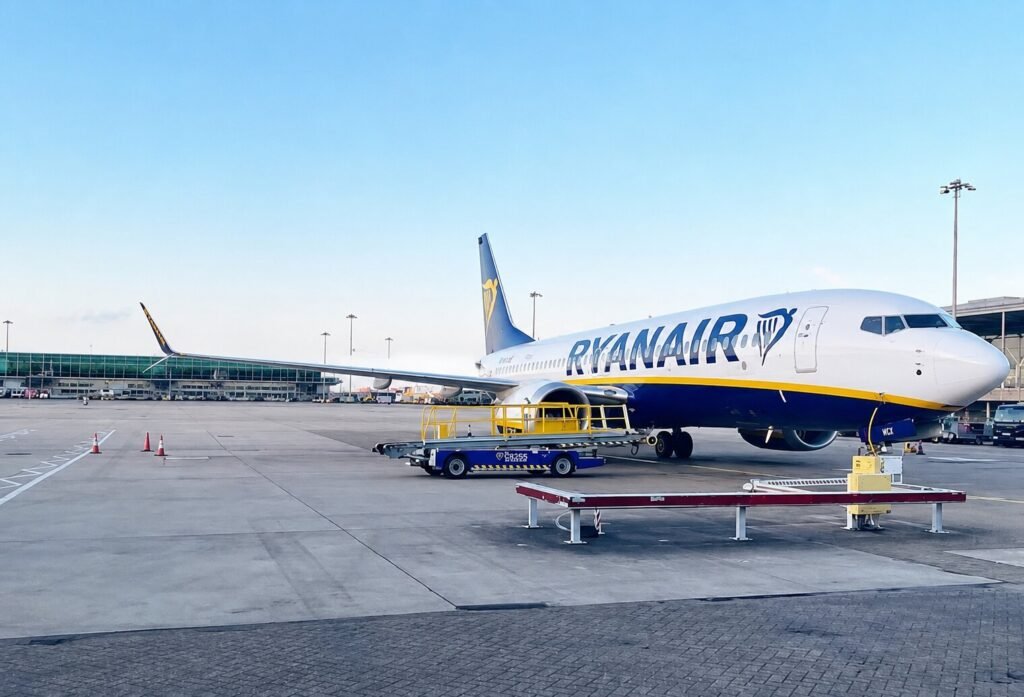
London, United Kingdom: Europe’s largest low-cost carrier, Ryanair, has changed its long-standing family seating policy, allowing parents travelling with young children to sit together without paying a mandatory seat reservation fee. The move follows an investigation launched earlier this month by the UK’s Competition and Markets Authority (CMA) into whether the airline’s previous practice breached consumer protection laws.
The revised policy took effect on Thursday, June 25, 2026, the same day Ryanair publicly announced the changes. While the airline maintains that its previous policy complied with all applicable laws and regulations, it said it would “reluctantly” adopt what it described as the industry standard rather than continue arguing with regulators.
Under the updated policy, families who choose not to purchase reserved seats will receive complimentary seat allocations after completing online check-in. Ryanair said these free seats will generally be located toward the rear of the aircraft, where more seats are available.
Passengers who prefer specific seats, including those closer to the front of the cabin, can still pay the usual seat reservation fee.
The airline said the change would be revenue neutral, adding that it does not expect any financial impact from the revised seating arrangement.
Before the change, Ryanair required at least one accompanying adult travelling with children aged 2 to 11 years to purchase what it called a “mandatory family seat.”
That adult paid a discounted reserved seat fee typically around £8 (US$10.70) per flight sector, according to the CMA while up to four children on the same booking could reserve adjacent seats free of charge.
Ryanair argued that the policy ensured families knew their seating arrangements at the time of booking while maintaining the airline’s low-fare model. The carrier also emphasized that it never charged children to sit beside their accompanying adult, only the adult reservation.
The policy change came just two weeks after the Competition and Markets Authority (CMA) announced, on June 11, that it was investigating whether Ryanair’s mandatory family seating fee amounted to an unfair contract term under UK consumer law.
The regulator questioned whether parents were effectively being charged for the airline to meet its own obligations under aviation safety and disability rules, since Ryanair’s own conditions required at least one parent to sit with children between the ages of two and eleven.
The CMA also noted that additional fees could significantly increase the cost of holidays for families already budgeting carefully for travel. Ryanair Group CEO Michael O’Leary was openly critical of the regulatory pressure that led to the change.
In the company’s announcement, he said, “We will reluctantly adjust to this industry standard as we don’t want to waste time explaining to misguided regulators how badly they misunderstand what is in the best interest of UK and Europe’s consumers.”
O’Leary defended Ryanair’s previous model, arguing it had been “the most progressive and transparent in Europe.”
He also accused regulators of focusing on Ryanair while overlooking broader issues affecting consumers, including higher fares charged by airlines operating without low-cost competition, airport monopoly charges, and inefficiencies in European air traffic management.
According to O’Leary, the revised policy would not increase consumer welfare but merely align Ryanair with competitors’ seating practices.
Although the CMA welcomed the airline’s decision, it stressed that the investigation has not concluded. A CMA spokesperson said the regulator would examine whether Ryanair’s updated policy fully complies with consumer law.
The authority added that while the revised policy appears to benefit families by removing mandatory seating charges, it does not change the fact that passengers had previously been required to pay for so-called mandatory family seats.
The watchdog confirmed that Ryanair chose to amend its policy voluntarily and that the ongoing investigation will continue assessing the legality of the airline’s previous practices.