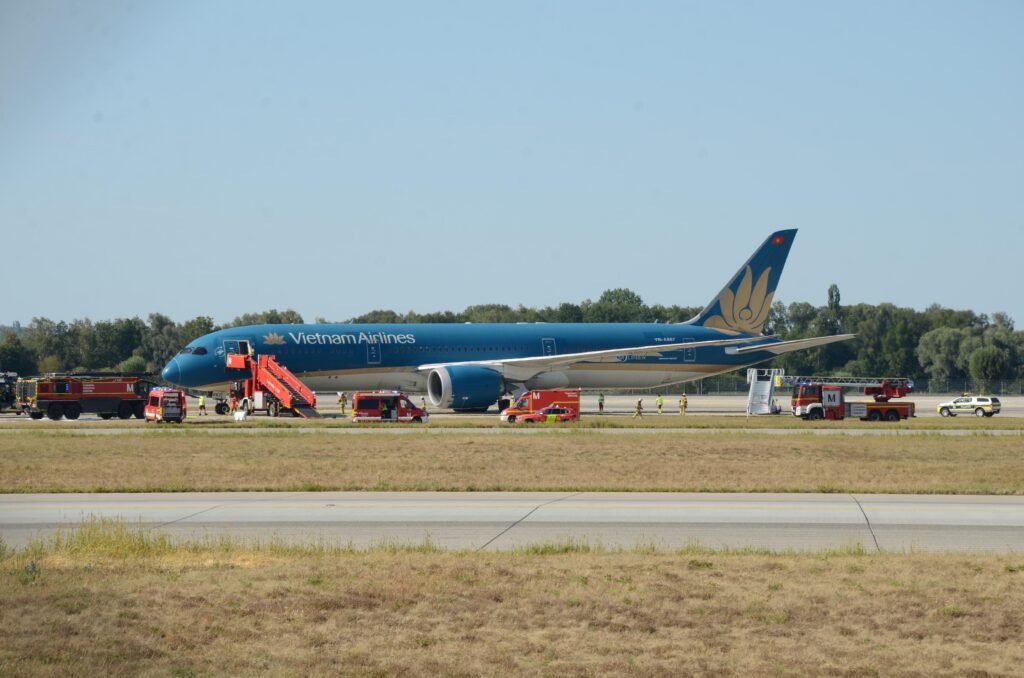
Munich, Germany: A Vietnam Airlines Boeing 787-9 bound for Hanoi took an unusually long takeoff run from Munich Airport on August 15 before finally becoming airborne beyond the normal paved runway area, in an incident that resulted in runway damage, a tail strike and subsequent damage to the aircraft’s landing gear. The aircraft later returned to Munich after remaining airborne for about two hours, with no injuries reported among the passengers or crew. The exact reason for the aircraft’s prolonged acceleration and extremely late liftoff remains under investigation.
The most significant part of the incident occurred during the takeoff roll. Video footage recorded from inside the cabin and from outside the airport shows the 787 accelerating along Runway 26L for an unusually long distance before rotation. Instead of lifting off with substantial runway remaining, the aircraft continued almost to the end of the approximately 4,000-metre runway. Reports based on flight-tracking data indicate that the aircraft reached the runway end area before becoming airborne, with reports putting the excursion beyond the paved surface at roughly 120 metres.
The available video is particularly significant because it shows that the issue was not simply a conventional tailstrike during an otherwise normal rotation. The aircraft appears to remain on the ground for an unusually long period, with the runway threshold passing while the aircraft was still accelerating. It eventually rotated at the very end of the runway area, after which a large cloud of dust was visible beneath the rear of the aircraft.
The reason for the unusually slow or prolonged takeoff has not been established. Online speculation has included possibilities such as an incorrect takeoff configuration, incorrect thrust or a problem affecting the aircraft’s acceleration. However, none of those explanations has been confirmed by Vietnam Airlines or investigators and should not be presented as the cause.
Vietnam Airlines has described the event as resulting from a technical issue and said the crew followed safety procedures. The airline has not publicly identified a specific technical failure responsible for the aircraft’s unusually long takeoff roll. That distinction is important because the aircraft’s subsequent warnings and damage do not, by themselves, establish what caused the initial lack of acceleration.
Vietnam’s aviation authorities have provided additional information on what happened after the aircraft became airborne. According to the latest reporting on the Civil Aviation Authority of Vietnam’s information, warnings indicating tail contact and low tyre pressure were triggered shortly after takeoff. The authorities said the aircraft subsequently returned to Munich, while German authorities led the investigation with Vietnamese investigators assisting.
After the aircraft finally lifted off, the crew did not immediately attempt to land. The Boeing 787 climbed to around 9,000 feet and remained in the Munich area for approximately two hours. During that period, the crew assessed the situation and reduced the aircraft’s weight before returning to the airport. The tailstrike occurred as the aircraft became airborne after the exceptionally long takeoff run.
The rear underside of the aircraft contacted the ground, producing the visible dust plume captured on video. A tailstrike can damage the aircraft’s lower aft fuselage, pressure vessel, structural frames, systems, wiring and other components around the tail area. In this case, photographs and video circulating after the incident showed damage around the rear fuselage and the loss or damage of the Boeing 787’s tailstrike protection component. The full extent of the structural damage, however, remains subject to technical inspection.
The aircraft also sustained landing-gear and tyre damage. Reports indicate that several tyres were damaged or deflated, and footage following the return showed the aircraft unable to taxi away from the runway under its own power. The landing-gear damage also resulted in debris being left on the runway.
The aircraft eventually landed back at Munich Airport, using the airport’s other runway. Following the landing, the affected aircraft remained on the runway, forcing the closure of the runway and requiring airport authorities to clear debris and deal with the disabled aircraft. Traffic was subsequently handled through the other available runway, causing disruption at the German hub.
There were no reported injuries among the passengers or crew. The aircraft was carrying passengers and crew on the Munich-Hanoi service; Vietnam Airlines has reported the total as 271 passengers and 16 crew members. All occupants were reported safe after the aircraft returned to Munich.
The incident is now being examined by the relevant German authorities, with Vietnamese aviation investigators assisting. Investigators will need to establish why the Boeing 787 did not achieve the expected acceleration during the takeoff roll, why the aircraft reached the end of the runway area before becoming airborne and whether any technical, operational or performance-related factor contributed to the event.