News
Civil Aviation
Pilot Training
Flight School Analysis
Aviation Jobs
Training
Services
About Us
Contact Us

SACAA Preliminary Findings Show No Engine Power At Impact In Fatal South Africa Crash

Picture of Aviation Today News Desk

Aviation Today News Desk

Fochville, South Africa: The preliminary accident report, released on 28 July 2026 by the Accident and Incident Investigations Division (AIID) of the South African Civil Aviation Authority (SACAA), found that the engine of a Bird Aviation Piper PA-28-180 registered ZS-ESZ was not producing power when the aircraft struck the ground near Fochville, Gauteng, on 27 June 2026. The report remains preliminary, with the investigation still ongoing and the AIID cautioning that its findings do not apportion blame or liability. According to the report, the operator was Bird Aviation, while the aircraft was being used under a hire-and-fly arrangement for hour-building. The operation was classified as Training under Part 91, and the aircraft belonged to the approved training organisation (ATO) from which it was hired. The accident involved two people, a 21-year-old Indian pilot and one passenger. Both were fatally injured and the aircraft was destroyed. The pilot held a valid Private Pilot Licence (PPL) and was building flight hours toward a Commercial Pilot Licence (CPL) through the ATO. The flight took place on the afternoon of 27 June 2026, when the pilot and passenger departed Lanseria International Airport (FALA) in Gauteng on an hour-building flight, intending to return to the same airport. The flight was conducted under visual meteorological conditions (VMC) and in accordance with Part 91 of the Civil Aviation Regulations. The flight had initially been planned for 0900Z, but departure was delayed because of persistent haze and low visibility. After conditions improved, the aircraft departed Runway 07 at 1325Z, as confirmed by an air traffic control officer at Lanseria. It then flew toward the Johannesburg General Flying Area (GFA), Flight Area Dangerous 182 (FAD 182). Multiple eyewitnesses later reported seeing the aircraft flying unusually low and performing unfamiliar manoeuvres. The aircraft subsequently flipped and began spinning to the left before impacting the ground. The crash occurred on a farm at Elandsfontein, south-east of Fochville, Gauteng, at coordinates 26° 35' 27.30" South, 27° 33' 41.24" East, with a field elevation of 5,124 feet. The accident was recorded at 1415Z. The pilot was a 21-year-old Indian national with a valid PPL. His licence was initially issued by the regulator on 25 May 2026 and was valid until 30 April 2027. His Class 2 aviation medical certificate was issued on 26 March 2025 and was valid until 31 March 2030. The report states that the aircraft type was endorsed on his licence and that he had no previous accidents recorded in relation to the investigation. The pilot had accumulated 132.2 total flight hours, including 19.4 hours in the previous seven days and 55.1 hours in the previous 90 days. He had flown 43.8 hours on the aircraft during the previous 90 days and had accumulated 122.7 hours on the Piper PA-28-180. The aircraft was a 1977-built Piper PA-28-180, a four-seat, single-engine, all-metal, low-wing aircraft with fixed tricycle landing gear. It was powered by a four-cylinder, naturally aspirated 180-horsepower Lycoming O-360-series engine. Its serial number was 28-3303, and it had accumulated 3,242.6 airframe hours by the time of the accident. The AIID found that the aircraft had valid registration and airworthiness documentation. Its current Certificate of Registration had been issued on 19 September 2025, while its latest Certificate of Airworthiness was valid until 31 October 2026. The aircraft underwent its mandatory periodic inspection on 13 March 2026 at 3,218.4 airframe hours, after which a Certificate of Release to Service was issued, valid until 12 March 2027 or 3,318.4 total airframe hours, whichever came first. The aircraft was maintained by an approved aircraft maintenance organisation whose certificate was valid until 30 June 2026. The organisation held Category A and Category C ratings for the aircraft's airframe and engine. The ATO's certificate had been renewed on 17 November 2025 and was valid until 28 February 2029. Fuel records showed that 111 litres of Avgas 100LL had been uplifted after the aircraft's flight on 26 June 2026, with the pilot refuelling the tanks before parking the aircraft. The Piper PA-28-180 has a fuel capacity of 189 litres, providing approximately six hours of endurance. The preliminary findings state that the aircraft departed Lanseria with full fuel tanks and no technical issues. However, fuel was found leaking from the aircraft after the accident. The report does not currently identify the fuel leak as the cause of the engine power loss. Weather conditions were favourable and were not considered a contributing factor. The 1400Z METAR from Lanseria recorded winds from 300° at 7 knots, CAVOK visibility, a temperature of 16°C, scattered clouds at 4,500 feet, a dew point of 5°C and QNH of 1026 hPa. The aircraft's navigation and communication equipment had no recorded defects before the flight. It was not equipped with a flight data recorder (FDR) or cockpit voice recorder (CVR), and the report states that neither was required for this aircraft type. The wreckage examination showed that the aircraft hit the ground in a steep nose-down attitude at high speed with little forward momentum. The debris was concentrated around the impact point, with a crater being the only ground scar identified. The aircraft came to rest facing south-east. Investigators found that the ailerons could not be moved and were both in the down position, while the elevator and rudder moved freely. The landing gear had broken and collapsed rearwards. Both wings suffered severe leading-edge damage and accordion-like deformation that ruptured the fuel tanks. The damage was consistent with heavy compressive loading during the steep, rapid-impact sequence. The top engine cowling had separated from the aircraft and was found approximately 10 metres ahead of the main wreckage. The engine cradle was deformed and the engine was facing slightly to the right. The propeller showed asymmetric damage, with one blade bent rearwards and the other showing little or no deformation. Neither blade displayed S-curve bending. The AIID said the damage pattern was consistent with the propeller being non-rotating at impact. This evidence, together with eyewitness accounts of the pilot apparently attempting to restart the engine, led investigators to conclude that the engine was not producing power at the time of impact. However, the preliminary report does not yet establish the underlying reason for the loss of engine power. The instrument panel was broken into multiple pieces, with several indicators dislodged from their original positions. The report does not provide a final interpretation of the instrument evidence at this stage. There was no evidence of a pre- or post-impact fire. Investigators considered the accident not survivable because of the extent of cockpit damage. Emergency responders reported that the pilot-in-command was not wearing his seat belt and was consequently thrown from the aircraft. Medical and pathological information is reserved for the final report. The aircraft was operating in the Johannesburg GFA within FAD 182, outside the Terminal Control Area. FAD 182 extends from the ground to Flight Level 100, or 10,000 feet, except where it intersects the TMA. Bird Aviation also used the Safely Track Me application to monitor flights. The system relied on the pilot's mobile-phone GPS signal. Tracking was active when ZS-ESZ departed Lanseria, but shortly after the aircraft exited the Johannesburg Special Rules Area West TMA, the phone stopped transmitting its GPS position and the aircraft could no longer be tracked through the application. The AIID's preliminary findings confirm that the pilot was qualified and medically fit for the flight, the aircraft was being used under a valid hire-and-fly arrangement for hour-building, the operator/ATO held a valid certificate, the aircraft had valid registration and airworthiness documentation, and its maintenance records were up to date. The investigation therefore establishes several key facts but has not yet determined the precise cause of the accident. The aircraft left Lanseria with full fuel and no known technical issues; the engine was not producing power at impact; weather was not a factor; and the aircraft entered a steep, high-speed descent before striking the ground. The AIID is continuing to examine other aspects of the accident that could have safety implications. No safety recommendations have been issued at this stage. The AIID said these will be addressed in the final report. The investigation was classified as a Category 1 accident. The AIID appointed an investigator-in-charge and a co-investigator, dispatched investigators to the site and notified the relevant states and organisations under South African regulations and ICAO Annex 13. The AIID will lead the investigation and issue the final report. The AIID has warned that the preliminary report is based on evidence gathered during an ongoing investigation and that information may change if additional evidence emerges. Accordingly, the current finding should be described as the engine not producing power at impact, rather than stating that investigators have already determined the cause of the engine power loss.
Image: SACAA

Fochville, South Africa: The preliminary accident report, released on 28 July 2026 by the Accident and Incident Investigations Division (AIID) of the South African Civil Aviation Authority (SACAA), found that the engine of a Bird Aviation Piper PA-28-180 registered ZS-ESZ was not producing power when the aircraft struck the ground near Fochville, Gauteng, on 27 June 2026. 

The report remains preliminary, with the investigation still ongoing and the AIID cautioning that its findings do not apportion blame or liability. According to the report, the operator was Bird Aviation, while the aircraft was being used under a hire-and-fly arrangement for hour-building. The operation was classified as Training under Part 91, and the aircraft belonged to the approved training organisation (ATO) from which it was hired.

The accident involved two people, a 21-year-old Indian pilot and one passenger. Both were fatally injured and the aircraft was destroyed. The pilot held a valid Private Pilot Licence (PPL) and was building flight hours toward a Commercial Pilot Licence (CPL) through the ATO. The flight took place on the afternoon of 27 June 2026, when the pilot and passenger departed Lanseria International Airport (FALA) in Gauteng on an hour-building flight, intending to return to the same airport. The flight was conducted under visual meteorological conditions (VMC) and in accordance with Part 91 of the Civil Aviation Regulations.

The flight had initially been planned for 0900Z, but departure was delayed because of persistent haze and low visibility. After conditions improved, the aircraft departed Runway 07 at 1325Z, as confirmed by an air traffic control officer at Lanseria. It then flew toward the Johannesburg General Flying Area (GFA), Flight Area Dangerous 182 (FAD 182).

Multiple eyewitnesses later reported seeing the aircraft flying unusually low and performing unfamiliar manoeuvres. The aircraft subsequently flipped and began spinning to the left before impacting the ground.
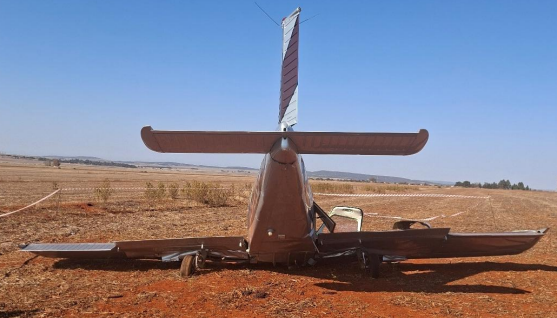
Image: SACAA

The crash occurred on a farm at Elandsfontein, south-east of Fochville, Gauteng, at coordinates 26° 35′ 27.30″ South, 27° 33′ 41.24″ East, with a field elevation of 5,124 feet. The accident was recorded at 1415Z.

The pilot was a 21-year-old Indian national with a valid PPL. His licence was initially issued by the regulator on 25 May 2026 and was valid until 30 April 2027. His Class 2 aviation medical certificate was issued on 26 March 2025 and was valid until 31 March 2030. The report states that the aircraft type was endorsed on his licence and that he had no previous accidents recorded in relation to the investigation.

The pilot had accumulated 132.2 total flight hours, including 19.4 hours in the previous seven days and 55.1 hours in the previous 90 days. He had flown 43.8 hours on the aircraft during the previous 90 days and had accumulated 122.7 hours on the Piper PA-28-180.

The aircraft was a 1977-built Piper PA-28-180, a four-seat, single-engine, all-metal, low-wing aircraft with fixed tricycle landing gear. It was powered by a four-cylinder, naturally aspirated 180-horsepower Lycoming O-360-series engine. Its serial number was 28-3303, and it had accumulated 3,242.6 airframe hours by the time of the accident.

The AIID found that the aircraft had valid registration and airworthiness documentation. Its current Certificate of Registration had been issued on 19 September 2025, while its latest Certificate of Airworthiness was valid until 31 October 2026. The aircraft underwent its mandatory periodic inspection on 13 March 2026 at 3,218.4 airframe hours, after which a Certificate of Release to Service was issued, valid until 12 March 2027 or 3,318.4 total airframe hours, whichever came first.

The aircraft was maintained by an approved aircraft maintenance organisation whose certificate was valid until 30 June 2026. The organisation held Category A and Category C ratings for the aircraft’s airframe and engine. The ATO’s certificate had been renewed on 17 November 2025 and was valid until 28 February 2029. Fuel records showed that 111 litres of Avgas 100LL had been uplifted after the aircraft’s flight on 26 June 2026, with the pilot refuelling the tanks before parking the aircraft. The Piper PA-28-180 has a fuel capacity of 189 litres, providing approximately six hours of endurance.

The preliminary findings state that the aircraft departed Lanseria with full fuel tanks and no technical issues. However, fuel was found leaking from the aircraft after the accident. The report does not currently identify the fuel leak as the cause of the engine power loss.

Weather conditions were favourable and were not considered a contributing factor. The 1400Z METAR from Lanseria recorded winds from 300° at 7 knots, CAVOK visibility, a temperature of 16°C, scattered clouds at 4,500 feet, a dew point of 5°C and QNH of 1026 hPa. The aircraft’s navigation and communication equipment had no recorded defects before the flight. It was not equipped with a flight data recorder (FDR) or cockpit voice recorder (CVR), and the report states that neither was required for this aircraft type.

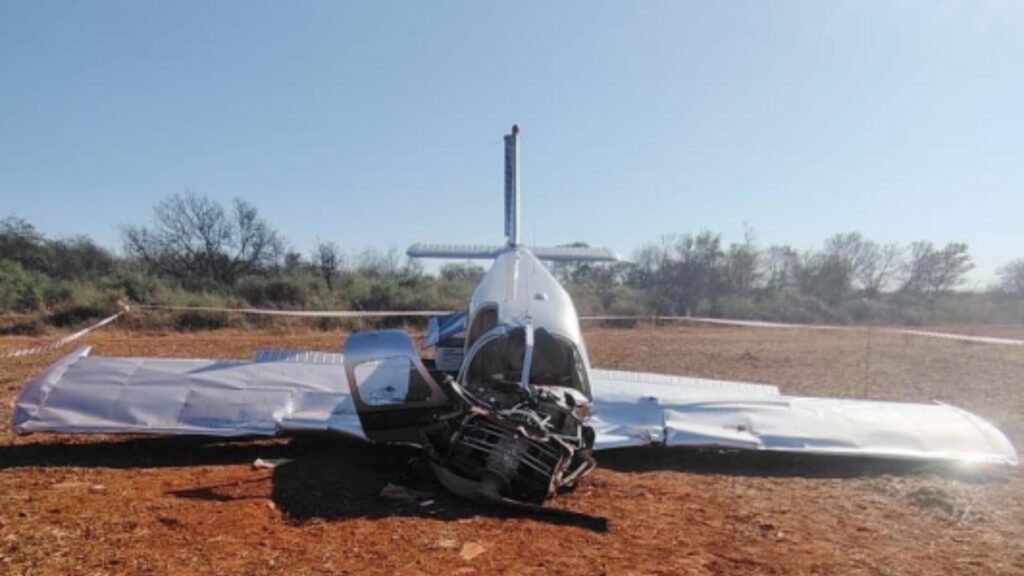
The wreckage examination showed that the aircraft hit the ground in a steep nose-down attitude at high speed with little forward momentum. The debris was concentrated around the impact point, with a crater being the only ground scar identified. The aircraft came to rest facing south-east.

Investigators found that the ailerons could not be moved and were both in the down position, while the elevator and rudder moved freely. The landing gear had broken and collapsed rearwards. Both wings suffered severe leading-edge damage and accordion-like deformation that ruptured the fuel tanks. The damage was consistent with heavy compressive loading during the steep, rapid-impact sequence.

The top engine cowling had separated from the aircraft and was found approximately 10 metres ahead of the main wreckage. The engine cradle was deformed and the engine was facing slightly to the right.

The propeller showed asymmetric damage, with one blade bent rearwards and the other showing little or no deformation. Neither blade displayed S-curve bending. The AIID said the damage pattern was consistent with the propeller being non-rotating at impact.

This evidence, together with eyewitness accounts of the pilot apparently attempting to restart the engine, led investigators to conclude that the engine was not producing power at the time of impact. However, the preliminary report does not yet establish the underlying reason for the loss of engine power.

The instrument panel was broken into multiple pieces, with several indicators dislodged from their original positions. The report does not provide a final interpretation of the instrument evidence at this stage.

There was no evidence of a pre- or post-impact fire. Investigators considered the accident not survivable because of the extent of cockpit damage. Emergency responders reported that the pilot-in-command was not wearing his seat belt and was consequently thrown from the aircraft. Medical and pathological information is reserved for the final report.

The aircraft was operating in the Johannesburg GFA within FAD 182, outside the Terminal Control Area. FAD 182 extends from the ground to Flight Level 100, or 10,000 feet, except where it intersects the TMA.

Bird Aviation also used the Safely Track Me application to monitor flights. The system relied on the pilot’s mobile-phone GPS signal. Tracking was active when ZS-ESZ departed Lanseria, but shortly after the aircraft exited the Johannesburg Special Rules Area West TMA, the phone stopped transmitting its GPS position and the aircraft could no longer be tracked through the application.

The AIID’s preliminary findings confirm that the pilot was qualified and medically fit for the flight, the aircraft was being used under a valid hire-and-fly arrangement for hour-building, the operator/ATO held a valid certificate, the aircraft had valid registration and airworthiness documentation, and its maintenance records were up to date.

The investigation therefore establishes several key facts but has not yet determined the precise cause of the accident. The aircraft left Lanseria with full fuel and no known technical issues; the engine was not producing power at impact; weather was not a factor; and the aircraft entered a steep, high-speed descent before striking the ground. The AIID is continuing to examine other aspects of the accident that could have safety implications.

No safety recommendations have been issued at this stage. The AIID said these will be addressed in the final report.

The investigation was classified as a Category 1 accident. The AIID appointed an investigator-in-charge and a co-investigator, dispatched investigators to the site and notified the relevant states and organisations under South African regulations and ICAO Annex 13. The AIID will lead the investigation and issue the final report.

The AIID has warned that the preliminary report is based on evidence gathered during an ongoing investigation and that information may change if additional evidence emerges. Accordingly, the current finding should be described as the engine not producing power at impact, rather than stating that investigators have already determined the cause of the engine power loss.
Leave a Comment

Subscribe to our Newsletter

Recent News

Aviation Today Perspectives