News
Civil Aviation
Pilot Training
Flight School Analysis
Aviation Jobs
Training
Services
About Us
Contact Us

India Targets Electric Air Taxis By 2028 As Sarla Advances eVTOL Testing In Bengaluru

Picture of Aviation Today News Desk

Aviation Today News Desk

Bengaluru, India: India is targeting the introduction of electric air taxis by 2028, with Union Civil Aviation Minister Ram Mohan Naidu saying testing of electric vertical take-off and landing (eVTOL) aircraft is expected to accelerate from 2027. The latest development comes as Bengaluru-based Sarla Aviation has secured Design Organisation Approval (DOA) from the Directorate General of Civil Aviation (DGCA), a key regulatory step toward type certification of its indigenous eVTOL aircraft. The approval was handed over to Sarla Aviation at the inauguration of its new Bengaluru headquarters on August 8, 2026. Naidu said India wants to see the aircraft operating by 2028. “By 2028, we want to see these machines fly in India. There is a huge requirement, not only in Bangalore, but Mumbai and Delhi,” he said. He added, “I expect that next year we'll be completely in the testing phase,” while reiterating, “By 2028, we plan to make this happen.” Sarla Aviation has also moved beyond the early prototype stage. On July 1, 2026, the company announced that its half-scale Sylla 1.0 eVTOL technology demonstrator had completed more than 500 tests and over 18 hours of flight testing during a six-month campaign. The 700-kg-class aircraft has a 7.5-metre wingspan and, according to Sarla, became the heaviest electric aircraft to take off in India. The programme tested the aircraft's electric propulsion, battery architecture, distributed propulsion, flight controls, airframe and landing gear as an integrated system. Sarla Aviation CTO and co-founder Rakesh Gaonkar said the Sylla programme had produced the data needed to guide the next stage of development. “Sylla has given us the data we set out to capture, and those learnings are already shaping our next-gen aircraft as we move towards transition and sustained wing-borne flight on our journey to our 6+1 air taxi Shunya,” he said. The next step is Sylla 2.0, which is intended to demonstrate controlled transition from hover to sustained wing-borne flight. That is an important stage before the company moves toward a certifiable passenger-carrying eVTOL. Sarla's planned production aircraft is the six-passenger-plus-pilot Shunya. The developments provide an important update to the electric-air-taxi plan outlined by ET Now. The publication reported that India had set a 2028 target for eVTOL aircraft, with Naidu saying testing would gather pace the following year. The report highlighted Bengaluru, Mumbai and Delhi as cities where demand for such aircraft could be particularly significant because of severe road congestion and lengthy airport-city journeys. An eVTOL is an electrically powered aircraft capable of vertical take-off and landing. Unlike conventional fixed-wing aircraft, it does not require a conventional runway and can potentially operate from smaller facilities closer to urban centres. The technology combines characteristics associated with helicopters, drones and conventional aircraft and is being developed under the broader advanced-air-mobility sector. Sarla Aviation's Shunya is designed around seven electric motors. Six motors provide vertical lift, while a seventh motor mounted at the rear provides forward propulsion. Sarla Aviation co-founder and CEO Adrian Schmidt explained the configuration to ANI: “It's powered by six electric motors that lift it up and one in the rear that pushes it forward. So we have a total of seven electric motors that we're using and it's piloted as of now with six passengers.” The company has said the aircraft's propulsion remains electrically driven. However, Schmidt explained that the design leaves room for a turbo-generator that could potentially recharge the batteries during flight. “We have enough space allocation so that we can consider putting in a turbo generator to charge our batteries mid-flight. But the energy transition from the battery to the motors is always going to be purely electric,” he said. Sarla first unveiled the Shunya prototype at the Bharat Mobility Global Expo in New Delhi in January 2025. The aircraft was presented as a six-passenger eVTOL with a maximum payload of about 680 kg and a targeted top speed of up to 250 km/h. The company said it was designed primarily for short urban journeys of roughly 20–30 km, while reported specifications indicated a potential range of up to 160 km with available battery technology. Sarla's roadmap has also included infrastructure and manufacturing. In November 2025, the company signed an MoU with the Andhra Pradesh government for a 500-acre aerospace campus in Anantapur, with an initial investment of ₹1,300 crore. Sarla described the project as an integrated Urban Air Mobility facility for eVTOL manufacturing and related activities. The company has said the facility is intended to support future aircraft production and air-taxi operations. The company's airport strategy also began taking shape earlier. Sarla Aviation and Bengaluru International Airport Limited signed a partnership agreement in January 2024 to explore an eVTOL ecosystem at Bengaluru airport, including connectivity between the airport and urban areas, vertiport infrastructure and an advanced traffic-management system for future eVTOL operations. Healthcare is another potential application. Bengaluru airport had an agreement with Sarla Aviation for last-mile connectivity and that Manipal Hospitals had also entered an agreement with the company for potential air-ambulance operations. More recent industry reporting indicates that hospitals and air-ambulance operators are increasingly exploring eVTOL partnerships as India develops its advanced-air-mobility ecosystem. The possible uses therefore extend beyond passenger air taxis. The technology could support airport-to-city transfers, last-mile connectivity, air ambulance operations, medical evacuation and cargo transportation. For India, airport connectivity is expected to be one of the earliest practical applications because road journeys between major airports and city centres can take considerable time. Naidu has said an airport-to-city journey that currently takes as long as two hours could potentially be reduced to around 20–30 minutes using eVTOL aircraft. The initial model is therefore expected to focus on short-distance and airport-linked journeys rather than replacing conventional public transportation. The Indian eVTOL market is not limited to Sarla Aviation. Chennai-based The ePlane Company is developing its e200X electric aircraft, while Hyderabad-based BluJ Aerospace is working on eVTOL technology for cargo and other applications. India is therefore developing multiple domestic approaches to advanced air mobility rather than relying solely on one manufacturer. There is also an international dimension to India's air-taxi plans. In 2023, InterGlobe Enterprises, the parent company of IndiGo, announced a partnership with US-based Archer Aviation to explore an all-electric air-taxi service in India, with an original 2026 target. However, that timeline has not materialised as initially envisaged. In 2026, IndiGo Ventures separately invested about ₹10 crore in Sarla Aviation, giving the Indian startup additional strategic backing. Importantly, the IndiGo investment should not be presented as confirmation that IndiGo itself will operate Sarla's eVTOL air-taxi service. Recent reporting said Sarla Aviation clarified that IndiGo's investment did not mean the airline was directly involved in its eVTOL operating plans. The regulatory process remains one of the biggest hurdles. Before commercial passenger operations can begin, eVTOL aircraft must demonstrate compliance with safety and airworthiness requirements and obtain the necessary certification. The DGCA will have to address aircraft design, flight operations, pilot qualifications, infrastructure, vertiports and integration with existing air-traffic systems. Infrastructure is another challenge. Commercial operations will require suitable landing and take-off locations, charging or energy infrastructure, maintenance facilities and systems for managing eVTOL traffic around densely populated areas. Battery performance, aircraft range, weather, operating economics and air-traffic management will also influence whether the 2028 target can be achieved at scale. Sarla's progress in 2026 nevertheless represents a significant shift from the concept and prototype phase. With the Sylla demonstrator having completed an extensive flight-test campaign and the company now holding DGCA Design Organisation Approval, its Shunya programme has entered a more advanced development and certification phase. The government's 2028 target will now depend on the pace of testing, transition-flight development, type certification, infrastructure creation and operational approvals over the next two years.
Image: Sarla Aviation

Bengaluru, India: India is targeting the introduction of electric air taxis by 2028, with Union Civil Aviation Minister Ram Mohan Naidu saying testing of electric vertical take-off and landing (eVTOL) aircraft is expected to accelerate from 2027. The latest development comes as Bengaluru-based Sarla Aviation has secured Design Organisation Approval (DOA) from the Directorate General of Civil Aviation (DGCA), a key regulatory step toward type certification of its indigenous eVTOL aircraft. The approval was handed over to Sarla Aviation at the inauguration of its new Bengaluru headquarters on August 8, 2026.

Naidu said India wants to see the aircraft operating by 2028. “By 2028, we want to see these machines fly in India. There is a huge requirement, not only in Bangalore, but Mumbai and Delhi,” he said. He added, “I expect that next year we’ll be completely in the testing phase,” while reiterating, “By 2028, we plan to make this happen.”

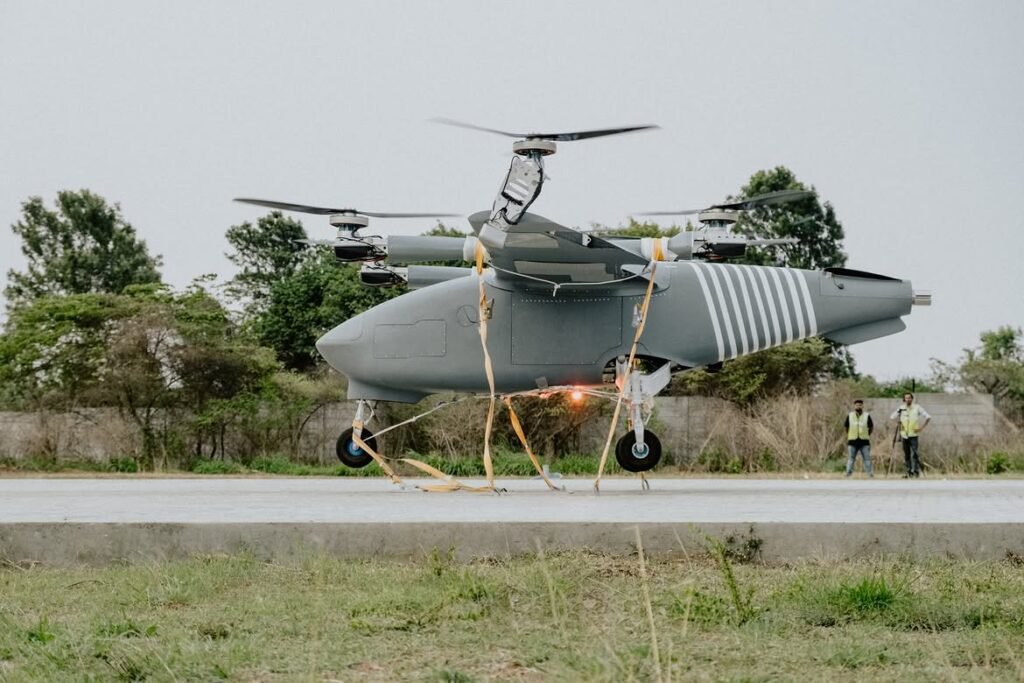
Sarla Aviation has also moved beyond the early prototype stage. On July 1, 2026, the company announced that its half-scale Sylla 1.0 eVTOL technology demonstrator had completed more than 500 tests and over 18 hours of flight testing during a six-month campaign. The 700-kg-class aircraft has a 7.5-metre wingspan and, according to Sarla, became the heaviest electric aircraft to take off in India. The programme tested the aircraft’s electric propulsion, battery architecture, distributed propulsion, flight controls, airframe and landing gear as an integrated system.

Sarla Aviation CTO and co-founder Rakesh Gaonkar said the Sylla programme had produced the data needed to guide the next stage of development. “Sylla has given us the data we set out to capture, and those learnings are already shaping our next-gen aircraft as we move towards transition and sustained wing-borne flight on our journey to our 6+1 air taxi Shunya,” he said.

The next step is Sylla 2.0, which is intended to demonstrate controlled transition from hover to sustained wing-borne flight. That is an important stage before the company moves toward a certifiable passenger-carrying eVTOL. Sarla’s planned production aircraft is the six-passenger-plus-pilot Shunya.

The developments provide an important update to the electric-air-taxi plan. The publication reported that India had set a 2028 target for eVTOL aircraft, with Naidu saying testing would gather pace the following year. The report highlighted Bengaluru, Mumbai and Delhi as cities where demand for such aircraft could be particularly significant because of severe road congestion and lengthy airport-city journeys.

An eVTOL is an electrically powered aircraft capable of vertical take-off and landing. Unlike conventional fixed-wing aircraft, it does not require a conventional runway and can potentially operate from smaller facilities closer to urban centres. The technology combines characteristics associated with helicopters, drones and conventional aircraft and is being developed under the broader advanced-air-mobility sector.

Sarla Aviation’s Shunya is designed around seven electric motors. Six motors provide vertical lift, while a seventh motor mounted at the rear provides forward propulsion. Sarla Aviation co-founder and CEO Adrian Schmidt explained the configuration to ANI: “It’s powered by six electric motors that lift it up and one in the rear that pushes it forward. So we have a total of seven electric motors that we’re using and it’s piloted as of now with six passengers.”

The company has said the aircraft’s propulsion remains electrically driven. However, Schmidt explained that the design leaves room for a turbo-generator that could potentially recharge the batteries during flight. “We have enough space allocation so that we can consider putting in a turbo generator to charge our batteries mid-flight. But the energy transition from the battery to the motors is always going to be purely electric,” he said.

Sarla first unveiled the Shunya prototype at the Bharat Mobility Global Expo in New Delhi in January 2025. The aircraft was presented as a six-passenger eVTOL with a maximum payload of about 680 kg and a targeted top speed of up to 250 km/h. The company said it was designed primarily for short urban journeys of roughly 20–30 km, while reported specifications indicated a potential range of up to 160 km with available battery technology.

Sarla’s roadmap has also included infrastructure and manufacturing. In November 2025, the company signed an MoU with the Andhra Pradesh government for a 500-acre aerospace campus in Anantapur, with an initial investment of ₹1,300 crore. Sarla described the project as an integrated Urban Air Mobility facility for eVTOL manufacturing and related activities. The company has said the facility is intended to support future aircraft production and air-taxi operations.

The company’s airport strategy also began taking shape earlier. Sarla Aviation and Bengaluru International Airport Limited signed a partnership agreement in January 2024 to explore an eVTOL ecosystem at Bengaluru airport, including connectivity between the airport and urban areas, vertiport infrastructure and an advanced traffic-management system for future eVTOL operations.

Healthcare is another potential application. Bengaluru airport had an agreement with Sarla Aviation for last-mile connectivity and that Manipal Hospitals had also entered an agreement with the company for potential air-ambulance operations. More recent industry reporting indicates that hospitals and air-ambulance operators are increasingly exploring eVTOL partnerships as India develops its advanced-air-mobility ecosystem.

The possible uses therefore extend beyond passenger air taxis. The technology could support airport-to-city transfers, last-mile connectivity, air ambulance operations, medical evacuation and cargo transportation. For India, airport connectivity is expected to be one of the earliest practical applications because road journeys between major airports and city centres can take considerable time.

Naidu has said an airport-to-city journey that currently takes as long as two hours could potentially be reduced to around 20–30 minutes using eVTOL aircraft. The initial model is therefore expected to focus on short-distance and airport-linked journeys rather than replacing conventional public transportation.

The Indian eVTOL market is not limited to Sarla Aviation. Chennai-based The ePlane Company is developing its e200X electric aircraft, while Hyderabad-based BluJ Aerospace is working on eVTOL technology for cargo and other applications. India is therefore developing multiple domestic approaches to advanced air mobility rather than relying solely on one manufacturer.

There is also an international dimension to India’s air-taxi plans. In 2023, InterGlobe Enterprises, the parent company of IndiGo, announced a partnership with US-based Archer Aviation to explore an all-electric air-taxi service in India, with an original 2026 target. However, that timeline has not materialised as initially envisaged. In 2026, IndiGo Ventures separately invested about ₹10 crore in Sarla Aviation, giving the Indian startup additional strategic backing.

Importantly, the IndiGo investment should not be presented as confirmation that IndiGo itself will operate Sarla’s eVTOL air-taxi service. Recent reporting said Sarla Aviation clarified that IndiGo’s investment did not mean the airline was directly involved in its eVTOL operating plans.

The regulatory process remains one of the biggest hurdles. Before commercial passenger operations can begin, eVTOL aircraft must demonstrate compliance with safety and airworthiness requirements and obtain the necessary certification. The DGCA will have to address aircraft design, flight operations, pilot qualifications, infrastructure, vertiports and integration with existing air-traffic systems.

Infrastructure is another challenge. Commercial operations will require suitable landing and take-off locations, charging or energy infrastructure, maintenance facilities and systems for managing eVTOL traffic around densely populated areas. Battery performance, aircraft range, weather, operating economics and air-traffic management will also influence whether the 2028 target can be achieved at scale.

Sarla’s progress in 2026 nevertheless represents a significant shift from the concept and prototype phase. With the Sylla demonstrator having completed an extensive flight-test campaign and the company now holding DGCA Design Organisation Approval, its Shunya programme has entered a more advanced development and certification phase. The government’s 2028 target will now depend on the pace of testing, transition-flight development, type certification, infrastructure creation and operational approvals over the next two years.

Leave a Comment

Subscribe to our Newsletter

Recent News

Aviation Today Perspectives