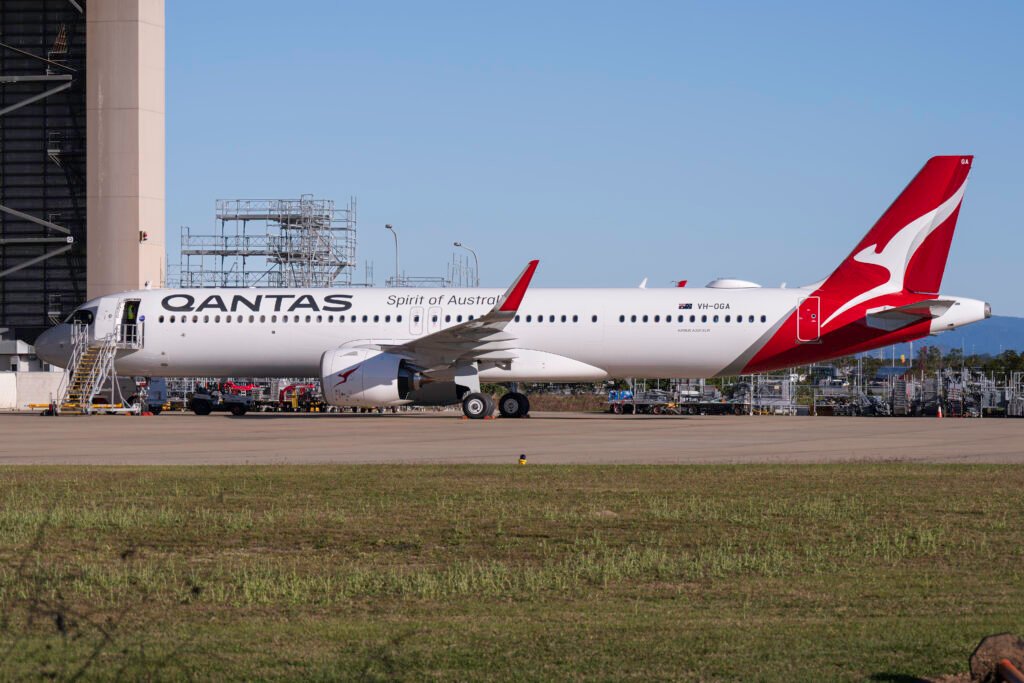
Canberra, Australia: In a landmark move, Qantas has launched commercial operations with its first two Airbus A321XLRs, becoming the first airline in the Asia-Pacific region to introduce the model into revenue service.
The aircraft, designated “Great Ocean Road” (VH-OGA) and “Outback Way” (VH-OGB), commenced service on 25 September, initially operating the Sydney–Melbourne and Sydney–Perth routes. The names reflect the airline’s tradition of celebrating Australia’s iconic landscapes.
Qantas Group CEO Vanessa Hudson noted the scale of preparation required for the launch: “Preparing for these commercial flights has taken an enormous effort, with nearly 350 training flights and more than 40,000 hours of training completed, as well as thousands of pieces of equipment deployed across our network.”
Beyond its domestic deployment, the A321XLR’s extended range opens up new possibilities. With a maximum range of approximately 8,700 km, about 3,000 km beyond that of the Boeing 737-800, the aircraft is seen as a bridge between domestic and short-to-medium international flights into Southeast Asia and beyond. Hudson said Qantas plans to roll out the jets on additional domestic and international routes as more units enter service.
The two aircraft carry 197 seats in a two-class format 20 in Business and 177 in Economy which amounts to a 13 percent increase in capacity compared to Qantas’s 737-800 fleet (without reducing seat pitch). Notably, the number of Business seats has increased by 66 percent over earlier models. The A321XLRs are powered by Pratt & Whitney Geared Turbofan engines.
Looking ahead, Qantas expects to receive a third A321XLR in November 2025, bringing the total in service to seven by June 2026. In August 2025. Earlier Qantas placed an order for 20 more A321XLRs, pushing its total commitment to 48 aircraft. These aircraft form a key component in Qantas’s largest-ever fleet renewal program, which totals more than 200 firm orders plus additional purchase options from both Airbus and Boeing.



![Washington, United States: A United Airlines flight bound for Guatemala City made an emergency diversion to Washington Dulles International Airport after a passenger allegedly attempted to open a cabin door at cruising altitude and assaulted another traveler, according to air traffic control communications and federal authorities. The incident involved United Airlines Flight 1551, operated by a Boeing 737 MAX 8, which departed from Newark Liberty International Airport on Thursday evening carrying 145 passengers and six crew members. The aircraft had been en route to Guatemala City when the crew declared an emergency and diverted to Washington Dulles International Airport in Virginia. According to audio between the flight crew and air traffic controllers, the pilot informed controllers that the disruptive passenger attempted to open Door 2L while the aircraft was cruising at approximately 36,000 feet. The pilot also reported that the passenger later assaulted another individual onboard. During the exchange, the tower asked the crew which door the passenger had attempted to access. The pilot responded: “Door 2L at 36,000 feet and then [the passenger] assaulted a fellow passenger.” When controllers asked whether there were any injuries onboard, the pilot replied: “Not to our knowledge.” The aircraft landed safely at Washington Dulles at approximately 8:38 p.m. local time. Law enforcement and emergency personnel met the aircraft upon arrival. The FBI later confirmed that agents responded to the incident at the airport, although the agency did not immediately release additional details regarding the passenger’s identity, possible charges, or whether the individual was taken into federal custody. Flight tracking data showed the aircraft remained airborne for a period before diverting toward the Washington region instead of continuing south toward Guatemala. The diversion temporarily disrupted the scheduled international service but no injuries among passengers or crew were officially reported. United Airlines had not issued a detailed public statement at the time of publication regarding the circumstances surrounding the diversion or the status of the passenger involved. Federal authorities are expected to review crew reports, passenger statements, and onboard evidence as part of the investigation.](https://aviationtoday.in/wp-content/uploads/2026/05/AVIATION-TODAY-UNITEDV-AIRLINES-RUDE-PASSENGER-768x432.jpg)