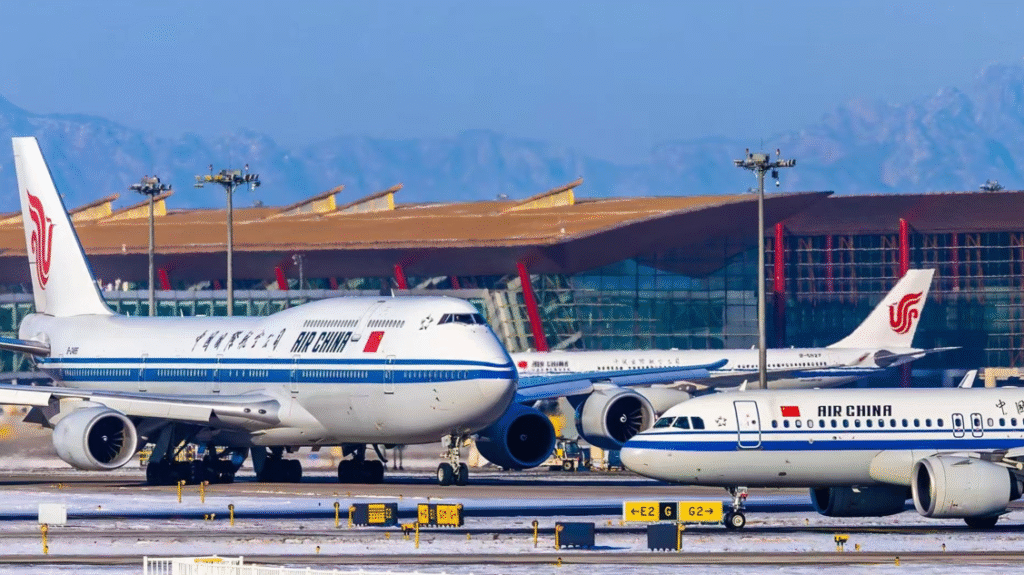
Beijing, China China’s three largest state-owned airlines Air China, China Eastern Airlines and China Southern Airlines are expected to record combined second-quarter losses of more than RMB 10 billion ($1.48 billion) after a sharp increase in jet fuel prices wiped out profits achieved during the first three months of 2026.
The downturn follows a profitable first quarter, when the three carriers collectively earned about RMB 4.8 billion ($710 million), supported by strong Lunar New Year travel demand, recovering international traffic and lower fuel prices. However, rising oil prices linked to the Middle East conflict reversed the recovery during the April-June period.
Based on company filings, the three airlines are forecasting a combined first-half net loss between RMB 7.37 billion ($1.09 billion) and RMB 8.97 billion ($1.33 billion). The second-quarter loss is estimated at more than RMB 10 billion ($1.48 billion), effectively eliminating their first-quarter profits.
Air China expects a first-half net loss of RMB 2.1 billion to RMB 2.6 billion ($293 million-$363 million). China Eastern Airlines has forecast a loss of RMB 3.5 billion to RMB 4 billion, while China Southern Airlines expects a loss between RMB 2.7 billion and RMB 3.3 billion.
The losses mark a significant reversal from the first quarter. China Southern reported a first-quarter net profit of RMB 1.48 billion ($216 million), recovering from a RMB 747 million loss in the same period last year. Air China posted a RMB 1.71 billion profit compared with a RMB 2.04 billion loss a year earlier, while China Eastern recorded RMB 1.63 billion profit after a previous-year loss of RMB 995 million.
Fuel costs emerged as the biggest pressure point for the carriers. Jet fuel remains the largest operating expense for airlines, typically accounting for around 30%-35% of total operating costs. The escalation in international crude oil prices pushed domestic jet fuel prices significantly higher, with April prices exceeding the previous record reached in July 2022. May fuel prices were reported to be twice the level recorded during the same period in 2025.
The Middle East conflict that began in March triggered a rapid increase in oil prices. Industry executives highlighted fuel exposure as the primary impact on airline operations, with fuel prices in March reportedly rising sharply compared with January and February levels.
Unlike many international carriers that use extensive fuel-hedging strategies to protect against price volatility, Chinese airlines hedge only a limited portion of their fuel consumption. This has left the country’s largest carriers more exposed to sudden increases in fuel prices, particularly because of their large fleets and extensive domestic and international networks.
The impact has also been amplified by weaker passenger demand. Analysts noted that China’s slowing economic growth, adverse weather conditions and increasing competition from high-speed rail have affected domestic air travel demand. Domestic travel demand reportedly declined 6.2% in May, marking one of the weakest performances among major aviation markets.
The difficult environment has also affected expectations for the summer travel season. July and August passenger numbers are projected to decline 3.6% year on year, while average daily flights and economy-class fares are expected to remain under pressure.