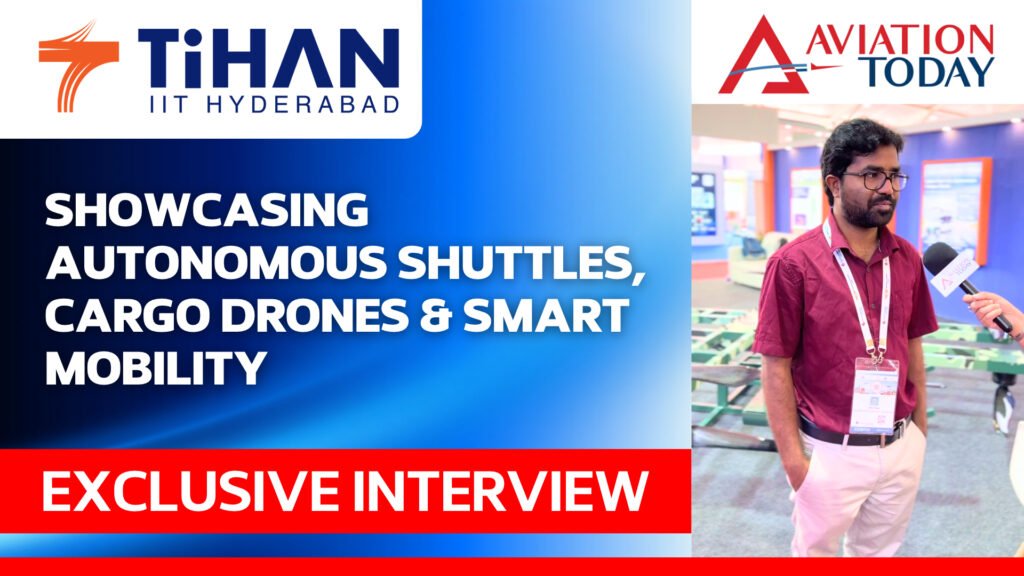
Hyderabad, India: Speaking to Aviation Today during Wings India at Begumpet Airport, Hyderabad, Dr. Sanju Kumar, Technical Officer at TiHAN, IIT Hyderabad, highlighted how the Technology Innovation Hub is driving advancements in autonomous mobility through drones, autonomous ground vehicles and intelligent navigation systems.
He discussed TiHAN’s work in developing driverless campus shuttles, cargo and passenger drone technologies, sustainable testing infrastructure, smart mobility solutions for airports and cities, and autonomous e-bikes. He also explained TiHAN’s collaborations with government agencies, industry and academia to accelerate innovation through technology transfer and real-world testing.
Conversation In Details
Aviation Today: What is TiHAN showcasing at Wings India 2026?
Dr. Sanju Kumar: TiHAN (Technology Innovation Hub on Autonomous Navigation) is located within the IIT Hyderabad campus, which spans around 700 acres on the outskirts of Hyderabad. The hub was established under the National Mission on Interdisciplinary Cyber-Physical Systems (NM-ICPS), an initiative inaugurated by the Prime Minister of India.
TiHAN primarily focuses on two major domains autonomous aerial systems and autonomous ground vehicles. On the ground mobility side, TiHAN has developed autonomous campus shuttle vehicles that have been operational within the IIT Hyderabad campus for over two years. These vehicles currently operate at Level 2 and Level 3 autonomy and provide visitors and students with an opportunity to experience autonomous navigation technology in real-world conditions.
On the aerial mobility front, TiHAN is working on a wide range of drone technologies, including medium-payload and heavy-payload cargo drones. The organisation is also developing passenger drone technologies aimed at supporting future urban air mobility, enabling faster transportation within and between cities while reducing traffic congestion.
For logistics applications, cargo drones eliminate the need for conventional runway infrastructure and can significantly improve the speed, efficiency and reliability of transporting goods. TiHAN collaborates extensively with government organisations, private industry and academic institutions while transferring its technologies to external partners through Technology Transfer (ToT) programmes.
Aviation Today: How sustainable do you think these innovations are?
Dr. Sanju Kumar: Sustainability is one of the core objectives of TiHAN’s innovation ecosystem. The organisation is building advanced infrastructure and dedicated test beds that allow companies, researchers and developers to evaluate and validate autonomous technologies under real operating conditions.
These facilities are designed for long-term use and support continuous testing of both autonomous drones and ground vehicles. Through collaboration with multiple stakeholders, TiHAN enables innovators to develop, test and refine their technologies efficiently, creating a sustainable ecosystem for autonomous mobility development.
Aviation Today: Can you give us some insights into the fully autonomous campus shuttle?
Dr. Sanju Kumar: Autonomous shuttle technology has applications similar to mobility vehicles already used at airports for assisting passengers, particularly those with reduced mobility.
At IIT Hyderabad, TiHAN has developed autonomous electric shuttles in different configurations, including six-seater and larger shuttle platforms. These driverless vehicles have been operating daily for more than two years across three dedicated routes inside the campus, covering over five kilometres.
One of the unique aspects of the system is that it operates without GPS. Instead, it relies on an integrated autonomous navigation stack. If the shuttle detects an obstacle, it automatically stops, safely avoids the obstruction once the path is clear, and continues to its destination without human intervention.
Aviation Today: How can this technology benefit smart cities and airports?
Dr. Sanju Kumar: Autonomous mobility technologies can significantly improve safety, efficiency and operational reliability in smart cities and airport environments.
Humans working for extended periods often experience fatigue, increasing the likelihood of operational errors. Autonomous systems equipped with advanced sensors and intelligent navigation can reduce dependence on continuous human intervention while maintaining consistent operational performance.
Although human expertise remains essential, autonomous systems assist by handling repetitive and demanding tasks more safely and efficiently. At the same time, people can develop the necessary skills to operate, monitor and manage these advanced technologies.
Aviation Today: Could you share some insights about your autonomous e-bike project?
Dr. Sanju Kumar: TiHAN has been working on autonomous e-bike technology for the past two years. The concept is designed for campuses and other controlled environments where multiple users share mobility resources.
A user can ride an e-bike to a destination and leave it there. The next user can summon the same vehicle using a smartphone. The autonomous e-bike then navigates independently to the requested location using its integrated navigation stack.
The system is capable of balancing itself autonomously while travelling. After use, the e-bike can automatically return to a designated parking or charging station, allowing multiple users to utilize the same vehicle efficiently without requiring manual repositioning.
Aviation Today: What message would you like to give our viewers?
Dr. Sanju Kumar: I invite everyone to visit TiHAN at IIT Hyderabad and explore the latest advancements in autonomous mobility. Visitors can experience the cutting-edge technologies we are developing in autonomous ground vehicles, aerial systems and intelligent navigation, and witness how these innovations are shaping the future of mobility.