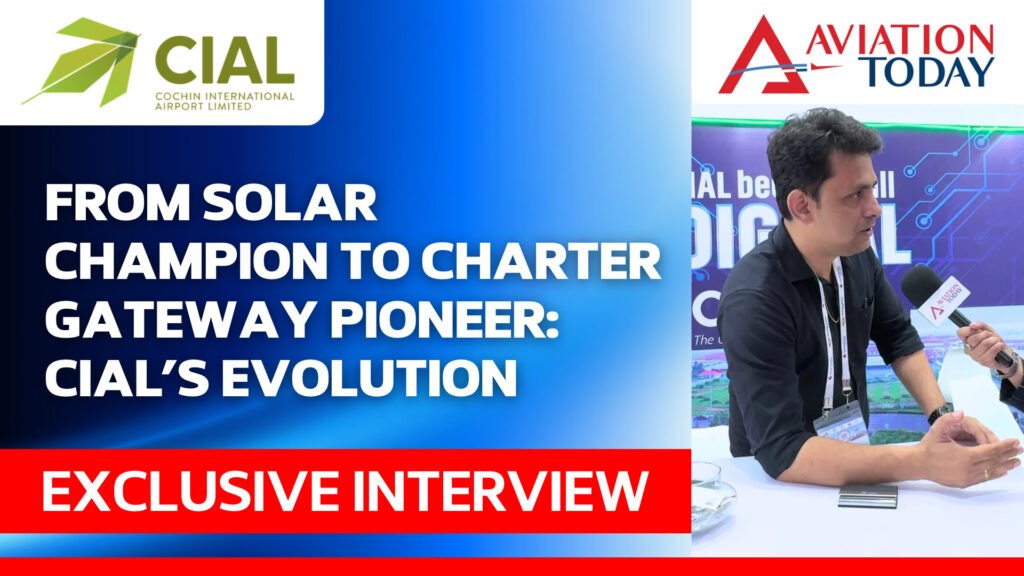
Hyderabad, India: Speaking to Aviation Today during Wings India at Begumpet Airport, Hyderabad, Anish C R, Senior Manager (Commercial) at Cochin International Airport Limited (CIAL), highlighted the airport’s pioneering sustainability journey, which transformed CIAL into the world’s first fully solar-powered airport.
He also discussed the evolution of CIAL’s innovative Charter Gateway, explaining how the facility has enhanced business aviation in South India through faster passenger processing, dedicated infrastructure, and multimodal operations.
During the conversation, he outlined the airport’s continued investment in renewable energy, power storage solutions, and infrastructure aimed at supporting the future growth of aviation.
Conversation In Details
Aviation Today: CIAL is recognised as the world’s first fully solar-powered airport. Could you share some insights into this sustainability journey?
Anish C R: Sustainability at CIAL did not happen overnight. The foundation for this journey was laid in 2012, when the airport launched a pilot solar project with a 100-kilowatt rooftop installation. Initially, the primary objective was to reduce rising electricity costs by generating its own power. As the project proved successful, sustainability naturally became an integral part of the airport’s long-term strategy.
Encouraged by the positive results, CIAL expanded its solar infrastructure and commissioned its first 1 MW solar power plant by the end of 2013. The airport continued to increase its renewable energy capacity, and by 2016, it became the world’s first airport to meet 100% of its electricity requirements through on-site solar power generation, achieving complete power neutrality.
This milestone earned international recognition, culminating in the United Nations Champions of the Earth Award in 2018. The honour was shared alongside Prime Minister Narendra Modi, who also received the prestigious environmental award that year. According to Anish, the recognition placed CIAL on the global stage as a benchmark for sustainable airport operations.
He explained that CIAL remains one of the few airports worldwide to generate its own electricity while maintaining its power-neutral status. As the airport’s operational demands have increased over the years, it has simultaneously expanded both its on-site and off-site solar generation facilities to match the growing energy requirements.
Currently, the airport consumes approximately 1.5 to 1.6 lakh units of electricity daily, while generating nearly 2 lakh units through its solar installations. The excess electricity is supplied back to the power grid. Looking ahead, CIAL is also exploring energy storage solutions, enabling the airport to store surplus electricity instead of exporting it to the grid, further strengthening its renewable energy ecosystem.
Aviation Today: Could you also share some insights about CIAL’s Charter Gateway?
Anish C R: The Charter Gateway is another major innovation introduced by CIAL to support the future of business aviation. Anish explained that the concept was envisioned by Managing Director S. Suhas, who identified an opportunity to repurpose CIAL’s old terminal building, which had become redundant.
Rather than allowing the facility to remain unused, CIAL transformed it into a dedicated charter terminal to strengthen Kerala’s and South India’s business aviation landscape. The result is the largest Charter Gateway of its kind, spread across approximately 50,000 square feet and developed through significant investment into a modern, premium facility.
The terminal features five lounges and has been specifically designed to offer a seamless experience for business aviation passengers, where time is a critical factor. Anish noted that domestic passengers can move from their aircraft to their parked vehicle on the city side in less than two minutes, dramatically reducing transit time compared with conventional airport terminals.
He described this rapid passenger movement as a game changer for business travellers, where saving time directly translates into operational efficiency and convenience.
The Charter Gateway also functions as a multimodal terminal, capable of handling both domestic and international charter operations. The facility has been operational since 2022 and continues to play an important role in supporting business aviation growth while providing dedicated infrastructure tailored to charter operators and premium travellers.
The interview concluded with Anish reiterating CIAL’s commitment to innovation, sustainability, and infrastructure development, positioning the airport as a global leader in environmentally responsible aviation while continuously enhancing facilities for business and charter aviation.