News
Civil Aviation
Pilot Training
Flight School Analysis
Aviation Jobs
Training
Services
About Us
Contact Us

China’s W5000 Uncrewed Cargo Aircraft Completes First Test Flight In Inner Mongolia

Picture of Aviation Today News Desk

Aviation Today News Desk

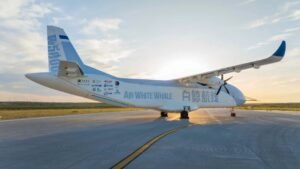
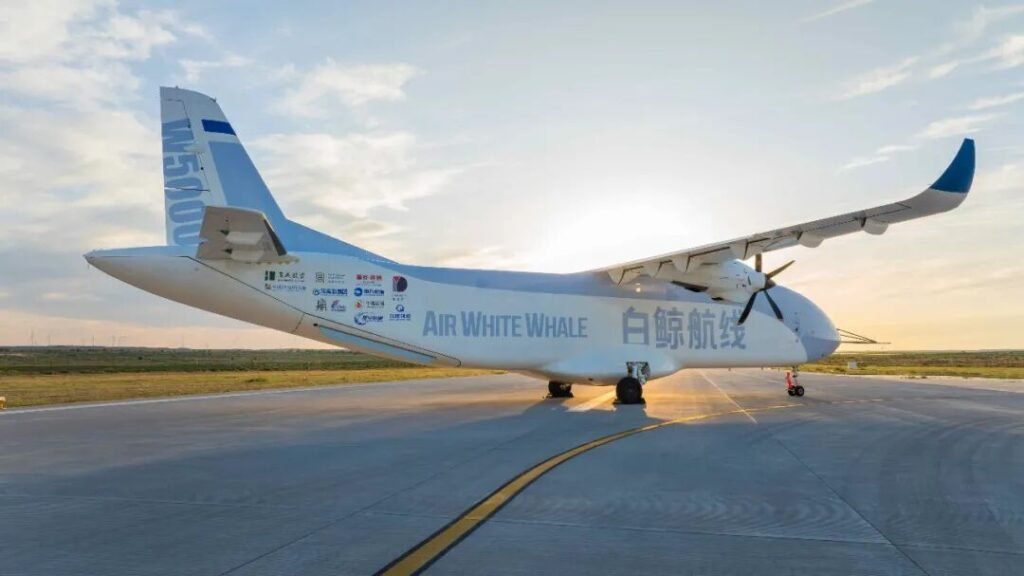
Inner Mongolia, China: China’s Air White Whale W5000 uncrewed cargo aircraft successfully completed its first technical verification flight on November 14, 2026, at Otog Front Banner General Aviation Airport in Inner Mongolia, marking a milestone in the development of large uncrewed cargo aircraft. The aircraft was assembled at Changzhou National Hi-Tech District in Jiangsu Province before being transported to Inner Mongolia for the test. According to an announcement published on November 16, 2026, by the Commerce Bureau of Changzhou National Hi-Tech District under the Xinbei District People's Government, the W5000 took off at full thrust with its flaps set at eight degrees and landing gear extended. It covered approximately 600 metres along the runway before becoming airborne. During the approximately 30-minute flight, the aircraft climbed to 1,000 metres above the airfield at an indicated airspeed of approximately 220 km/h and a climb rate of five metres per second. It completed climbing, level flight, turning, descent and approach-to-landing manoeuvres. The aircraft performed four turns along its planned flight path, maintaining a bank angle of approximately 20 degrees and an indicated airspeed of 220 km/h. Before landing, it descended to 500 metres above the airfield and approached at a glide angle of approximately three degrees. The test assessed the aircraft's handling stability and the coordinated operation of its propulsion, flight control, avionics and ground-based monitoring systems. Designed for regional logistics operations, the W5000 has a maximum payload capacity of five tonnes, a cargo compartment volume exceeding 65 cubic metres and a maximum range of 2,600 kilometres. It can accommodate different types of standard aviation cargo containers and pallets, supporting regional freight transportation, cold-chain logistics and emergency supply deliveries. The aircraft is designed to operate through an "autonomous flight + ground monitoring" model, without an onboard flight crew. Its operating concept is intended to reduce personnel and cockpit-related equipment costs while supporting operations at civil aviation and general aviation airports. Air White Whale Founder, Chairman and Chief Executive Officer Hu Zhendong said the W5000's logistics cost per tonne-kilometre could be reduced by more than 60% compared with conventional crewed cargo aircraft in the same category. He attributed the projected savings to the removal of flight crew costs and crewed cockpit equipment, reduced aircraft weight and lower energy consumption. Hu Zhendong also highlighted the aircraft's domestic manufacturing capabilities, stating, "The aircraft is equipped with domestically produced turboprop engines, and its airframe extensively uses domestically produced carbon-fibre composite materials." He added that the materials reduce structural weight while maintaining strength, allowing a greater proportion of the maximum take-off weight to be allocated to cargo. The company stated that key systems, including the aircraft's overall design, flight controls, avionics, propulsion system and composite airframe, have achieved domestic independent development and control. According to the November 16 government announcement, the W5000 has received expressions of interest covering 835 aircraft. The company expects the aircraft to enter commercial operations by the end of 2027, with development and airworthiness certification activities continuing.
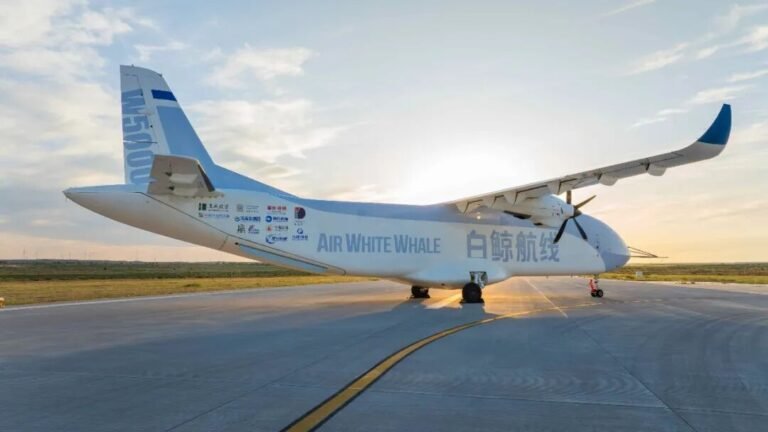
Image: @GoJiangsu (X)

Inner Mongolia, China: China’s Air White Whale W5000 uncrewed cargo aircraft successfully completed its first technical verification flight on November 14, 2026, at Otog Front Banner General Aviation Airport in Inner Mongolia, marking a milestone in the development of large uncrewed cargo aircraft.

The aircraft was assembled at Changzhou National Hi-Tech District in Jiangsu Province before being transported to Inner Mongolia for the test. According to an announcement published on November 16, 2026, by the Commerce Bureau of Changzhou National Hi-Tech District under the Xinbei District People’s Government, the W5000 took off at full thrust with its flaps set at eight degrees and landing gear extended. It covered approximately 600 metres along the runway before becoming airborne.

During the approximately 30-minute flight, the aircraft climbed to 1,000 metres above the airfield at an indicated airspeed of approximately 220 km/h and a climb rate of five metres per second. It completed climbing, level flight, turning, descent and approach-to-landing manoeuvres. The aircraft performed four turns along its planned flight path, maintaining a bank angle of approximately 20 degrees and an indicated airspeed of 220 km/h. Before landing, it descended to 500 metres above the airfield and approached at a glide angle of approximately three degrees.

The test assessed the aircraft’s handling stability and the coordinated operation of its propulsion, flight control, avionics and ground-based monitoring systems.

Designed for regional logistics operations, the W5000 has a maximum payload capacity of five tonnes, a cargo compartment volume exceeding 65 cubic metres and a maximum range of 2,600 kilometres. It can accommodate different types of standard aviation cargo containers and pallets, supporting regional freight transportation, cold-chain logistics and emergency supply deliveries.

The aircraft is designed to operate through an “autonomous flight + ground monitoring” model, without an onboard flight crew. Its operating concept is intended to reduce personnel and cockpit-related equipment costs while supporting operations at civil aviation and general aviation airports.

Air White Whale Founder, Chairman and Chief Executive Officer Hu Zhendong said the W5000’s logistics cost per tonne-kilometre could be reduced by more than 60% compared with conventional crewed cargo aircraft in the same category. He attributed the projected savings to the removal of flight crew costs and crewed cockpit equipment, reduced aircraft weight and lower energy consumption.

Hu Zhendong also highlighted the aircraft’s domestic manufacturing capabilities, stating, “The aircraft is equipped with domestically produced turboprop engines, and its airframe extensively uses domestically produced carbon-fibre composite materials.” He added that the materials reduce structural weight while maintaining strength, allowing a greater proportion of the maximum take-off weight to be allocated to cargo.

The company stated that key systems, including the aircraft’s overall design, flight controls, avionics, propulsion system and composite airframe, have achieved domestic independent development and control.

According to the November 16 government announcement, the W5000 has received expressions of interest covering 835 aircraft. The company expects the aircraft to enter commercial operations by the end of 2027, with development and airworthiness certification activities continuing.

Leave a Comment

Subscribe to our Newsletter

Recent News

Aviation Today Perspectives