News
Civil Aviation
Pilot Training
Flight School Analysis
Aviation Jobs
Training
Services
About Us
Contact Us

EXCLUSIVE: Gandhi Automations Highlights Air India’s 269m Hangar Door Project

Picture of Aviation Today Exclusive

Aviation Today Exclusive

Aviation Today: That's really great, sir. How will this affect airport efficiency and help customers? Sanjay Lal: So, see, there are two aspects to it. One is when you talk about the aviation industry, there are various activities involved in this. Being a door manufacturer, we are more inclined towards MRO activities, but yes, if you talk about the aviation industry, there are two major players in India, IndiGo and Air India. And they capture more than 90% of markets here. They have planes, they have orders for new planes also, which is going to come up. But the existing planes, earlier they used to send, still they are sending outside to get it repaired. So now there will be a facility for Air India where they will repair their own planes and there are other companies like GMR. GMR is also doing MRO facility activities for other players. So, if you talk about aviation, it has been divided into, aviation into commercial aviation, where planes are flying, people are using that service. And secondly, on the back, there are other activities and one of the activities is MRO. Aviation Today: At this point, how do you see India's role in becoming a global aviation hub? Sanjay Lal: So, currently, if I'm not wrong, it is hardly 3%, 4% of the total aviation industry, which we are doing here. But yes, it's growing, and by 2030, it will become a 4 billion market. So, currently the CAGR is approximately 6.5%. So we are seeing growth, a lot of new players are entering into the market and you are seeing that a lot of assembly lines are being created by Indian companies. So we see that in going forward most of the passenger planes will also be manufactured in India. Aviation Today: Can you please also tell us what the biggest challenges you have faced so far? Sanjay Lal: Challenge is again, managing resources because there is a limited resource in terms of the aviation industry. Yes, there are certain players who are trying to manage the resources and increase the resources so that at least they can get good support in expansion. So like FTOs are coming up, there are a lot of FTOs you will see in coming years, who will come and train people and they will support the industry. There are a lot of them, like GMR has started training suits, Air India has started training suits. So new pilots, we are having a scarcity of pilots. So there are pilot training suits, which are coming up, giving training. So I see in the next two, three years, we will have adequate resources for this aviation industry where we will have, we can do all end-to-end activities without support of other parts of the world. Aviation Today: That's really great, sir. And then, on this biggest platform like Wings India 2026, are you looking for any other collaborations or partnerships? Sanjay Lal: So if we talk about collaboration, we are ourselves equipped with the current industry scenario. Yes, we may come up with some new exciting products where we are working on, which may be linked to the IoT or double IoT and collaboration, not now, yes, because it's a completely Indian company. So we believe in making India. So we develop our own self. We have a design and development team where we do a lot of research activities and we launch products, we test products with our set of customers. We take feedback from them and then we launch the products.

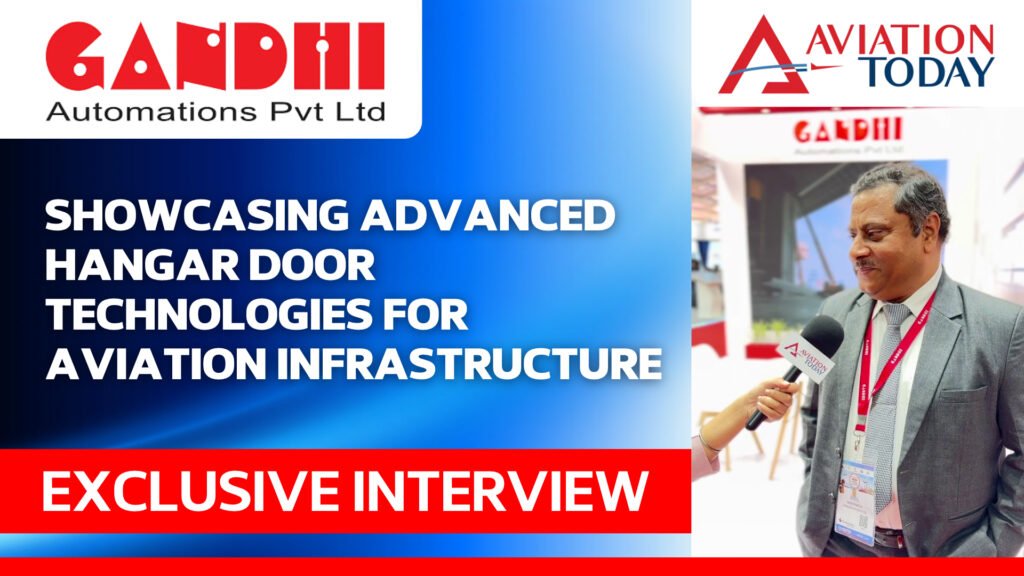
Hyderabad, India: Speaking to Aviation Today during Wings India at Begumpet Airport, Hyderabad Sanjay Lal, General Manager – Project Sales at Gandhi Automations, discussed the company’s recent projects and innovations in the aviation sector, including its work on airport infrastructure and hangar doors. 

He highlighted Gandhi Automations’ ongoing project for Air India in Bengaluru, described as one of the largest projects in Asia, involving a 269-metre-wide and approximately 22-metre-high hangar door for an MRO facility. 

He also discussed India’s growing aviation and MRO ecosystem, the country’s potential to become a global aviation hub, challenges related to skilled resources, and the growing role of flight training organisations. He also spoke about Gandhi Automations’ focus on developing products in India through its own design and development team and customer feedback. 

Conversation In Details:

Aviation Today: Thank you so much for joining us at Wings India 2026. Can you please explain what recent innovations you have introduced to make airports more flexible for customers?

Sanjay Lal: So when you talk about Gandhi Automation, it’s a 30-year-old company and it’s an Indian multinational where we are exporting to 72 countries. Related to projects, yes, we have done a lot of big projects in the last two, three years, especially in the Middle East and Indonesia, Singapore. And currently we are doing one of the largest projects of India, which is of Air India in Bangalore. This is all about Hangardoor as of now.

Aviation Today: Can you give us details about the Air India project that is currently underway?

Sanjay Lal: Yeah, so if you talk about the Air India project, the Air India project is one of the largest Asia projects where the Hangardoor width is 269 meter and height is approximately 22 meter. So, it is one of the unique establishments which is going to come up for MRO in India, where Air India will have a MRO facility for their own place where they will repair, they will overhaul and do maintenance work for all the planes which are with them. Probably they might go for other players also to prepare their planes.

Aviation Today: That’s really great, sir. How will this affect airport efficiency and help customers?

Sanjay Lal: So, see, there are two aspects to it. One is when you talk about the aviation industry, there are various activities involved in this. Being a door manufacturer, we are more inclined towards MRO activities, but yes, if you talk about the aviation industry, there are two major players in India, IndiGo and Air India. And they capture more than 90% of markets here. They have planes, they have orders for new planes also, which is going to come up. But the existing planes, earlier they used to send, still they are sending outside to get it repaired. So now there will be a facility for Air India where they will repair their own planes and there are other companies like GMR. GMR is also doing MRO facility activities for other players. So, if you talk about aviation, it has been divided into, aviation into commercial aviation, where planes are flying, people are using that service. And secondly, on the back, there are other activities and one of the activities is MRO.

Aviation Today: At this point, how do you see India’s role in becoming a global aviation hub?

Sanjay Lal: So, currently, if I’m not wrong, it is hardly 3%, 4% of the total aviation industry, which we are doing here. But yes, it’s growing, and by 2030, it will become a 4 billion market. So, currently the CAGR is approximately 6.5%. So we are seeing growth, a lot of new players are entering into the market and you are seeing that a lot of assembly lines are being created by Indian companies. So we see that in going forward most of the passenger planes will also be manufactured in India.

Aviation Today: Can you please also tell us what the biggest challenges you have faced so far?

Sanjay Lal: Challenge is again, managing resources because there is a limited resource in terms of the aviation industry. Yes, there are certain players who are trying to manage the resources and increase the resources so that at least they can get good support in expansion. So like FTOs are coming up, there are a lot of FTOs you will see in coming years, who will come and train people and they will support the industry. There are a lot of them, like GMR has started training suits, Air India has started training suits. So new pilots, we are having a scarcity of pilots. So there are pilot training suits, which are coming up, giving training. So I see in the next two, three years, we will have adequate resources for this aviation industry where we will have, we can do all end-to-end activities without support of other parts of the world.

Aviation Today: That’s really great, sir. And then, on this biggest platform like Wings India 2026, are you looking for any other collaborations or partnerships?

Sanjay Lal: So if we talk about collaboration, we are ourselves equipped with the current industry scenario. Yes, we may come up with some new exciting products where we are working on, which may be linked to the IoT or double IoT and collaboration, not now, yes, because it’s a completely Indian company. So we believe in making India. So we develop our own self. We have a design and development team where we do a lot of research activities and we launch products, we test products with our set of customers. We take feedback from them and then we launch the products.

Leave a Comment

Subscribe to our Newsletter

Recent News

Aviation Today Perspectives