Manitoba, Canada: The Transportation Safety Board of Canada (TSB) has concluded its investigation into a fatal mid-air collision involving two Harv’s Air Service training aircraft, finding that the accident highlights the limitations of relying on the visual “see-and-avoid” principle and the importance of stronger traffic-awareness measures.
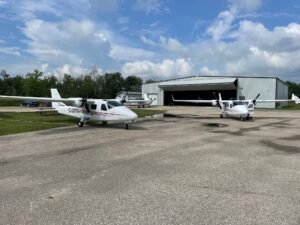
The final report, A25C0066, was officially released on 21 October 2026, following a Class 4 limited-scope investigation. The investigation concerned the collision between a Cessna 172R, registered C-GZKA, and a Cessna 152, registered C-GGPE, near Steinbach (South) Aerodrome, Manitoba, on 8 July 2025.
The two aircraft were conducting separate solo training flights in the aerodrome circuit under visual flight rules. Both eventually turned into final approach for Runway 36, with the aircraft approximately 100 feet above C-GGPE when they were about one mile from the runway.
At about 0842 Central Daylight Time, the aircraft made initial contact. The pilot of C-GGPE immediately applied full power and pitched the aircraft up, but the two aircraft collided again, became entangled and crashed approximately 0.25 statute miles south of the runway threshold. Both pilots were fatally injured, and both aircraft were destroyed in the subsequent post-impact fire.
The TSB found that the circumstances exposed several weaknesses in traffic separation and pilot situational awareness at the uncontrolled aerodrome. The aircraft were operating in Class G airspace, where pilots were responsible for maintaining separation through visual lookout and radio awareness.
A significant issue was the effectiveness of the see-and-avoid principle. The TSB noted that an aircraft on a collision course can remain visually difficult to detect because it may appear almost stationary in another pilot’s field of view. The Board has identified similar limitations in several previous mid-air collision investigations.
The report also found that neither aircraft was equipped with an airborne collision avoidance system (ACAS) or ADS-B IN, nor were they required to be. ADS-B IN could provide pilots with information about the position, altitude and movement of other suitably equipped aircraft and could enhance situational awareness.
The TSB also examined the way traffic was being managed in the circuit. Several aircraft were operating in the circuit at the same time, with pilots extending their downwind legs to maintain spacing.
The Cessna 172 pilot had extended the downwind leg by about one statute mile on two occasions. The report found that, before the collision, neither of the two pilots involved stated the distance from the runway threshold when announcing they were on final.
That was significant because Harv’s Air Service had already introduced a corrective action plan following an earlier near-collision involving two of its aircraft approximately six months before the fatal accident. The plan required pilots on final to include their distance from the runway threshold in radio calls to improve situational awareness.
However, the procedure was not consistently followed on the day of the fatal collision.
Weather conditions were legally suitable for VFR operations, but visibility was affected by smoke from severe wildfires in northern Manitoba.
The TSB also determined that the sun was approximately 28 degrees above the horizon and at an azimuth of about 84 degrees magnetic. The Runway 36 circuit’s base leg was oriented at approximately 0.86 degrees magnetic, meaning aircraft flying that portion of the circuit were heading almost directly toward the sun.
The report could not establish whether either pilot was wearing sunglasses at the time. It also could not confirm whether either aircraft had its lights on apart from the beacon.
The TSB did not identify a qualification issue involving either pilot. The pilot of C-GZKA held a private pilot licence and had accumulated 169.4 hours of total flight time, including 73.2 hours solo, while working toward a commercial pilot licence.
The pilot of C-GGPE held a student pilot permit and had accumulated 59.3 hours of total flight time, including 14.4 hours solo, while working toward a private pilot licence. Both pilots held valid medical certificates.
Following the accident, Harv’s Air Service imposed a limit of three aircraft in the circuit at one time.
The company also required all final-approach radio calls to include distance from the runway threshold and introduced safety briefings for students and aircraft renters covering lookout techniques, situational awareness and aircraft blind spots.
It further required aircraft lights to remain on during flight and began upgrading its fleet with LED lighting and expanding the number of aircraft equipped with ADS-B IN and ADS-B OUT.
The TSB noted that it has investigated 13 mid-air collision accidents since 2011. In several cases, the Board identified limitations in relying on visual detection alone and warned that the risk of mid-air collisions would not be substantially reduced until traffic-awareness systems are more widely adopted.
The Board’s central safety message from the investigation is that pilots operating around uncontrolled aerodromes need to actively monitor radio calls and maintain situational awareness rather than rely solely on visual detection. It also encouraged aircraft owners and pilots to install systems capable of providing additional traffic information.
On 8 July 2025, the two Harv’s Air Service aircraft were conducting solo circuit training at Steinbach (South) Aerodrome. The Cessna 172R and Cessna 152 were among several aircraft operating in the circuit.
At about 0841, both aircraft reported turning onto final for Runway 36 only seconds apart. They were then separated by roughly 0.5 statute mile horizontally and 200 feet vertically. By 0841:58, both were about one mile from the runway, with the Cessna 172 approximately 100 feet above the Cessna 152.
The aircraft made initial contact shortly afterwards. Despite the Cessna 152 pilot applying full power, the aircraft collided again, became entangled and crashed. Both pilots died.
The TSB said the investigation was conducted solely to advance transportation safety and did not assign fault or determine civil or criminal liability. The 21 October 2026 report concludes the TSB’s investigation into the accident.