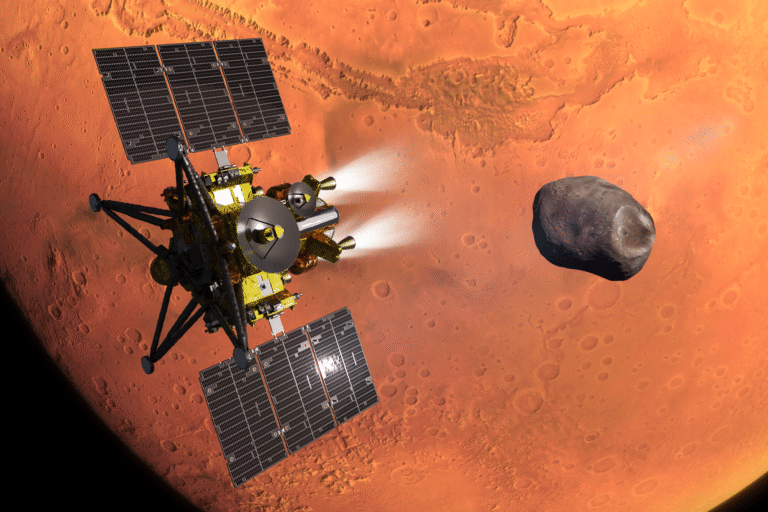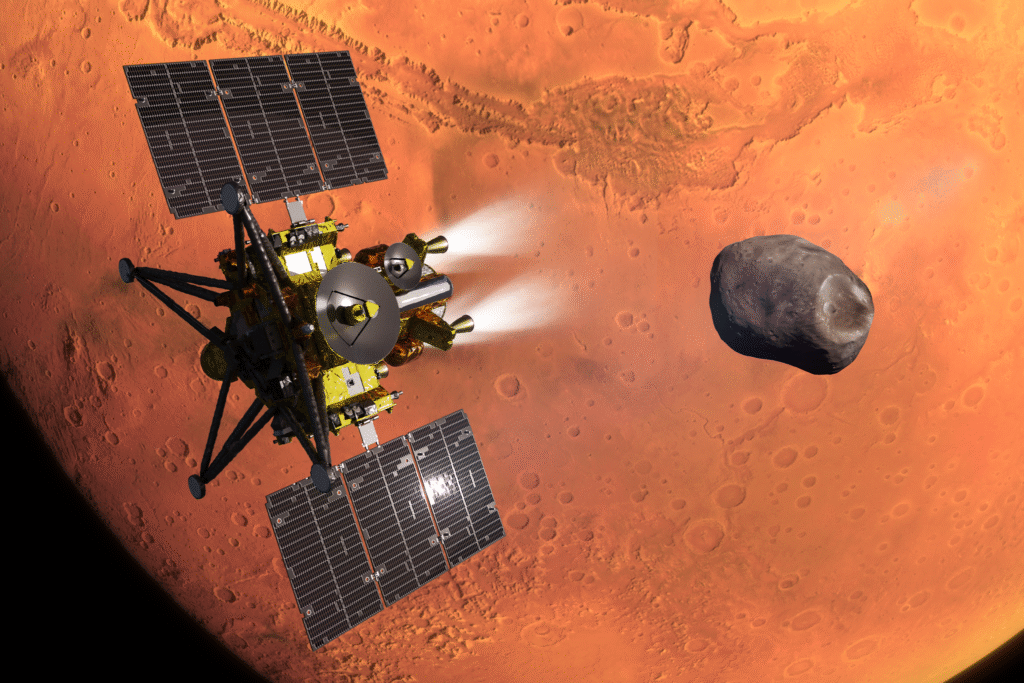
Tokyo, Japan: Japan is preparing to launch its Martian Moons eXploration (MMX) spacecraft on 20 October 2026, in a five-year mission to collect samples from Phobos, one of Mars’s two moons, and return them to Earth in 2031. Led by the Japan Aerospace Exploration Agency (JAXA), the mission aims to help scientists determine how the Martian moons formed, investigate the evolution of the Mars system and understand how materials essential to life may have been transported through the early Solar System.
JAXA announced the planned launch date on 20 August 2026, setting the launch of the MMX spacecraft aboard its H3 rocket for 20 October at 4:41:03 am Japan Standard Time (JST). The agency confirmed the launch time in a further announcement on 18 October. The spacecraft is scheduled to depart from the Tanegashima Space Center in Kagoshima Prefecture, with a backup launch window running from 21 October to 9 November. The mission remains scheduled as of 19 October.
The mission has also received international attention ahead of launch. The European Space Agency (ESA) published its mission briefing on 13 October, NASA issued a media advisory on 8 October outlining its contributions.
The MMX mission is designed to return at least 10 grams of material from Phobos, making it the first mission to bring samples back from a moon in the Martian system. The spacecraft will also observe Deimos, Mars’s smaller moon, during a flyby, while conducting detailed investigations of Phobos’s surface, composition, topography, internal structure and gravity.
Scientists have two leading explanations for the origins of Phobos and Deimos. Under the giant-impact hypothesis, the moons formed from debris ejected into orbit after a large object collided with Mars. Under the capture hypothesis, they are asteroids that were captured by Mars’s gravitational field. Analysing material collected directly from Phobos could help distinguish between these explanations and clarify how the Martian system evolved.
JAXA’s official mission website says the project aims to explore “the origin of the Mars system” and the pathways through which habitability and life may have emerged. The agency also expects the samples to provide insights into the movement of water, volatile substances and organic compounds through the Solar System. Scientists believe Phobos may contain a small proportion of material ejected from Mars by ancient impacts, potentially providing additional information about the planet’s geological history.
The mission is not designed to establish that life existed on Mars or Phobos. Instead, it will investigate the physical and chemical evidence needed to understand the conditions and processes that may have supported habitability on rocky planets.
The MMX spacecraft consists of three main modules: propulsion, exploration and return. The approximately five-tonne spacecraft will travel to the Martian system, conduct observations, approach Phobos and collect samples before beginning its journey back to Earth. Only the return module and its protected sample capsule are intended to return to Earth.
The spacecraft carries scientific instruments for studying the moons’ surface and composition, including cameras, spectrometers and a radiation monitor. The mission carries 13 instruments, including equipment supplied by international partners. NASA’s contributions include the MEGANE gamma-ray and neutron spectrometer, a pneumatic sampling mechanism and communications and navigation support through its Deep Space Network.
MEGANE, developed by Johns Hopkins Applied Physics Laboratory, will measure gamma rays and neutrons emitted from Phobos to help determine the elements present on its surface. The results will contribute to assessments of the moon’s composition and possible origin.
The sampling system combines US-developed pneumatic technology with JAXA’s coring sampler. The pneumatic device uses pressurised gas to lift surface dust into a collection container, while the Japanese system is designed to obtain material from below the surface, at a depth of approximately two centimetres. JAXA aims to collect at least 10 grams through two sampling operations.
The mission will use observations of candidate landing sites to identify terrain suitable for touchdown and sample collection. Because Phobos has extremely weak gravity and a heavily cratered surface, landing and collecting material without bouncing or losing contact with the ground present substantial engineering challenges.
Before the main spacecraft attempts sample collection, it is scheduled to deploy Idefix, a 25-kilogram rover developed jointly by France’s National Centre for Space Studies (CNES) and the German Aerospace Center (DLR). The rover’s deployment is planned for 2029, with surface operations expected to last approximately 100 days.
Idefix will examine the texture and mechanical properties of Phobos’s surface, collect scientific measurements and help identify a suitable landing area for the main spacecraft. Its observations are intended to reduce the risks associated with the subsequent landing and sampling operations.
The rover carries four scientific instruments, including navigation and wheel cameras, a Raman spectrometer and an infrared radiometer. These will help characterise the surface and study how the rover’s wheels interact with the loose material covering the moon.
ESA said: “The 25-kg Idefix rover has two main tasks: providing information to prepare for the landing of the main spacecraft to collect samples, and analysing the composition and texture of Phobos’s surface.”
The rover will also demonstrate whether a wheeled vehicle can move reliably on a small celestial body with extremely low gravity, providing engineering data that could be useful for future robotic missions to asteroids and other moons.
Although JAXA leads the mission, MMX involves NASA, ESA, CNES and DLR, alongside universities, research institutes and technology companies. The collaboration brings together expertise in spacecraft engineering, surface exploration, scientific instrumentation, sample collection and deep-space communications.
NASA is providing the MEGANE instrument, the pneumatic sampler, Deep Space Network support and funding for US scientists participating in the mission’s science team. CNES and DLR are jointly responsible for Idefix, while France is also contributing the MIRS near-infrared spectrometer, which will help identify minerals on Phobos and Deimos.
ESA is contributing deep-space communications technology and coordinating European scientific participation. The mission’s findings and returned samples are expected to be made available for scientific study by international research teams.
The mission builds on Japan’s experience with asteroid sample-return programmes, including Hayabusa and Hayabusa2, which returned material from asteroids to Earth. MMX extends that experience to the Martian system, where the spacecraft must operate close to Mars and then escape its gravitational influence to return home.
Following its scheduled launch on 20 October 2026, MMX is expected to reach the vicinity of Mars in August 2027. It will then conduct detailed observations of Phobos from a quasi-satellite orbit, following a path that allows the spacecraft to remain near the moon without entering a conventional low-altitude orbit around it.
The mission plan includes deploying Idefix in 2029, collecting samples from Phobos in 2030 and departing the Martian system for the return journey. The spacecraft is expected to release its sample-return capsule before atmospheric entry in 2031. The capsule is scheduled to land in Australia, after which the samples will be transferred to Japan for recovery, cataloguing and scientific analysis.
The sample-return process will allow researchers to use sophisticated laboratory instruments on Earth that cannot be carried aboard a spacecraft. Scientists expect analyses of the material to continue long after the mission ends, as improved laboratory techniques may reveal details that cannot be identified using current instruments.
Beyond planetary science, MMX is intended to demonstrate technologies needed for future missions travelling to the Martian system and returning safely to Earth. These include navigation around Mars’s moons, operations in low gravity, precision landing, robotic sampling, sample preservation and deep-space communications.
JAXA has also identified the potential use of Phobos as a staging point for future human exploration of Mars as a long-term area of interest. However, MMX is an uncrewed scientific mission and will not test a crewed landing on Mars or establish Phobos as an operational space station.
The mission comes as space agencies continue to investigate Mars and consider future human exploration. Its findings could provide new information about the evolution of Mars and its moons, while demonstrating technologies relevant to more complex planetary sample-return missions.
With launch scheduled for 20 October, MMX is set to begin a journey that will take approximately five years from departure to the planned return of Phobos material. Its success will depend on the spacecraft’s ability to reach the Martian system, operate under challenging gravity conditions, collect and preserve samples, and return them safely to Earth.