Kuala Lumpur, Malaysia: Malaysia’s Ministry of Finance (MoF) has confirmed that the government has not entered into any agreement or made any commitment to provide financial support to AirAsia, whether through guarantees, loans, financing or injections of public funds, as the airline faces mounting pressure from high jet-fuel prices, foreign-exchange losses and debt obligations.
The clarification was contained in a written reply to the Dewan Rakyat on 19 October 2026, issued in response to a question from Datuk Seri Dr Wee Ka Siong, Member of Parliament for Ayer Hitam, who asked whether the government was considering providing guarantees, loans or public funds to AirAsia.
The Finance Ministry said applications for government support from companies in any sector would be considered according to national and public interests, fiscal sustainability and the protection of public funds, in accordance with prevailing laws and procedures. The ministry also said it would not comment on speculation or figures reported by the media where doing so could affect markets or the interests of employees, customers and other stakeholders.
“The government will continue to monitor the developments closely, while prioritising the people’s interest,” the ministry said in its written parliamentary reply.
The MoF also said it had taken note of concerns surrounding AirAsia, including losses reported in the group’s latest quarterly financial results. AirAsia has primarily attributed the deterioration to a sharp increase in jet-fuel prices following the conflict in West Asia.
“The government regularly engages with players across the aviation industry as part of its monitoring efforts, to seek input from industry players, technical experts and other parties, as it has also done for other economic sectors affected by the West Asia crisis,” the ministry said.
The latest clarification means that reported discussions, government monitoring or assistance in fundraising should not be described as an agreed Malaysian government bailout or financing package. As of 19 October, there was no confirmed government guarantee, loan or public-fund injection for AirAsia.
The position was reiterated in Malaysian media on 20 and 21 October 2026, with The Star reporting on 21 October that there was still “no AirAsia financial aid deal yet”. The report repeated the Finance Ministry’s position that no agreement or commitment had been made while the government continued to monitor fuel prices, currency movements, the regional crisis and air connectivity.
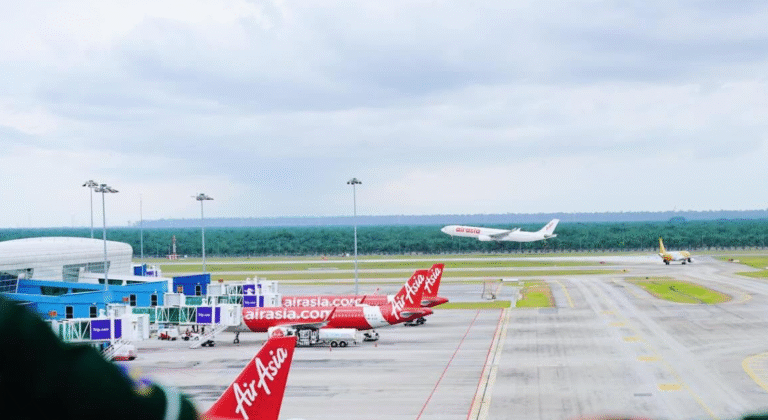
The government’s continued monitoring is closely linked to AirAsia’s large role in Malaysia’s aviation network. The Finance Ministry said AirAsia accounted for approximately 41% of the 104.5 million passenger movements recorded at airports operated by Malaysia Airports Holdings Bhd (MAHB) in 2025 and almost 60% of domestic passenger movements.
The airline’s importance is particularly pronounced in Sabah and Sarawak. In 2025, AirAsia carried about 62% of passengers in Sabah and 70% in Sarawak, excluding short take-off and landing airports.
At individual airports, AirAsia accounted for approximately 79% of passenger movements at Sibu, 77% at Bintulu, 75% at Sandakan, 72% at Kuching, 70% at Tawau, 63% at Miri and 62% at Kota Kinabalu.
In Peninsular Malaysia, its passenger shares were about 70% in Johor, 56% in Terengganu, 56% in Langkawi, 49% in Alor Setar and 46% in Kelantan. At KLIA Terminal 2, or klia2, AirAsia accounted for about three-quarters of passenger movements.
The figures explain why AirAsia’s financial position has become an aviation-connectivity issue for the Malaysian government, particularly for Sabah and Sarawak, rather than solely a corporate financing matter.
AirAsia’s financial position came under greater scrutiny after its second-quarter 2026 results showed a RM 527.16 million net loss, with revenue falling 14.5% to RM5.09 billion. The group had RM2.27 billion in net debt, RM 953.67 million in cash, RM3.13 billion in borrowings and RM13.3 billion in lease liabilities as of 30 June.
AirAsia has been seeking up to US$1 billion in international debt financing and RM700 million in local credit facilities, primarily for debt refinancing and balance-sheet restructuring. In September, the Finance Ministry also engaged Alton Aviation Consultancy to assess the airline’s funding needs.
The issue intensified in October after co-founder Tony Fernandes had met Finance Ministry officials in late September. Fernandes said the discussions focused on fuel and airport costs rather than financial assistance, while acknowledging that AirAsia would not reject government support if offered. Transport Minister Anthony Loke separately said on 12 October 2026 that his ministry had held no meetings with AirAsia in the preceding two to three weeks and had reached no agreement with the airline.
Fernandes had earlier said on 18 September that AirAsia did not need a bailout and remained confident in its liquidity and business sustainability. The latest Finance Ministry response now provides the clearest official position: no government financing agreement or commitment has been made to AirAsia as of 19 October 2026.