What Could Slow AAM Down?
A serious AAM strategy must also acknowledge the reasons the sector may scale more slowly than its advocates expect. High operating costs may keep early service confined to premium travelers for longer than planned.
Vertiport development may lag because zoning, community acceptance, real-estate economics, and power infrastructure are all harder to align than early renderings suggest. Airspace integration and certification may also take time, particularly in dense metropolitan environments where safety margins, noise concerns, and operational complexity are elevated.
There is also the possibility that demand will be strong only in a limited number of corridors rather than across a whole metropolitan area. If that proves true, some cities may support only a small number of profitable routes in the near term. That outcome would not invalidate AAM, but it would mean the sector must be more disciplined about where it deploys capital and how it defines success. These constraints are not reasons to dismiss AAM.
They are reasons to treat the industry as a transportation network buildout rather than an aircraft launch cycle. The companies and governments that acknowledge these limits early will be better positioned to create credible services, earn public trust, and scale with less friction over time. In practice, the industry should judge early success not by demonstration count but by repeat usage, on-time performance, route utilization, community acceptance, and the ability to extend one route into a larger network.
Five Imperatives for Scaling AAM
First, select routes based on demonstrated demand, not available real estate. Demand analysis should include travel-time savings, willingness to pay, trip frequency, congestion exposure, existing transit gaps, and potential for network expansion.
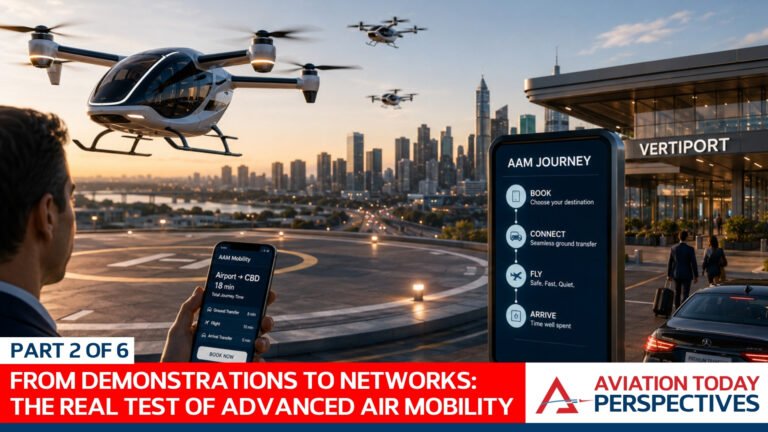
Second, build end-to-end journeys, not just air legs. Every route should include digital booking, ground connections, passenger processing, baggage considerations where relevant, and seamless destination access. Third, prioritize repeatability over spectacle.
The industry should measure success by scheduled service completion, on-time performance, passenger conversion, repeat bookings, aircraft utilization, community acceptance, and weather resilience. Fourth, create network logic from the first route. Early routes should connect nodes that can support a second, third, and fourth route. AAM needs a scalable topology, not a collection of isolated demonstration sites.
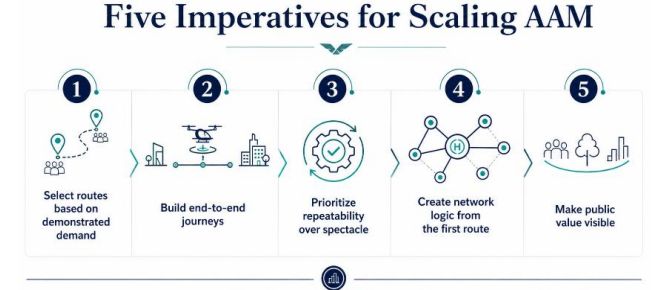
Fifth, make public value visible. Governments and operators should clearly explain how AAM contributes to broader mobility, economic-development, resilience, and environmental objectives. Premium service may fund the first chapter, but public value will determine whether the story continues.
This is the 5th of a series of 6 articles on: “From Demonstrations to Networks: The Real Test of Advanced Air Mobility”
Read Part 4 of this six-part series here
This article is part of Aviation Today’s Perspectives, a dedicated series that publishes expert viewpoints from aviation authorities and industry leaders on emerging trends, policy developments, and the future of global aviation.
Disclaimer: The views and opinions expressed in this article are solely those of the authors and do not necessarily reflect the views or editorial position of Aviation Today.
About The Authors