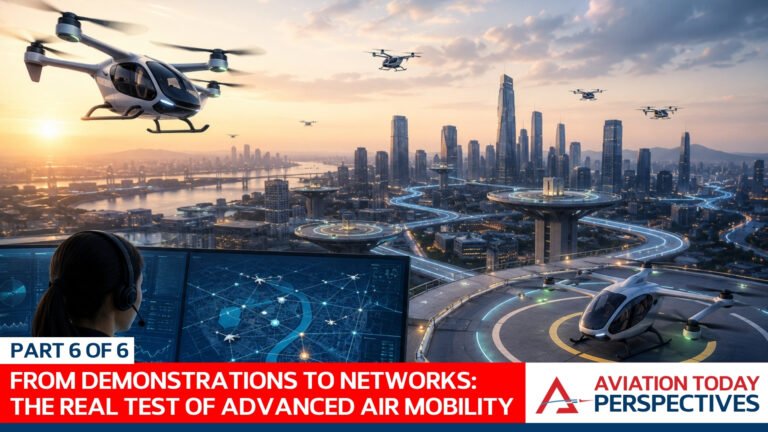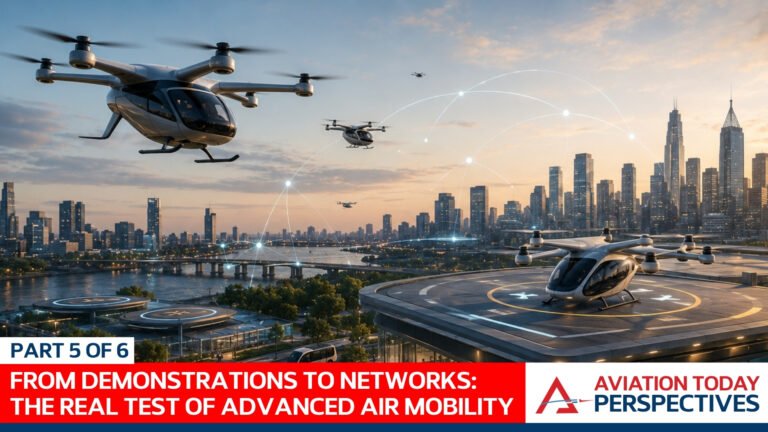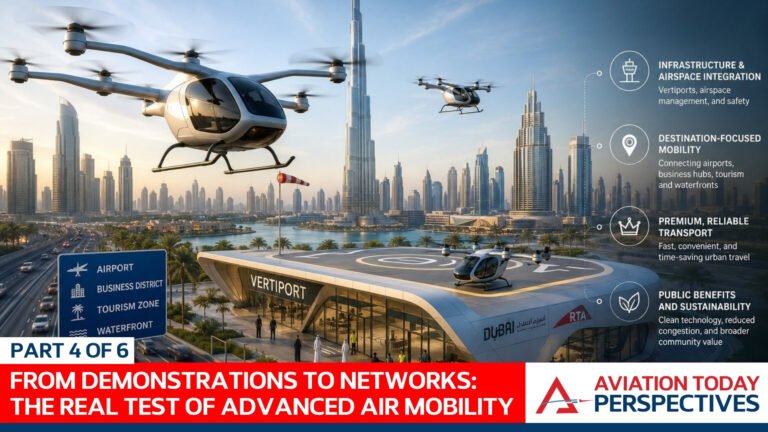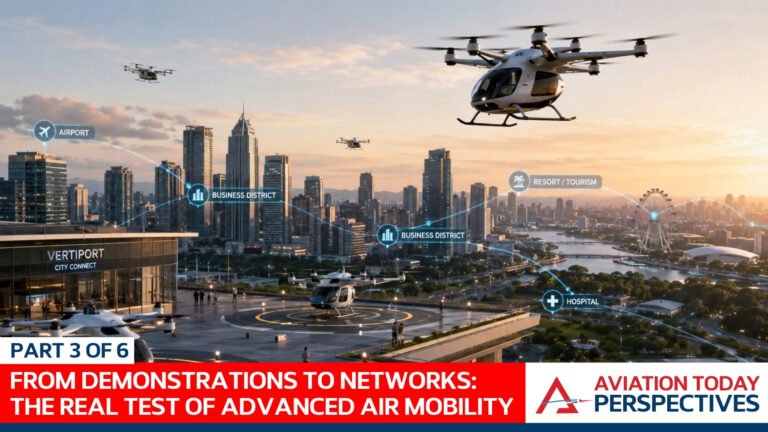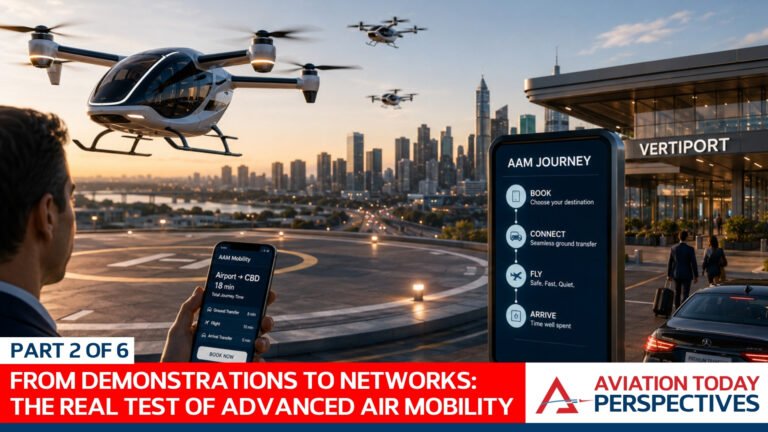
Advanced Air Mobility is approaching an inflection point. AAM’s next test is not flight; it is building an air transportation network that people will be willing to pay to use. Around the world, aircraft are flying, vertiports are being announced, pilot programs are multiplying, and governments are positioning themselves as future hubs for electric vertical takeoff and landing aircraft. Yet the central question facing the sector is no longer whether eVTOL can fly. It is whether industry and government can build a transportation system that people will actually use at scale.
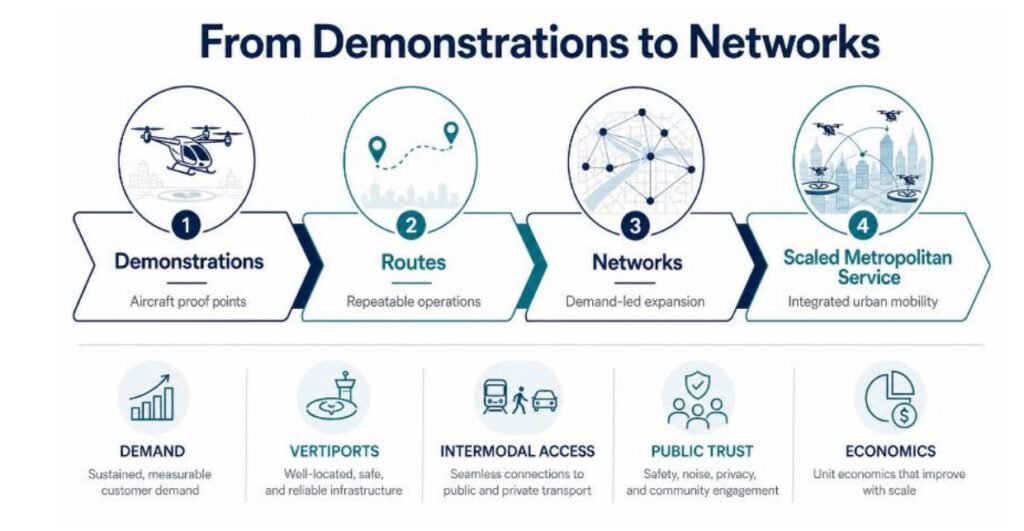
That distinction matters because a successful flight demonstration proves technical capability, while a successful citywide network proves that Advanced Air Mobility can become part of the transportation fabric of a metropolitan region. The industry must now shift its center of gravity from aircraft demonstrations and ceremonial launch sites toward the harder, more consequential work of identifying high-demand travel corridors, integrating with existing transportation systems, securing public confidence, and delivering a reliable premium mobility service on demand.
The future of AAM will not be determined by where a vertiport is easiest to build, but by where passengers have the strongest reason to use one.
The Market Must Move Beyond the “Test Flight Trap”
For years, AAM progress has been measured through milestones that are meaningful but incomplete: prototype flights, aircraft orders, certification campaigns, memoranda of understanding, and concept vertiports. These activities are necessary. None, however, guarantees that a city will support a viable air mobility network.
AAM risks falling into a “test flight trap” in which aviation stakeholders celebrate technical proof points without solving the commercial and operational problem. A test flight can be staged almost anywhere with enough planning, security, and temporary infrastructure. A transportation network cannot. A network must work repeatedly, safely, predictably, and economically across weather conditions, congested airspace, changing passenger demand, community expectations, and real-world disruptions.
The industry should therefore treat a single route not as a public-relations exercise but as the first node in a network. Each early route should be selected because it can establish operational learning, recurring demand, strong economics, public acceptance, and logical expansion opportunities. The first route should not merely prove that an aircraft can connect two points. It should prove that a passenger will choose the service again tomorrow.
That is the difference between aviation theater and transportation transformation.
This is the 1st of a series of 6 articles on: “From Demonstrations to Networks: The Real Test of Advanced Air Mobility
This article is part of Aviation Today’s Perspectives a dedicated series that publishes expert viewpoints from aviation authorities and industry leaders on emerging trends, policy developments, and the future of global aviation.
Disclaimer: The views and opinions expressed in this article are solely those of the authors and do not necessarily reflect the views or editorial position of Aviation Today.
About the Authors