Tomblaine, France: Eleven people were killed after a skydiving aircraft crashed shortly after takeoff near Nancy in northeastern France on Sunday, June 28, in one of the country’s deadliest civilian aviation accidents involving a parachuting flight in decades.
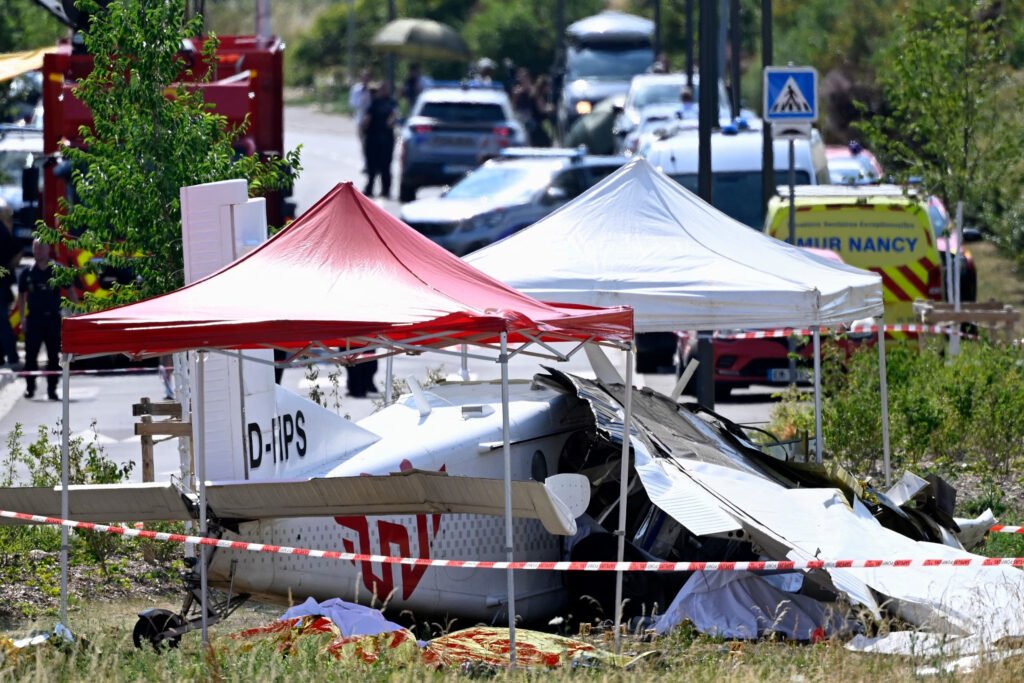
The aircraft, identified by authorities as a German-registered Pilatus PC-6, departed from Nancy-Essey Airport at approximately 11:00 a.m. local time before suffering what officials described as a malfunction moments after becoming airborne. The aircraft crashed in the commune of Tomblaine, around 300 metres from the end of the runway, killing everyone on board.
The victims included the pilot, five skydiving instructors and five trainee parachutists, according to regional authorities. No one survived the crash.
According to Meurthe-et-Moselle Prefect Yves Séguy, the aircraft encountered a malfunction shortly after departure from Nancy-Essey Airport.
Officials said the airplane lost altitude rapidly and plunged almost vertically before striking the ground near a bicycle path adjacent to a commercial area. Despite the severity of the accident, the aircraft narrowly missed nearby residential buildings, preventing what authorities said could have been an even greater tragedy. Investigators have not yet determined the precise cause of the accident.
Witnesses reported hearing the aircraft’s engine suddenly fall silent shortly after takeoff, followed almost immediately by the impact. Several residents told local media the aircraft appeared to descend without any obvious attempt to return to the airport.
Authorities said there was no evidence of an in-flight explosion or significant post-impact fire, although the aircraft was completely destroyed upon impact.
The aircraft was being used for a scheduled parachuting flight operated by a skydiving school. French authorities confirmed the aircraft was registered in Germany, although officials have not yet publicly identified the operator or ownership details.
The Swiss-built Pilatus PC-6 Porter is widely used around the world for parachuting operations because of its excellent short takeoff and landing performance, high-wing configuration and ability to carry multiple skydivers.
The flight was carrying 10 parachutists, comprising five instructors and five students, along with the pilot.
Several reports indicated the students were preparing for tandem skydives. Some media outlets reported that the trainee participants included nursing professionals from the Nancy area taking part in a recreational skydiving experience. However, French authorities have not officially released the identities of any victims.
Officials confirmed that some relatives and friends of those on board had gathered at the airport to watch the planned parachute jumps. Several family members reportedly witnessed the aircraft’s fatal descent shortly after takeoff.
Emergency psychological support teams were deployed to assist grieving relatives, witnesses and first responders.
More than 50 firefighters, police officers, emergency medical teams and specialist aviation investigators responded to the scene.
Authorities established a security perimeter around the crash site and urged members of the public to stay away while rescue and recovery operations continued.
French Interior Minister Laurent Nuñez travelled to the scene, while Transport Minister Philippe Tabarot described the accident as a “terrible tragedy” and extended condolences to the victims’ families.
The wreckage remained under guard as investigators began documenting evidence and recovering aircraft components.
France’s aviation accident investigators have launched a formal investigation into the crash. Authorities have stressed that no cause has yet been established.
Although northeastern France experienced exceptionally high temperatures the day before the accident, investigators have not linked the weather to the crash.
Witness reports that the engine appeared to stop shortly after takeoff will form part of the investigation, but officials cautioned that eyewitness accounts alone cannot determine the cause. Unlike many larger commercial aircraft, the Pilatus PC-6 is generally not equipped with a cockpit voice recorder or flight data recorder, meaning investigators will rely heavily on physical evidence, maintenance documentation, operational records and witness testimony.
As investigators continue examining the wreckage, authorities have urged the public to avoid speculation until the official investigation determines what caused the aircraft to crash so soon after takeoff.