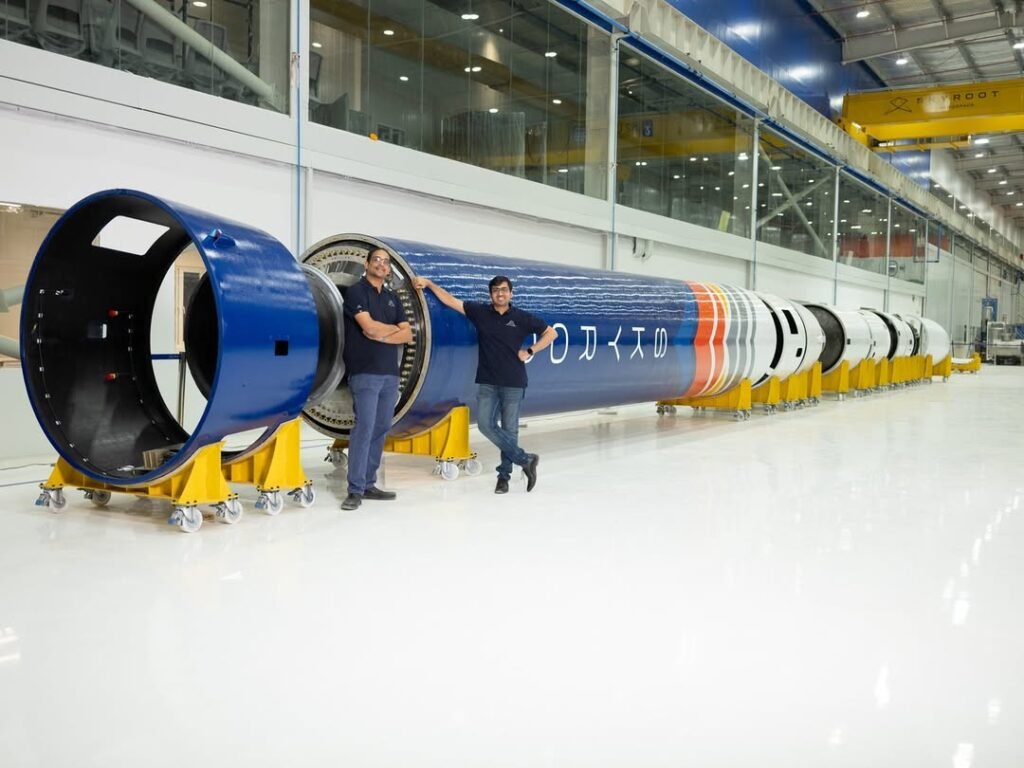
Hyderabad, India: Hyderabad-based Skyroot Aerospace has become India’s first space-tech unicorn after raising $60 million in a major funding round led by Sherpalo Ventures and Singapore sovereign wealth fund GIC, marking a defining moment for the country’s rapidly expanding private space sector. The funding round pushed the company’s valuation to approximately $1.1 billion, making it the first Indian private space startup to cross the unicorn threshold.
The round saw participation from funds managed by BlackRock, founders of Greenko Group, Arkam Ventures, Playbook Partners, Shanghvi Family Office and several existing investors. With this latest infusion, Skyroot’s total funding has climbed to nearly $160 million since its founding in 2018.
The company said the fresh capital will be used to increase launch frequency, expand manufacturing capacity, accelerate development of its heavier-lift Vikram-2 rocket and strengthen its commercial launch operations globally.
Founded by former ISRO scientists Pawan Kumar Chandana and Naga Bharath Daka, Skyroot emerged from Hyderabad’s growing deep-tech ecosystem and became one of the earliest startups incubated at T-Hub. The company was established shortly after the Indian government opened the space sector to private participation in 2020, enabling startups to access ISRO facilities and infrastructure. Skyroot later became the first private Indian company to formally sign an agreement with ISRO for testing and launch support.
Skyroot first entered global headlines in November 2022 after successfully launching Vikram-S, India’s first privately developed rocket to reach space. The suborbital mission, named “Mission Prarambh,” was launched from Sriharikota and reached an apogee of nearly 89.5 kilometres, establishing the company as a pioneer in India’s commercial launch industry.
The company is now preparing for the maiden orbital launch of Vikram-1, which is expected to become India’s first privately developed orbital launch vehicle. Skyroot has positioned the Vikram series as low-cost, rapidly deployable launch systems designed primarily for the growing global small satellite market.
According to the company, the Vikram rockets incorporate extensive use of carbon composite structures, modular architecture and 3D-printed engines to reduce manufacturing timelines and operational costs. Skyroot has repeatedly stated that its long-term objective is to make space launches as reliable, regular and affordable as commercial aviation.
Sherpalo Ventures founder Ram Shriram, one of Silicon Valley’s most prominent early technology investors and an early Google backer, is expected to join Skyroot’s board following the investment. Sherpalo had previously invested in the company during earlier funding rounds as well.
Skyroot’s rise also reflects Hyderabad’s emergence as a major aerospace and defence innovation hub. Telangana leaders, including former IT minister KT Rama Rao, described the milestone as a validation of the state’s long-term focus on innovation infrastructure and deep-tech incubation through platforms such as T-Hub and T-Works.
In recent years, Skyroot has significantly expanded its infrastructure footprint. In 2023, the company unveiled “MAX-Q,” described as India’s largest private integrated rocket development facility near Hyderabad’s Rajiv Gandhi International Airport. The company has also signed agreements with the Telangana government to establish integrated private rocket manufacturing, integration and testing facilities in the state.
The startup has additionally developed multiple propulsion technologies under its “Kalam” engine series, named after former President and aerospace scientist APJ Abdul Kalam. Among its milestones were successful tests of the Kalam-5 and Kalam-100 rocket motors, both intended for use in the Vikram launch vehicles. The company has claimed these systems represent some of the largest privately developed rocket stages tested in India.
Skyroot’s unicorn milestone comes amid growing momentum in India’s private spacetech sector, with companies such as Agnikul Cosmos, Pixxel, Bellatrix Aerospace and Dhruva Space also attracting increasing investor interest and international partnerships. Analysts believe the country’s lower launch costs, engineering talent base and expanding satellite market position India as a major future player in the global commercial space industry.
Chief executive Pawan Kumar Chandana recently said global demand for satellite launches and international customers would become a major long-term revenue driver for the company as commercial launch requirements continue rising worldwide.