Busan, South Korea: Korean Air and the Busan Metropolitan Government have formalised a major aerospace development initiative through a memorandum of understanding (MOU) to establish a large-scale unmanned aircraft manufacturing facility in western Busan. The agreement marks a strategic expansion of South Korea’s aerospace and defence manufacturing ecosystem, with a focus on next-generation unmanned aerial systems (UAS), artificial intelligence-driven aviation technologies, and aircraft component production.
Under the agreement, Korean Air will invest approximately ₩200 billion (about $145 million) to construct and operate the new facility within the Busan Tech Center complex. The planned development site will span around 52,892 square meters, making it one of the significant aerospace infrastructure projects tied to the city’s long-term industrial diversification strategy.
The facility will be dedicated to multiple aerospace functions, including the manufacturing of unmanned aerial vehicles (UAVs), development of AI-enabled autonomous flight systems, production of aircraft structural components, and expansion of maintenance, repair, and overhaul (MRO) capabilities. The project is expected to enhance Korean Air’s position beyond its core airline operations, strengthening its aerospace manufacturing and defence-related aviation portfolio.
The agreement aligns with Busan’s broader ambition to develop an integrated aviation and aerospace industrial cluster, particularly in connection with future aviation infrastructure projects such as the Gadeokdo New Airport aviation ecosystem plan. Local authorities view the initiative as a catalyst for attracting high-value aerospace investment, research activity, and skilled employment in the region.
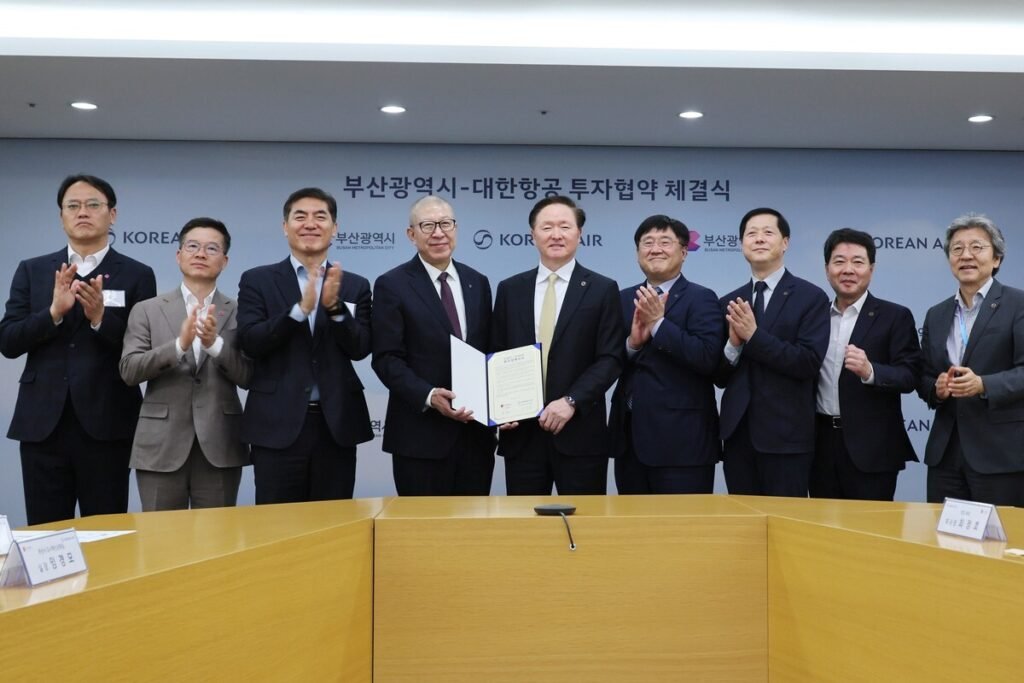
The MOU was signed on March 30, 2026 during an official ceremony attended by senior representatives from both sides. The Busan Metropolitan Government was represented by Mayor Park Heong-joon, while Korean Air was represented by Vice Chairman Woo Kee-hong, according to local government and media reports. Both sides emphasised the project’s potential to position Busan as a competitive hub for advanced aviation manufacturing and unmanned systems development in Northeast Asia.
Officials noted that the agreement currently remains a non-binding MOU, meaning it serves as a framework for cooperation rather than a finalized construction contract. Detailed investment execution plans, regulatory approvals, land development procedures, and project timelines are expected to be finalized in subsequent phases of implementation.
Korean Air has been steadily expanding its aerospace division in recent years, investing in areas such as unmanned aerial systems, aircraft structures manufacturing, and defence aviation technologies. The Busan project is widely viewed as part of this long-term strategic shift toward high-value aerospace engineering and future mobility solutions.
The initiative is also expected to strengthen South Korea’s domestic UAV industry and enhance its competitiveness in the global aerospace supply chain, particularly as demand rises for autonomous systems in both civilian and defence applications.