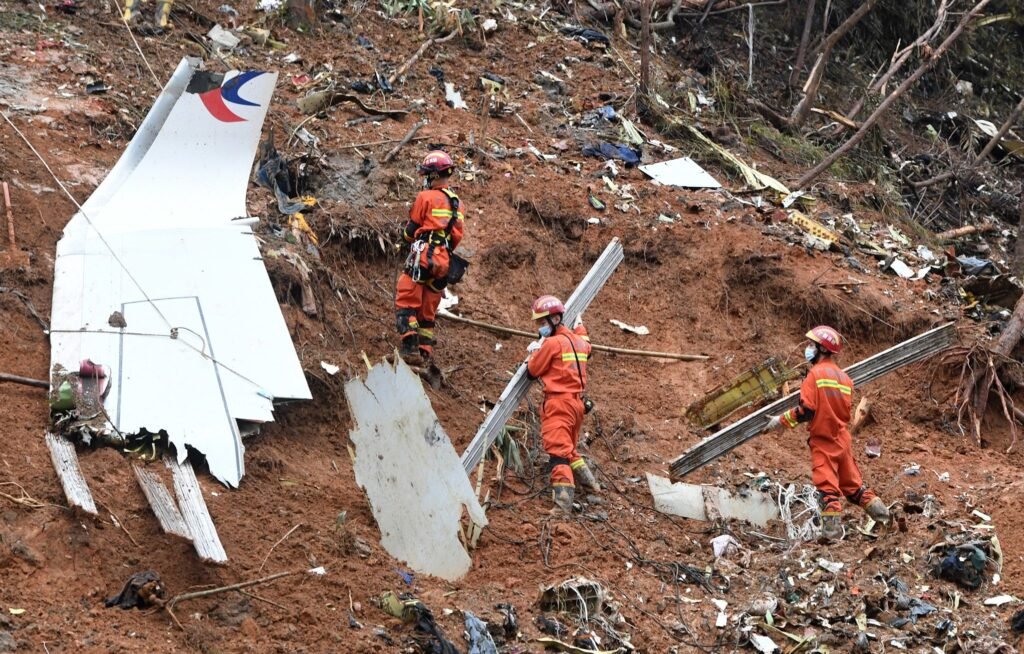
Wuzhou, China: The Boeing 737-800 aircraft, operating a routine domestic service from Kunming to Guangzhou on March 21, 2022, was carrying 132 people, including 123 passengers and nine crew members. About an hour into the flight, while cruising at altitude, the aircraft suddenly entered a steep and rapid descent before plunging almost vertically into a mountainous, forested area in Guangxi. All 132 occupants were killed, and no survivors were found, marking China’s deadliest air crash.
China’s aviation regulator, the Civil Aviation Administration of China, launched an investigation immediately after the crash, dispatching emergency teams to the remote impact site. Due to the aircraft’s U.S. manufacture, the investigation also involved international participants, including the National Transportation Safety Board, Boeing, and the Federal Aviation Administration, who provided technical assistance.
A major breakthrough in the early phase of the investigation came with the recovery of both flight recorders. The cockpit voice recorder was located on March 23, 2022, followed by the flight data recorder, which was retrieved from deep within the crash debris days later.
Both devices were severely damaged due to the high-impact crash and required detailed forensic analysis, including data extraction overseas. Preliminary examination of the data indicated that the aircraft descended rapidly from around 29,000 feet, briefly stabilized, and then entered a final near-vertical dive. Air traffic controllers attempted to contact the pilots multiple times during the descent, but no distress call was made and no response was received from the cockpit.
In its preliminary report released in April 2022, the CAAC ruled out several common causes of aviation accidents. Investigators found no evidence of mechanical failure, adverse weather conditions, or dangerous cargo.
The aircraft was deemed airworthy and properly maintained, while the flight crew were found to be qualified, adequately rested, and medically fit. Follow-up updates issued in 2023 and 2024 reiterated these findings, stating that no abnormalities had been identified in the aircraft systems, flight operations, or air traffic control procedures.
Despite these findings, investigators have not been able to establish a definitive cause of the crash. A report published in 2022 by The Wall Street Journal, citing U.S. officials familiar with black box analysis, suggested that the aircraft may have been intentionally put into a dive from the cockpit.
However, Chinese authorities have not confirmed this interpretation and have cautioned against speculation, warning that unverified conclusions could mislead the public and interfere with the investigation.
Under international aviation standards set by the International Civil Aviation Organization, accident investigations are expected to produce an initial report within 30 days and a final report within one year wherever possible. In the case of MU5735, a preliminary report was issued within the required timeframe, but no final report has been released even after four years. The last official update from Chinese authorities came in March 2024, with no substantive developments disclosed since then.
The prolonged delay has drawn attention from global aviation bodies, including the International Air Transport Association, which has emphasized the importance of timely accident reports in improving aviation safety worldwide.
As of 2026, the investigation into Flight MU5735 remains officially ongoing. No confirmed cause has been identified, and no comprehensive final report has been made public.