Louisville, United States: Federal investigators have identified a crucial aircraft component with a known history of failures as a key focus in the ongoing probe into the UPS Cargo Flight 2976 crash that killed 15 people in November 2025.
The National Transportation Safety Board (NTSB) disclosed this week that the metal housing around a spherical bearing assembly part of the structure securing the left engine to the wing on the McDonnell Douglas MD-11F freighter exhibited signs of metal fatigue and cracking before breaking during takeoff. The failure of this part is believed to have precipitated the catastrophic sequence that ended in the fatal crash.

Flight 2976 departed from Louisville Muhammad Ali International Airport on Nov. 4, 2025, bound for Honolulu, Hawaii. Seconds after beginning its takeoff roll on Runway 17R, the aircraft’s left engine and its pylon separated from the wing. Surveillance footage reviewed by investigators shows the engine detaching and vaulting up and over the fuselage as the freighter lifted briefly into the air before descending into an industrial area just beyond the airport perimeter. The crash claimed the lives of all three crewmembers aboard and 12 people on the ground, and left numerous others injured.
The NTSB has confirmed the component at the center of the investigation, the metal housing around the spherical bearing connecting the engine pylon to the wing had a documented history of four prior failures on other MD-11 aircraft, according to a Boeing service advisory issued in 2011. At that time, Boeing, which later acquired McDonnell Douglas, determined the issue did not constitute a “safety-of-flight condition” and recommended visual inspections rather than a mandatory redesign.
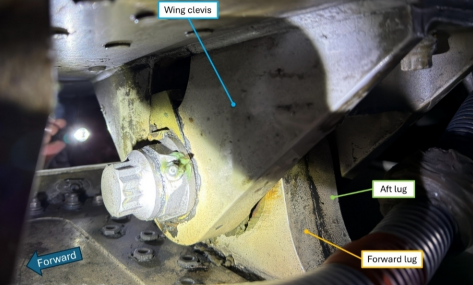
The advisory also suggested a newer version of the part that eliminated the design feature where cracks can initiate, but did not compel operators to adopt it. Investigators are now reviewing how that advisory was incorporated into routine maintenance and whether inspectors and operators, including UPS, followed the recommendations.
Preliminary NTSB findings show that detailed inspections of the engine mount parts were last performed in October 2021, and the aircraft was not scheduled for another detailed check until several thousand more flight cycles were completed. Critics have questioned whether the existing inspection intervals were sufficient to detect the developing fatigue cracks.
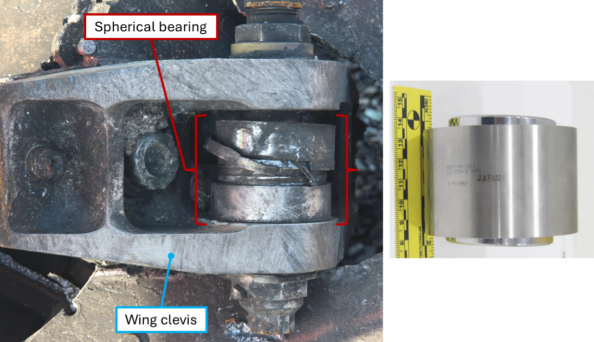
The MD-11 involved was 34 years old, an age at which structural components on aircraft are more susceptible to wear and fatigue. All MD-11 and related DC-10 models remain grounded across U.S. cargo fleets pending enhanced inspections and corrective actions.
The NTSB has recovered both the flight data recorder (FDR) and the cockpit voice recorder (CVR). Analysis of the cockpit recordings and detailed metallurgical examinations of the fractured parts continue as investigators work toward a final probable cause determination. The board has not yet released a complete conclusion on the chain of failures that led to the engine separation.
UPS has reiterated its cooperation with the ongoing investigation and expressed condolences to victims’ families. Boeing has acknowledged the probe but has not issued further comment beyond confirming the existence of the earlier service advisory.