Alberton, South Africa: The South African Civil Aviation Authority has concluded that fuel exhaustion caused the crash of a training aircraft into a school building in Gauteng last year.
The accident occurred on 26 October 2025 when a Tecnam P92 Echo, registration ZU-BJX of Accolade Flying Wings Academy operating under Part 141 training regulations suffered an engine stoppage while returning to Rand Aerodrome. The aircraft was being flown by a 30-year-old commercial pilot acting as flight instructor, accompanied by a student pilot, on a cross-country navigational training exercise.
According to the Accident and Incident Investigations Division (AIID) report the flight departed Rand at approximately 0800 UTC after filing a flight plan with Johannesburg briefing. The planned routing included stops at Vereeniging Aerodrome, Potchefstroom Aerodrome, Rustenburg Aerodrome and Carletonville Aerodrome before returning to Rand.
Investigators said the aircraft had been refuelled to 70 litres of Avgas 100LL prior to departure. The crew calculated this would provide approximately three and a half hours of endurance. The Tecnam P92 Echo is equipped with two wing tanks with a total usable fuel capacity of 66.8 litres, with 3.2 litres considered unusable.
At approximately 6,500 feet above ground level, while overhead the Alberton residential area and after being cleared to join the circuit for Runway 35 at Rand, the engine stopped. The instructor took control and attempted several restarts, but the engine did not respond.
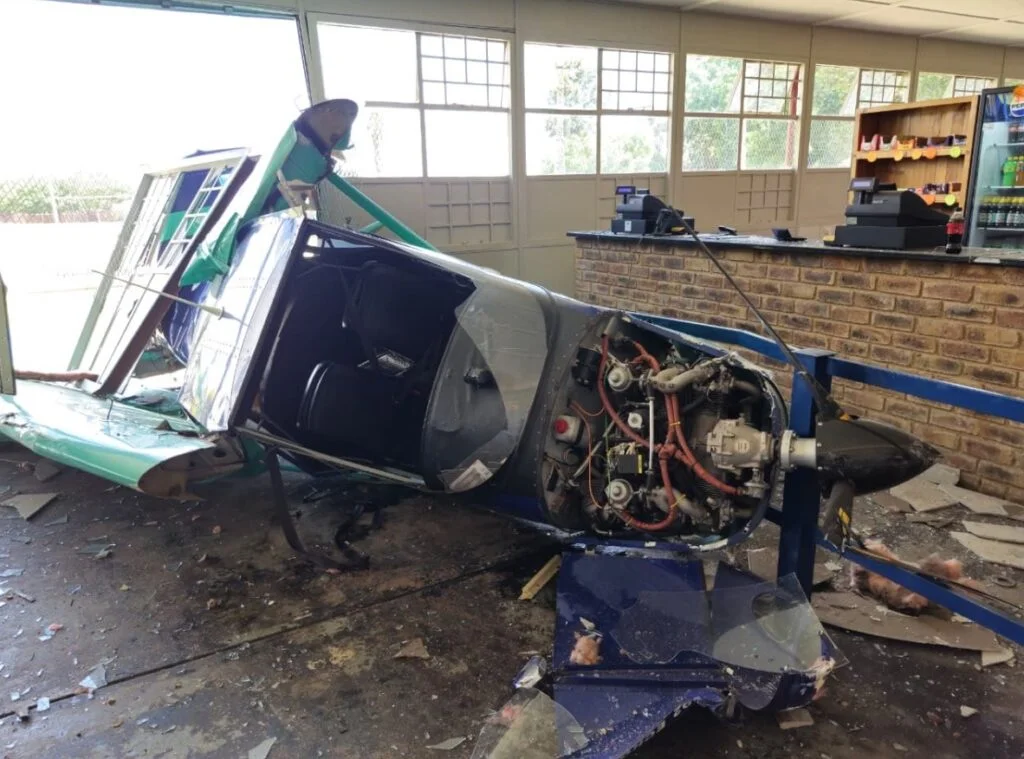
He then identified a sports field at Hoërskool Alberton as a forced landing site. The aircraft touched down in the middle of the field but was unable to stop within the available distance of approximately 120 metres. The P92 Echo requires roughly 300 metres for landing rollout. The aircraft overran the field and impacted the school cafeteria building, coming to rest halfway inside the structure.
Neither occupant was injured, and no injuries were reported on the ground. However, the aircraft was destroyed and the school building sustained structural damage.
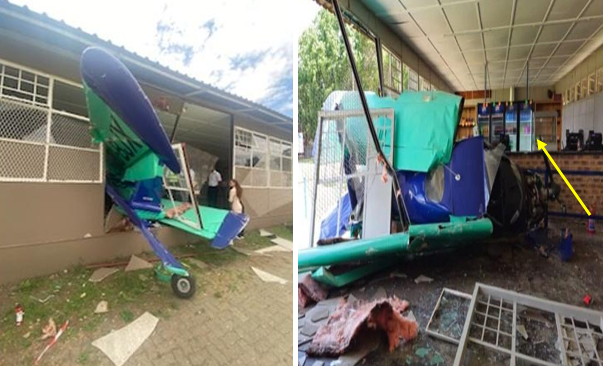
The AIID’s post-accident examination found no mechanical defects. Investigators reported no fuel leakage at the site. Both fuel tanks were dry, the gascolator contained no fuel, and only approximately three litres of unusable fuel were drained from the system. The engine was later test-run and operated normally, meeting all maintenance manual parameters.
Based on fuel burn calculations, investigators determined that the aircraft consumed an estimated 59.5 litres during the flight, including fuel used during a touch-and-go landing. Approximately 4.5 litres could not be reconciled but may have been consumed during ground running prior to departure. The report concluded that the engine stopped due to fuel exhaustion.
The investigation further found that the pilot-in-command did not comply with Part 91.07.12 of the Civil Aviation Regulations (CAR) 2011, which requires pilots to ensure sufficient usable fuel is carried to complete a flight safely and to maintain required reserves.
In its findings, the authority cited fuel mismanagement and inadequate pre-flight planning as contributing factors. The report emphasised the importance of cross-checking fuel quantity using at least two independent methods and adopting conservative planning margins.
The limited investigation was conducted in accordance with Regulation 12.03.1 of the CAR 2011 and ICAO Annex 13. The AIID stated that the purpose of the report is to promote aviation safety and reduce the risk of similar occurrences, not to apportion blame or liability.
Recent Flight Training School Incidents in South Africa:
19 February, 2026: A light-aircraft training flight crashed killing both the flight instructor and the student pilot on board. The aircraft was operated by Excellentia Airline Academy, and the two occupants aged 28 and 24 were pronounced dead at the scene after the plane went down shortly before 6 p.m. Rescue teams, including Aeronautical Rescue Coordination Centre units and police, responded immediately. A full investigation by the South African Civil Aviation Authority is underway to determine the cause of the crash
04 February, 2026: A Piper Cherokee 140 (ZS‑XPR) training aircraft departing from Grand Central Airport crashed near Carstenhof Hospital in Glen Austin, Midrand during a training flight. Both the flight instructor and the student pilot on board suffered serious injuries and were rushed to hospital, and the aircraft was substantially damaged.
26 October, 2025: During a morning training flight, a light aircraft suffered engine failure and attempted an emergency landing in a school field, veering into a tuckshop of Hoërskool Alberton in the City of Ekurhuleni, Gauteng. Both the instructor and student escaped unharmed.
15 October, 2025: Two training aircraft from Aviation Junction Flying School in Secunda, Mpumalanga, took off on routine flights over the KwaZulu‑Natal Midlands. Both aircraft Sling 2 types encountered poor weather with heavy mist and low visibility, lost contact with radio and radar, and later crashed in separate locations near Nottingham Road and Pietermaritzburg. The 26‑year‑old Indian trainee pilot Mayank Prajapati and 35‑year‑old South African pilot Martin Brown were killed in the twin crashes, prompting intensified calls for safety reforms in South Africa’s flight‑training sector.
13 October, 2025: A tragic training accident claimed the life of 20‑year‑old Piyush Pushp, a student from Ranchi, India, while he was undergoing solo flight training at the Vulcan Aviation Institute in Johannesburg. During the solo sortie, the light training aircraft reportedly suffered a sudden technical malfunction mid‑air, leading to a crash shortly after take‑off.
10 June, 2025: The aircraft, operated by Eagle Air Flight School, was part of a trio of light planes flying in a loose formation from an airstrip near Durban toward Pretoria. The group encountered severe weather, including low visibility and turbulence, which led them to divert from their planned refuelling stop in Ladysmith toward Greytown & crashed. Airport emergency responders arrived but all three pilots were killed.