London, United Kingdom: A final Royal Navy Service Inquiry has found that a chain of mechanical, warning-system, crew-response and training-related failures led to the fatal ditching of a Merlin HC4 helicopter in the English Channel in September 2024, killing Royal Navy Lieutenant Rhodri Leyshon. The Ministry of Defence published the final 152-page report on 11 September 2026. Investigators found that a failed diaphragm in the No. 2 engine caused an overspeed condition, but the crew incorrectly identified the affected engines and switched off the two serviceable engines, after which the malfunctioning engine also shut down. The inquiry made 44 recommendations, all of which the Royal Navy said it had accepted.
The accident occurred on 4 September 2024 during night deck-landing training involving HMS Queen Elizabeth, about 25 nautical miles south of Lyme Regis, Dorset. The aircraft was Merlin HC4 ZJ135, operated by 846 Naval Air Squadron of the Commando Helicopter Force. Lieutenant Leyshon, 31, was flying from the right-hand seat, with the aircraft commander in the left-hand seat and an aircrewman in the rear. The crew had been conducting deck-landing training as part of the carrier’s aviation currency activities.
According to the inquiry, at about 20:46, while ZJ135 was at approximately 125 feet and 65 knots on an approach to HMS Queen Elizabeth, a rubber diaphragm inside the No. 2 engine’s high-pressure fuel-pump assembly ruptured. Fuel flow increased sharply, causing the engine to overspeed and producing a major torque imbalance. The aircraft’s management system responded by reducing the power of the No. 1 and No. 3 engines to protect rotor speed.
The crew received a master warning, an engine-failure audio alert and a red engine-failure indication. However, the inquiry found that the warning system did not clearly identify which engine was malfunctioning. Seeing very low torque indications from engines No. 1 and No. 3, the crew concluded that those two engines had failed. Lieutenant Leyshon stated three times within about 21 seconds that the helicopter was operating on one engine, but the assessment was not formally challenged by another crew member.
The aircraft commander declared a MAYDAY and the crew turned towards the carrier, intending to conduct a running landing back on HMS Queen Elizabeth. Investigators found that the helicopter remained controllable and that rotor speed remained high and stable, indications that were inconsistent with the crew’s assessment of a double-engine failure. The inquiry said the crew members were working largely in relative isolation rather than collectively processing the available engine information.
The situation became critical when the No. 1 and No. 3 engine switches were moved from FLIGHT to OFF. The inquiry found that this was done without the second-crew-member confirmation required by Merlin procedures for flight-critical switches. With the two serviceable engines shut down, the No. 2 engine continued to accelerate until its overspeed protection system reached its limit and automatically cut its fuel supply. The helicopter was then left without power from any of its three engines.
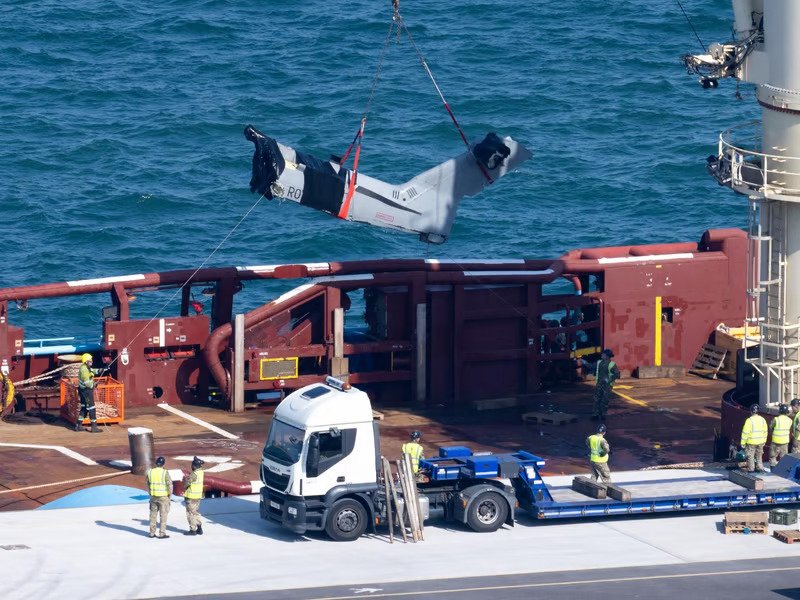
ZJ135 struck the sea at approximately 62 knots, with a descent rate of about 1,984 feet per minute and a peak deceleration of 10.6G. The main rotor struck the water, the tail section separated and the fuselage overturned. The aircraft commander and aircrewman escaped, but Lieutenant Leyshon suffered serious injuries and was unable to get out of the wreckage. He was recovered from the sea almost two hours after the ditching and was later pronounced dead at hospital.
The inquiry traced the original mechanical failure to the diaphragm in the No. 2 engine’s fuel-pump assembly. Investigators found that the component had been weakened by a manufacturing/maintenance process introduced by Safran Helicopter Engines in 2020. The process subjected the fuel system to repeated pressure and depressurisation cycles. The inquiry found that the approval process for the change had not properly assessed its effect on the diaphragm.
Investigators identified 226 diaphragms as potentially having undergone the process. Of 117 examined after the accident, 10 showed damage capable of leading to a split. One damaged diaphragm had previously been installed on another Merlin, ZJ998, which experienced an apparently similar engine runaway event at RNAS Yeovilton in October 2023. The inquiry said the earlier event had been assessed as a low-risk occurrence because the helicopter had overspeed protection and three-engine redundancy.
The inquiry also examined the crew’s recent flying experience. Both pilots were qualified, but neither was current for deck landings at the time of the sortie. The aircraft commander was also not current for night-vision-device deck landings. Investigators found that he had failed to meet the 15-hours-per-month competency target in four of the preceding six months and had flown only once during the previous 40 days. The panel concluded that collective skill fade very likely undermined the crew’s ability to manage the complex emergency.
The report also identified shortcomings in supervision and pre-flight preparation. The temporary Deputy Flight Safety Officer was simultaneously acting as the sortie’s Authorising Officer. The sortie was regarded as routine, although night deck landings in very low light were classified as a higher-technical-merit activity. The briefing discussed the low light but did not adequately address its implications or the crew’s competency and recent flying experience.
Survivability was another major part of the inquiry. Investigators found that Lieutenant Leyshon’s energy-absorbing seat had been set for a weight below his actual mass with clothing and survival equipment, reducing the protection available from the seat. The report also found that only two of the helicopter’s four aft flotation bags worked as intended, while the forward flotation bags did not deploy.
The inquiry further identified difficulties during the rescue. The second Merlin operating that night was not fitted with a rescue hoist, while a sea boat from HMS Queen Elizabeth was delayed by a davit sensor problem. Another boat launched without its search lamp and night-vision equipment. The two surviving crew members were found relatively quickly, while Lieutenant Leyshon was located later by a Coastguard helicopter. He was recovered at about 22:52, according to the inquiry’s timeline.
The report produced 44 recommendations covering engine maintenance and approval processes, the Merlin cockpit warning system, aircrew training, emergency procedures, aircraft survivability, rescue equipment and search-and-rescue arrangements. Among the recommendations is a review of the Merlin cockpit warning system to determine whether engine malfunction information can be presented more clearly, along with an audit of Safran’s UK maintenance and design-approval processes and revised training for power-related malfunctions.
The Ministry of Defence confirmed that the published document is the final Service Inquiry report, intended to inform both the military chain of command and the public about the findings and recommendations.
The Royal Navy said: “Our thoughts remain with Lt Rhodri Leyshon’s family, friends, and colleagues at this very difficult time. He served with great professionalism and is much missed by those who knew and worked alongside him.” The Navy said all 44 recommendations had been accepted in full, with some already implemented.
Lieutenant Leyshon had joined the Wales University Royal Naval Unit before entering the Royal Navy and was commissioned in 2014. He earned his Commando Helicopter Force wings in 2018 and served with 845 Naval Air Squadron, including deployments to the Caribbean, the United States and Norway, before spending his final 18 months with 846 Naval Air Squadron training new Commando Helicopter Force aviators. The Royal Navy described him as one of the force’s “most trusted and highly capable aircraft captains and instructors.”
His family said the inquiry “tells a harrowing story of compounded errors, with numerous mistakes which resulted in this deadly accident.” His mother, Mary, said: “I know that he would have done everything within his power to get the helicopter back. It is therefore heartbreaking to see that he was put into this situation.”
The final inquiry therefore establishes that the fatal accident was not attributed to a single failure. The initial engine component failure triggered an emergency that the report found was survivable, but the subsequent misidentification of the engine problem, shutdown of two serviceable engines and automatic shutdown of the remaining engine resulted in total power loss at low altitude over the sea. The report then identified additional training, coordination, supervision and survivability issues that compounded the consequences of the accident.