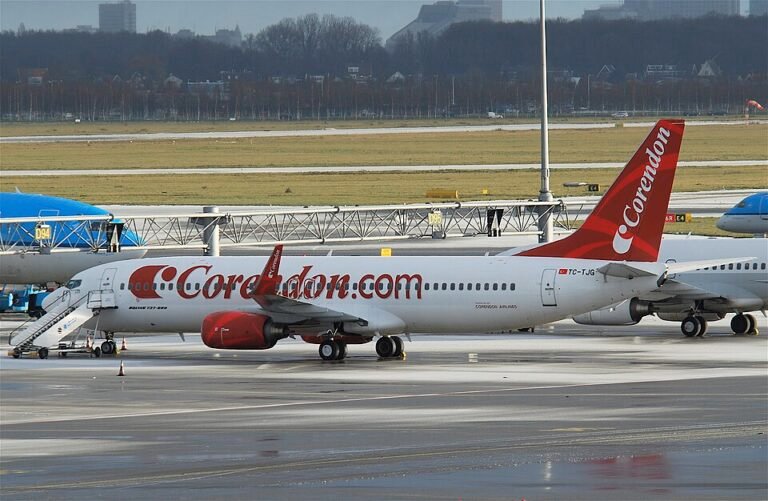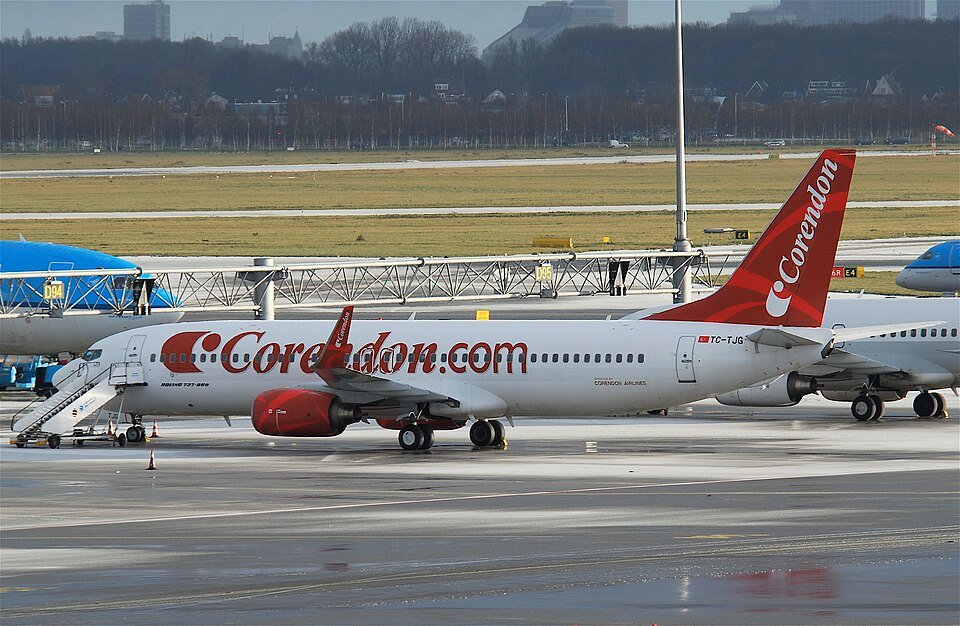
Nuremberg, Germany: Nuremberg Airport temporarily suspended all flight operations on Tuesday after a Corendon Airlines Boeing 737-800 operating flight XR456 from Corfu, Greece, to Nuremberg transmitted the international hijacking code 7500 while en route. The Malta-registered aircraft, 9H-CXD, was carrying 178 passengers and crew, according to Corendon, and ultimately landed safely after German and other European authorities responded to the alert.
The alert was triggered while the aircraft was in Croatian airspace. Corendon said the emergency code was transmitted “due to a brief malfunction in the radio communication system.” The situation became more serious when air traffic controllers could no longer establish radio contact with the cockpit. German police said, “From the cockpit, the code ‘7500’ (hijacking case) was transmitted, and furthermore, the pilot could no longer be reached by radio. For safety reasons, various alarm scrambles were then triggered.”
Code 7500 is the transponder signal used to indicate unlawful interference, including a possible hijacking. Because the code was accompanied by the loss of radio contact, authorities had to initially treat the situation as a genuine security threat rather than a technical problem. Police spokesman Michael Petzold said authorities had “received a code directly from the cockpit that suggested a hijacking” and, because neither the cockpit nor the tower could establish contact, “we had to assume the worst, that it might indeed be a hijacking.”
The alert triggered a coordinated air-policing response across Europe. A Croatian Air Force Rafale intercepted the Boeing over Croatia at about 11:02 local time after the Combined Air Operations Centre in Torrejón classified the aircraft as a potential threat. Croatia’s Defence Ministry said the Rafale visually identified the aircraft and established radio contact before escorting it out of Croatian airspace. The Boeing entered Slovenian airspace at about 11:20. Slovenian authorities monitored the aircraft and notified Hungary and Italy, while Austrian aircraft subsequently took over monitoring before the aircraft continued towards Germany.
Germany then scrambled two Eurofighter fighter jets from Neuburg Air Base. The German Air Force said such aircraft are used to identify, monitor or escort civilian aircraft when radio communication is lost. The two Eurofighters accompanied the Corendon aircraft during the final stage of its flight towards Nuremberg.
Police had already sealed parts of Nuremberg Airport and deployed a large security operation, including special police forces, before the aircraft arrived. The Boeing landed safely at Nuremberg at about 12:16 p.m. local time, roughly one minute after its scheduled 12:15 p.m. arrival, and was moved to a remote area for security checks. The airport remained closed while authorities examined the aircraft and passengers remained on board.
About an hour after landing, authorities determined that there was no threat. Police said, “The on-site checks have shown that there is no danger.” Passengers were allowed to leave the aircraft from about 1:25 p.m., while Nuremberg Airport subsequently resumed flight operations at around the same time, with some reports placing the full reopening at approximately 1:30 p.m. The shutdown therefore lasted for roughly an hour after the aircraft landed, although the wider operational disruption continued through the response and security checks.
The airport disruption affected other flights. Six flights were delayed and two inbound flights were diverted to other airports as a precaution. Separate reporting said the diverted arrivals went to Frankfurt, Memmingen, Stuttgart and Munich during the wider disruption, although the airport’s own earlier statement about a separate overnight incident recorded two diversions to Cologne and Prague.
Corendon later clarified that there had been no actual emergency or hijacking. The airline said, “no emergency situation occurred and that at no point were the passengers, flight crew or aircraft in any danger.” It added that the situation was immediately monitored, investigations were initiated and the necessary preparations were made before the aircraft landed safely at Nuremberg.
The exact mechanism that caused the aircraft to transmit 7500 is still being investigated. Croatian Defence Minister Ivan Anušić said the investigation found a fault within the radio communication system and that the backup system was also affected, describing the combination as highly unusual. He said the hijacking code was probably activated incorrectly but stressed that the investigation had not yet established a final cause. This distinction is important: the radio malfunction has been identified as the reason for the communication problem, but the precise reason code 7500 was transmitted is not yet conclusively established.
The incident followed a separate security disruption at Nuremberg Airport earlier on Tuesday. Three pilots independently reported seeing a possible unidentified object, suspected to be a drone, between about 2 a.m. and 4 a.m. Police launched a search with airport authorities, air traffic control and a police helicopter, but no drone was found. Nuremberg Airport said the earlier incident caused delays to six flights, involving two arrivals and four departures, while two incoming aircraft initially diverted to Cologne and Prague before continuing to Nuremberg. Authorities have not established any connection between that drone report and the later Corendon flight alert.
The false hijack alert also came amid heightened European aviation-security concerns following a series of unexplained drone incidents. Germany has recently accused Russia of involvement in an attempted attack at Leipzig/Halle Airport involving an explosives-laden drone. Moscow has denied the allegation. There is no evidence linking Russia to the Corendon incident, and the Nuremberg alert has been attributed by the airline to the aircraft’s radio communication malfunction.
The Boeing 737-800 continued its planned Corfu-Nuremberg route and completed the flight without injury or damage. German authorities have closed the immediate security response, while investigations into the communications-system malfunction and the erroneous 7500 transmission continue.