Muan, South Korea: Investigations into the 2024 crash of a Jeju Air passenger jet in South Korea have revealed that longstanding airport infrastructure failures likely played a critical role in turning a survivable emergency landing into the country’s deadliest aviation disaster.
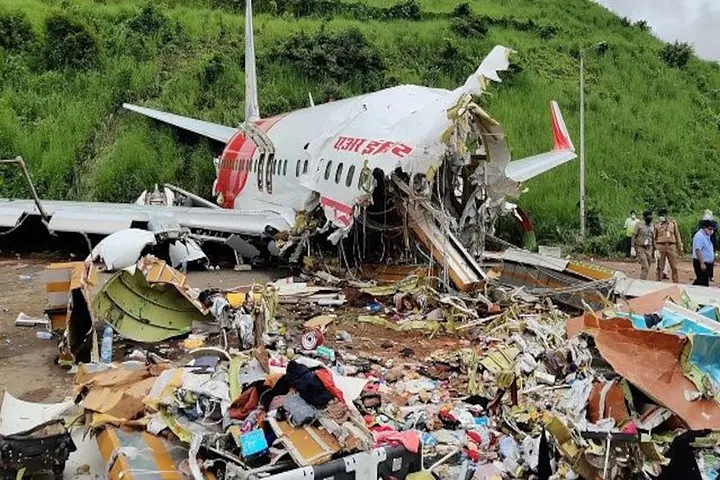
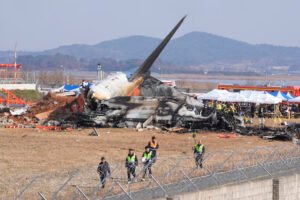
Jeju Air Flight 2216, a Boeing 737-800 operating from Bangkok to Muan, crashed at Muan International Airport on 29 December 2024, killing 179 of the 181 people on board. Only two cabin crew members survived the accident.
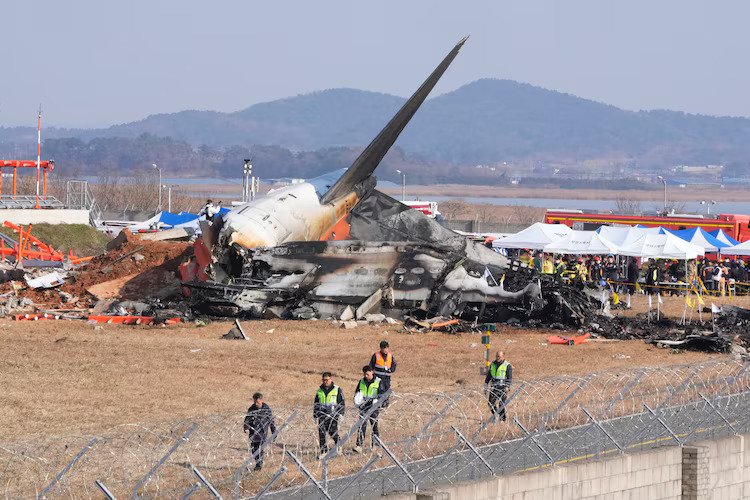
Recent findings cited in a government-commissioned report suggest that the aircraft’s occupants may have survived if the plane had not collided with a rigid concrete structure located at the end of the runway. The aircraft had belly-landed during an emergency approach and slid beyond the runway before striking a concrete mound supporting a navigation localiser antenna, triggering a catastrophic fire.
The concrete embankment that the aircraft struck has become a central focus of the investigation. Structural simulations conducted after the accident indicated that the impact with the runway overrun itself was survivable and that the aircraft could have come to a halt with far fewer casualties if the structure had been designed to break on impact.
Experts and lawmakers have argued that the structure did not meet international aviation safety standards, which typically require runway navigation equipment to be mounted on “frangible” supports designed to collapse during an aircraft collision.
South Korea’s transport authorities later acknowledged that the embankment contributed to the severity of the crash and announced plans to remove or redesign similar structures at several airports across the country.
Opposition lawmakers have also blamed decades of government negligence, noting that the problematic structure had existed since the late 1990s without corrective action despite safety concerns.
Investigators believe the emergency landing was triggered by a bird strike during the aircraft’s final approach. Remains of birds were found in both engines during the preliminary investigation.
Evidence later indicated that the pilots may have inadvertently shut down the less-damaged engine after the bird strike, potentially reducing available thrust during the emergency landing attempt.
The aircraft ultimately landed without deploying its landing gear and slid along the runway before colliding with the concrete structure at the runway’s end, leading to an explosion and fire that destroyed the aircraft.
The disaster has triggered widespread criticism of the investigation process and government oversight of aviation safety. Families of the victims have accused authorities of delaying reports and failing to provide transparency about the causes of the crash.
In response to mounting pressure, South Korea’s parliament approved an independent inquiry to examine the accident, including the role of bird strikes, possible mechanical failures, and the runway structure that the aircraft struck.
South Korea’s Transport Ministry has also acknowledged that a navigation structure at Muan International Airport failed to meet safety standards, contributing to the deadly crash of a Jeju Air Boeing 737-800 in December 2024. Authorities admitted the structure should have been designed to break on impact, in line with international safety guidelines, and its rigid construction likely worsened the disaster.
A final report from investigators is expected in 2026, as officials continue to analyze flight data, cockpit recordings and infrastructure safety standards.
The tragedy remains the deadliest aviation accident in South Korean history and has prompted a nationwide review of runway safety areas and navigation equipment installations at airports across the country.