News
Civil Aviation
Pilot Training
Flight School Analysis
Aviation Jobs
Training
Services
About Us
Contact Us

AAIA Issues Initial Findings On Deadly Emirates 747 Runway Excursion In Hong Kong

Picture of Aviation Today News Desk

Aviation Today News Desk

Hong Kong, China: Hong Kong’s Air Accident Investigation Authority (AAIA) has released its preliminary findings into last month’s fatal runway excursion involving an Emirates SkyCargo Boeing 747-481BDSF, operated by ACT Airlines, which veered off Runway 07L and plunged into the sea at Hong Kong International Airport on 20 October. The newly published report provides the first detailed account of the aircraft’s final moments but stops short of assigning cause, in line with international aviation investigation standards. According to the AAIA, the freighter, operating as flight UAE9788 from Dubai World Central, completed a routine approach to Runway 07L shortly before 4 a.m. local time. The co-pilot had control of the aircraft during the landing, while the captain served as pilot monitoring. Weather conditions at the time were favourable, with visibility exceeding 10 kilometres and all navigation, communication, and surveillance systems functioning normally. No foreign object debris or airfield irregularities were reported prior to the landing. After touchdown, the aircraft began decelerating as expected until an “AUTOBRAKES” alert appeared on the Engine Indication and Crew Alerting System. In response, the captain immediately took control of the aircraft. Within moments, the 747 began an uncommanded drift to the left and subsequently departed the runway surface abeam Taxiway C6. The aircraft broke through the airfield perimeter fence and collided with a stationary airport security vehicle positioned on the service road outside the runway boundary. The force of the impact pushed the patrol vehicle into the sea, killing both security personnel inside. The 747 continued forward and came to rest partially submerged in the waters adjacent to the airport. Its tail section had separated during the violent sequence, and the aircraft was declared destroyed. All four crew members survived without injury. The preliminary report reveals critical details from the flight data recorder that may help explain the aircraft’s sudden loss of directional control. Investigators confirmed that the aircraft had been dispatched under the Minimum Equipment List with the No. 4 engine thrust reverser inoperative, a condition permissible under the operator’s regulatory framework. While engines No. 2 and 3 entered reverse thrust at approximately 95% N1 and engine No. 1 entered idle reverse, engine No. 4 behaved abnormally. Instead of providing reverse or idle thrust, the outboard right engine began accelerating rapidly in the forward direction, reaching 90% N1 shortly after touchdown. Within seconds, it surged even further, climbing to more than 106% N1 before the aircraft left the runway. The strong forward thrust from a single engine created a severe asymmetry during the critical landing roll. When investigators examined the flight deck after the accident, they found the thrust levers for engines 1, 2, and 3 fully closed with their reverse levers deployed to maximum. However, the No. 4 engine thrust lever was discovered in the full forward position, with its reverse lever also fully forward an unusual configuration that will be a major focus of the ongoing inquiry. The speed brake lever was in the flight detent position, and the autobrake selector had disarmed during the landing roll. The AAIA has already completed extensive work, including securing and analysing the wreckage, retrieving the flight recorders, reviewing air traffic control surveillance data, studying foreign object debris detection reports, and interviewing both the flight crew and duty controllers. The investigation is now concentrating on several areas: the technical behaviour of the aircraft’s systems and engines at the time of the accident, the source and implications of the forward movement of the No. 4 thrust lever, the performance of the aircraft’s braking and thrust-reversing systems, and potential human factors. Investigators are also reviewing maintenance records, operational procedures, and the airline’s safety management practices. The AAIA emphasised that the objective of the investigation is to prevent future accidents and not to apportion blame. A final report addressing the causes and contributing factors will be issued once the analysis is complete, a process that could take up to a year.
Image: Associated Press

Hong Kong, China: Hong Kong’s Air Accident Investigation Authority (AAIA) has released its preliminary findings into last month’s fatal runway excursion involving an Emirates SkyCargo Boeing 747-481BDSF, operated by ACT Airlines, which veered off Runway 07L and plunged into the sea at Hong Kong International Airport on 20 October. The newly published report provides the first detailed account of the aircraft’s final moments but stops short of assigning cause, in line with international aviation investigation standards.

According to the AAIA, the freighter, operating as flight UAE9788 from Dubai World Central, completed a routine approach to Runway 07L shortly before 4 a.m. local time. The co-pilot had control of the aircraft during the landing, while the captain served as pilot monitoring. Weather conditions at the time were favourable, with visibility exceeding 10 kilometres and all navigation, communication, and surveillance systems functioning normally. No foreign object debris or airfield irregularities were reported prior to the landing.

After touchdown, the aircraft began decelerating as expected until an “AUTOBRAKES” alert appeared on the Engine Indication and Crew Alerting System. In response, the captain immediately took control of the aircraft. Within moments, the 747 began an uncommanded drift to the left and subsequently departed the runway surface abeam Taxiway C6. The aircraft broke through the airfield perimeter fence and collided with a stationary airport security vehicle positioned on the service road outside the runway boundary. 

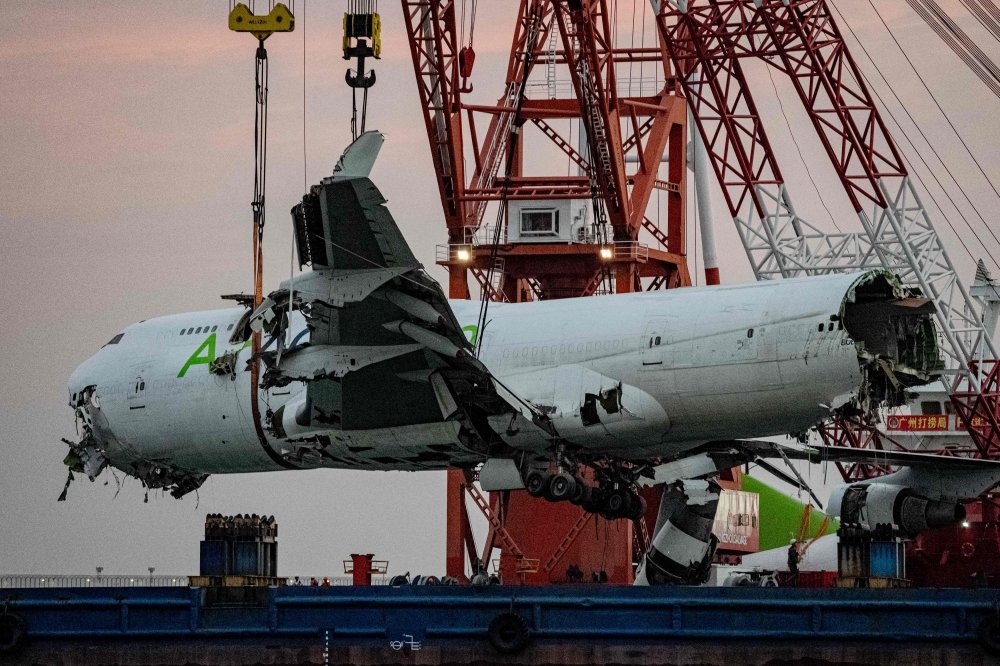
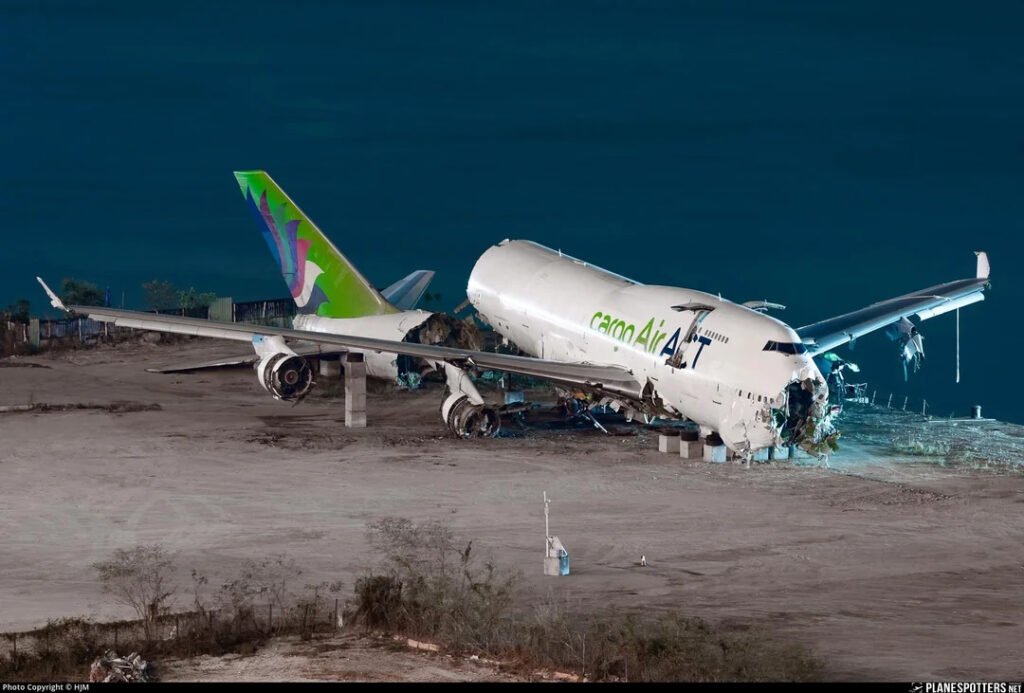
The force of the impact pushed the patrol vehicle into the sea, killing both security personnel inside. The 747 continued forward and came to rest partially submerged in the waters adjacent to the airport. Its tail section had separated during the violent sequence, and the aircraft was declared destroyed. All four crew members survived without injury.

The preliminary report reveals critical details from the flight data recorder that may help explain the aircraft’s sudden loss of directional control. Investigators confirmed that the aircraft had been dispatched under the Minimum Equipment List with the No. 4 engine thrust reverser inoperative, a condition permissible under the operator’s regulatory framework.

While engines No. 2 and 3 entered reverse thrust at approximately 95% N1 and engine No. 1 entered idle reverse, engine No. 4 behaved abnormally. Instead of providing reverse or idle thrust, the outboard right engine began accelerating rapidly in the forward direction, reaching 90% N1 shortly after touchdown. Within seconds, it surged even further, climbing to more than 106% N1 before the aircraft left the runway. The strong forward thrust from a single engine created a severe asymmetry during the critical landing roll.
Hong Kong, China: Hong Kong’s Air Accident Investigation Authority (AAIA) has released its preliminary findings into last month’s fatal runway excursion involving an Emirates SkyCargo Boeing 747-481BDSF, operated by ACT Airlines, which veered off Runway 07L and plunged into the sea at Hong Kong International Airport on 20 October. The newly published report provides the first detailed account of the aircraft’s final moments but stops short of assigning cause, in line with international aviation investigation standards.
According to the AAIA, the freighter, operating as flight UAE9788 from Dubai World Central, completed a routine approach to Runway 07L shortly before 4 a.m. local time. The co-pilot had control of the aircraft during the landing, while the captain served as pilot monitoring. Weather conditions at the time were favourable, with visibility exceeding 10 kilometres and all navigation, communication, and surveillance systems functioning normally. No foreign object debris or airfield irregularities were reported prior to the landing.
After touchdown, the aircraft began decelerating as expected until an “AUTOBRAKES” alert appeared on the Engine Indication and Crew Alerting System. In response, the captain immediately took control of the aircraft. Within moments, the 747 began an uncommanded drift to the left and subsequently departed the runway surface abeam Taxiway C6. The aircraft broke through the airfield perimeter fence and collided with a stationary airport security vehicle positioned on the service road outside the runway boundary. 
The force of the impact pushed the patrol vehicle into the sea, killing both security personnel inside. The 747 continued forward and came to rest partially submerged in the waters adjacent to the airport. Its tail section had separated during the violent sequence, and the aircraft was declared destroyed. All four crew members survived without injury.
The preliminary report reveals critical details from the flight data recorder that may help explain the aircraft’s sudden loss of directional control. Investigators confirmed that the aircraft had been dispatched under the Minimum Equipment List with the No. 4 engine thrust reverser inoperative, a condition permissible under the operator’s regulatory framework. While engines No. 2 and 3 entered reverse thrust at approximately 95% N1 and engine No. 1 entered idle reverse, engine No. 4 behaved abnormally. Instead of providing reverse or idle thrust, the outboard right engine began accelerating rapidly in the forward direction, reaching 90% N1 shortly after touchdown. Within seconds, it surged even further, climbing to more than 106% N1 before the aircraft left the runway. The strong forward thrust from a single engine created a severe asymmetry during the critical landing roll.
When investigators examined the flight deck after the accident, they found the thrust levers for engines 1, 2, and 3 fully closed with their reverse levers deployed to maximum. However, the No. 4 engine thrust lever was discovered in the full forward position, with its reverse lever also fully forward an unusual configuration that will be a major focus of the ongoing inquiry. The speed brake lever was in the flight detent position, and the autobrake selector had disarmed during the landing roll.
The AAIA has already completed extensive work, including securing and analysing the wreckage, retrieving the flight recorders, reviewing air traffic control surveillance data, studying foreign object debris detection reports, and interviewing both the flight crew and duty controllers. The investigation is now concentrating on several areas: the technical behaviour of the aircraft’s systems and engines at the time of the accident, the source and implications of the forward movement of the No. 4 thrust lever, the performance of the aircraft’s braking and thrust-reversing systems, and potential human factors. Investigators are also reviewing maintenance records, operational procedures, and the airline’s safety management practices.
The AAIA emphasised that the objective of the investigation is to prevent future accidents and not to apportion blame. A final report addressing the causes and contributing factors will be issued once the analysis is complete, a process that could take up to a year.
Image: Associated Press

When investigators examined the flight deck after the accident, they found the thrust levers for engines 1, 2, and 3 fully closed with their reverse levers deployed to maximum. However, the No. 4 engine thrust lever was discovered in the full forward position, with its reverse lever also fully forward an unusual configuration that will be a major focus of the ongoing inquiry. The speed brake lever was in the flight detent position, and the autobrake selector had disarmed during the landing roll.

The AAIA has already completed extensive work, including securing and analysing the wreckage, retrieving the flight recorders, reviewing air traffic control surveillance data, studying foreign object debris detection reports, and interviewing both the flight crew and duty controllers. The investigation is now concentrating on several areas: the technical behaviour of the aircraft’s systems and engines at the time of the accident, the source and implications of the forward movement of the No. 4 thrust lever, the performance of the aircraft’s braking and thrust-reversing systems, and potential human factors. Investigators are also reviewing maintenance records, operational procedures, and the airline’s safety management practices.

The AAIA emphasised that the objective of the investigation is to prevent future accidents and not to apportion blame. A final report addressing the causes and contributing factors will be issued once the analysis is complete, a process that could take up to a year.

Leave a Comment

Subscribe to our Newsletter

Recent News