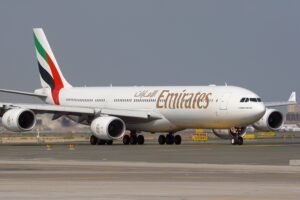
London, United Kingdom: An Emirates Airbus A380 operating on the busy London–Dubai route made a precautionary return to London Heathrow Airport (LHR) on the afternoon of December 31, 2025, after the flight crew detected a technical issue with the aircraft’s landing gear system shortly after take‑off.
Emirates Flight EK002, scheduled to depart Heathrow for Dubai International Airport (DXB), lifted off from Runway 27L at approximately 14:30 GMT but was forced into a holding pattern above southeast London after a sensor indicated a malfunction in the landing gear doors, which did not fully close as designed.
As the long‑haul aircraft such as the A380 are heavily fuelled at departure, the aircraft was above its maximum landing weight. Aviation protocols require weight reduction before a safe return can be attempted. Rather than immediately landing overweight, the flight crew elected to circle at around 10,000 ft, allowing fuel to burn off over a period of approximately 90 minutes before approaching Heathrow for landing.
Observers on the ground reported seeing the superjumbo in a holding pattern over areas such as Orpington and Kent, drawing attention during one of the year’s busiest travel periods.
Once within safe landing weight limits, the A380 touched down at London Heathrow’s Runway 27R at 16:28 GMT without incident. Emergency services were positioned as a standard precaution, though there were no injuries and normal evacuation procedures were followed.
In a statement, Emirates confirmed that “Flight EK002 departed London Heathrow for Dubai, but returned shortly after take‑off due to a technical fault.” The airline said passengers and crew were safely disembarked and that those affected would be rebooked on subsequent services. Emirates apologised for the disruption and emphasised that the safety of passengers and crew remains its highest priority.
The aircraft involved is an Airbus A380‑800 with the registration A6‑EUF, part of Emirates’ flagship fleet and one of the largest commercial passenger aircraft in service. The A380 is widely used on high‑demand intercontinental routes, carrying up to 500 passengers per flight.
Flight tracking platforms indicated the aircraft remained airborne for over an hour as it managed fuel and prepared for a controlled return, a common procedure under such technical circumstances. Given the timing on New Year’s Eve, the incident caused travel disruption during a peak period for global air travel.