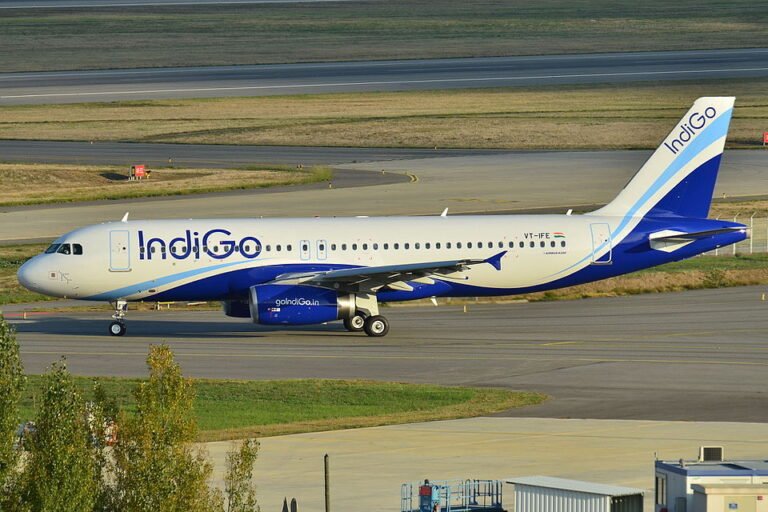
New Delhi, India: India’s largest airline, IndiGo, is battling a major operational crisis after its on-time performance (OTP) plunged sharply to just 19.7% on December 3, triggering widespread flight delays and 200 flight cancellations across key airports and disrupting travel plans for thousands of passengers nationwide.
As per IndiGo’s website, the airline operates well over 2,200 daily flights. Government data from Wednesday shows the airline’s on-time performance plunging to just 19.7%, a dramatic fall for a carrier long associated with punctuality. This implies that over 1,767 flights were delayed on that day alone.
The turbulence continued and on Wednesday airports in Delhi, Mumbai, Bengaluru, and Hyderabad collectively reported 200 flight cancellations by afternoon, in addition to hundreds of delayed departures and arrivals. The combined impact of delays and cancellations caused widespread disruption for domestic travellers, leaving passengers stranded, scrambling for alternatives, and highlighting the operational strain on the airline’s network.
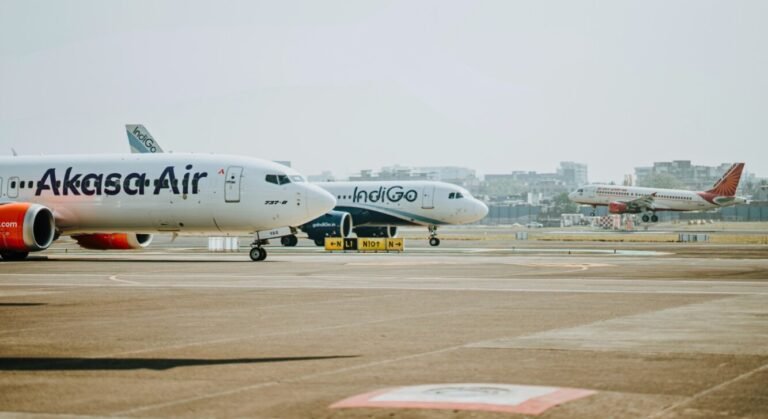
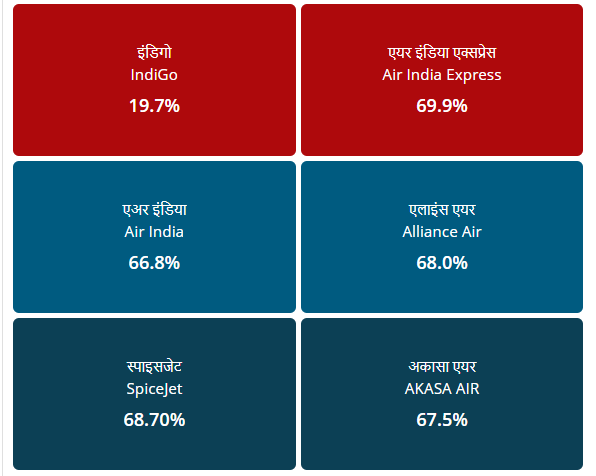
Official airport punctuality data on 3rd December shows a stark contrast between IndiGo and other domestic airlines:
- IndiGo: 19.7%
- Alliance Air: 68.0%
- Air India: 66.8%
- Akasa Air: 67.5%
- Air India Express: 69.9%
- SpiceJet: 68.70%
The disruptions are evident from the airline’s on-time performance (OTP) data; merely 19.7% on Wednesday, 35% of the IndiGo flights operated on time on Tuesday, while the figure was around 50% on Monday, as per the Ministry of Civil Aviation. IndiGo’s OTP typically used to be upwards of 80% prior to the second phase of the new FDTL norms taking effect in November.
Aviation industry officials attribute the crisis primarily to a severe shortage of pilots and cabin crew, which has worsened following the enforcement of revised Flight Duty Time Limitation (FDTL) norms. The updated rules require stricter rest periods, reduced night operations, and tighter rostering limits, significantly shrinking the pool of available crew for daily operations.
In addition to crew constraints, airport congestion, winter fog disruptions in north India, and internal operational realignments further compounded the stress on the airline’s network, according to aviation sources.
The disruption led to multiple delays stretching into several hours, and in many cases, short-notice cancellations, forcing passengers to look for alternative routes or remain stranded at airports. Social media platforms were flooded with complaints highlighting missed connections, lack of timely communication, and prolonged waiting at check-in counters and boarding gates.
Several travellers reported delays exceeding four to six hours, while others were informed of cancellations only after reaching the airport. Business travellers and holiday passengers alike were impacted during what is traditionally a high-demand travel period.
IndiGo acknowledged the disruption and attributed it to a combination of crew unavailability and operational challenges. In a public advisory, the airline urged passengers to check real-time flight status before heading to the airport and assured customers that rebooking or full refunds would be provided in accordance with company policy.
The airline also stated that it is working on “calibrated schedule adjustments” to stabilise operations and gradually restore normalcy across the network.
Meanwhile, the Directorate General of Civil Aviation (DGCA) said that it is looking into the IndiGo flight disruptions and has asked the airline to submit a report detailing the reasons for the situation.