Piedmont, Italy: A gyrocopter, an aircraft similar to a helicopter, crashed in northern Italy’s Piedmont region on August 26, 2026, after striking the cables of an Enel service cableway near the Campliccioli reservoir in Antrona Schieranco, killing both people on board. The accident occurred at about 11:10 a.m. local time at roughly 1,360-1,400 metres above sea level in the upper Antrona Valley, near the Italy-Switzerland border.
The two-seat gyrocopter was piloted by 62-year-old Alessandro Angelo Muscinelli, an engineer and resident of Premeno in the Verbano-Cusio-Ossola area. The passenger was 63-year-old Antonella Pagliarani, a Milan resident and the partner of Muscinelli’s brother. The pair had departed earlier that morning from the Megolo airfield in Pieve Vergonte, where Muscinelli kept the gyrocopter. Reports indicate that the aircraft was a Magni Gyro model, with aviation specialist reporting identifying it as a Magni M-16. Muscinelli was the aircraft’s owner and pilot.
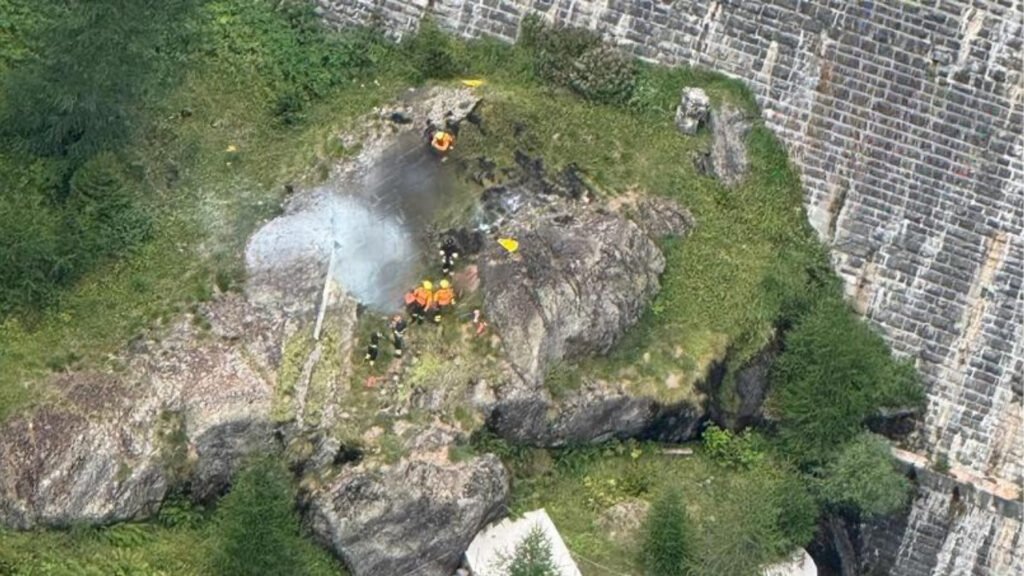
The gyrocopter was flying over the mountainous area around Lake Campliccioli, it had passed the lake and encountered a bank of clouds. The pilot is believed to have turned back because of reduced visibility. During the manoeuvre, the gyrocopter struck the cables of the Enel service cableway running toward Lake Camposecco. The impact caused the aircraft to catch fire in flight before it fell into the steep area downstream of the Campliccioli dam.
Investigators were also examining the possibility of solar glare contributing to the accident, with the pilot potentially facing the sun and losing visual contrast with the cables. A technical failure has not been ruled out. Investigators are also checking whether the cableway was properly marked on official aeronautical charts. These remain lines of inquiry rather than established causes.
The crash was witnessed from the area. Franco Borsotti, mayor of Antrona Schieranco, said he saw the gyrocopter from his home. “I saw the scene from the balcony of my house,” Borsotti said. “The aircraft was flying, then I saw a ball of fire.” He added that “there is no doubt that the aircraft caught fire when it touched the cables of the cableway leading to Camposecco.”
Borsotti also raised questions about the flight’s presence in the area, saying, “The cableway has been there for sixty years. It can not be marked on the charts.” He said the crash site falls within the Alta Valle Antrona Natural Park, adding that “normally, people do not fly there” and that it appeared the occupants “had not requested the permits.” The statements concern issues now being examined by investigators and do not establish that the flight was unauthorized.
Emergency teams from the Verbano-Cusio-Ossola provincial fire brigade reached the crash site, supported by the Drago helicopter from the Malpensa fire brigade flight unit. Carabinieri, the Guardia di Finanza and 118 emergency medical services, including an air ambulance from Borgosesia, also responded. Despite rescue efforts, neither occupant could be saved.
Muscinelli’s brother was in the Campliccioli area at the time and witnessed the crash. He was later assisted after going into shock. Local reports identified him as Pagliarani’s partner and Muscinelli’s brother, making him a direct witness to the final moments of the flight.
Muscinelli was an experienced recreational pilot who had developed an interest in flying about 15 years earlier through paragliding before moving to powered flight. Reports said that he had completed the required training, first obtaining certification for solo flight and later authorization to carry a passenger. He had also been preparing to undertake training to become an effective Civil Protection volunteer, with plans to make the aircraft available for regional monitoring and aerial-survey activities.
Gilberto Capparella, manager of the Megolo airfield and former president of Croce Alata, described Muscinelli as knowledgeable and passionate about the aircraft. “He was fresh from his studies for this type of aircraft, he had competence and passion,” Capparella said, adding that Muscinelli “had a good feeling with the gyrocopter” and understood its capabilities and technical aspects. Capparella said the investigation should establish the cause and determine whether the cableway was properly indicated on aeronautical charts.
The investigation is being coordinated by the Public Prosecutor’s Office of Verbania, with technical and investigative work assigned to the Soccorso Alpino della Guardia di Finanza (SAGF) in Domodossola. The investigators are examining the circumstances of the crash, the aircraft’s technical condition, environmental conditions and whether the gyrocopter had the necessary authorization to operate in the protected area.
A key part of the inquiry concerns the rules governing flights over protected areas. Italian reporting says aircraft are generally prohibited from flying below 500 metres above ground in protected parks, with exceptions for specifically authorized operations such as scientific activities or high-altitude work. Investigators will therefore establish whether the gyrocopter had the required authorization to fly in the area and at the altitude involved.
The investigation will also examine whether the Enel cableway was correctly represented on official aeronautical maps and whether visibility, solar glare, a possible technical problem or other factors contributed to the impact. At this stage, authorities have not established a definitive cause.