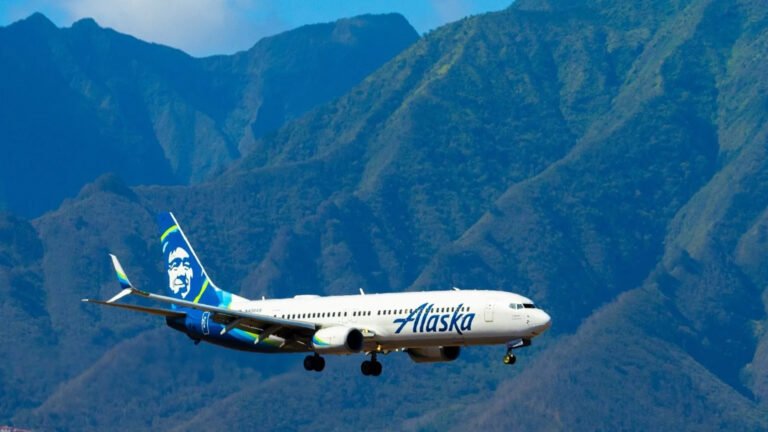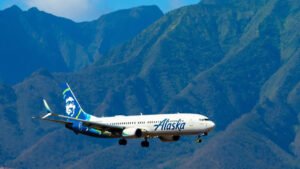
Washington, United States: Airport workers, union representatives and community members marched to Alaska Airlines’ corporate headquarters in SeaTac, Washington, on November 24, demanding stronger protections for passengers and employees following the detention of two travellers by US Immigration and Customs Enforcement (ICE) at Seattle-Tacoma International Airport on November 21.
The demonstration followed an incident involving Ricardo Larrondo Mendoza and Sofia Hernandez Mejia, who were detained by federal immigration officers while boarding Alaska Airlines Flight 1306 from Seattle to Los Angeles. The arrests took place on the aircraft’s jet bridge, prompting protests from passengers and raising questions about the airline’s awareness of the operation and the procedures governing federal law enforcement access to secured airport areas.
According to an event announcement by the Washington Indivisible Network, the demonstration began at Angle Lake Park at 11:30 a.m. local time before participants marched to Alaska Airlines’ headquarters. Organisers called on airline chief executive Ben Minicucci to take action against ICE operations at airports and introduce measures to protect passengers and employees.
Sterling Harders, president of SEIU Local 6, criticised the circumstances surrounding the arrests, saying, “Masked men tackled and detained two people at the airport on a skybridge while they were boarding a flight.”
Paula McGill, president of a flight attendants’ union, called on travellers to support the campaign, saying, “We are calling on the entire traveling public to join us in demanding ICE out of our airports.”
King County Executive Girmay Zahilay also questioned how federal agents gained access to the secured jet bridge and what airport personnel knew about the operation.
“How did agents gain access to that jet bridge? What did airport personnel know when?” Zahilay said.
He also called for congressional intervention and greater accountability for federal immigration enforcement. Seattle Mayor Katie Wilson joined the calls for congressional action, while a separate group of demonstrators later surrounded her vehicle as she attempted to leave the area. Police intervened to allow her to depart. KIRO 7 reported that the separate confrontation concerned another ICE-related issue.
The arrests took place on the morning of November 21, when passengers were boarding Alaska Airlines Flight 1306 from Seattle to Los Angeles ahead of the Thanksgiving travel period.
ICE said its officers conducted a targeted enforcement operation at approximately 8:05 a.m. Pacific Time to arrest Mendoza, whom the agency identified as a Mexican national who had overstayed his visa.
According to ICE, another passenger, identified as Hernandez Mejia, threw hot coffee at officers during the operation. The agency said she was also found to have overstayed her visa and was subsequently arrested. ICE said she would face a charge of assaulting a federal officer.
However, the family’s immigration attorney disputed the government’s account of the coffee incident, saying Hernandez Mejia dropped the cup during the confrontation. The attorney also said both individuals had entered the US legally, had valid work permits and had pending immigration cases.
Video recorded by passengers showed masked officers struggling with the two individuals on the jet bridge as other travellers watched. The incident prompted members of the flight crew to leave the aircraft.
Alaska Airlines subsequently confirmed that some inflight crew members requested replacement following the incident. The airline brought in an entirely new crew, and Flight 1306 eventually departed at 11:03 a.m. local time, after being delayed by nearly three hours.
Alaska Airlines issues updated statement
In its November 21 response, Alaska Airlines said it was concerned about the enforcement action and the impact on employees and passengers.
The airline stated: “We do not direct or coordinate immigration enforcement activity, and we remain committed to protecting the privacy and safety of our guests and employees wherever possible.”
It also said it had not received advance notice of the operation and was working to determine whether the appropriate protocols had been followed.
On November 24, the airline published an updated statement addressing the concerns raised following the incident. It said the events had “deeply impacted our employees, guests and community” and acknowledged the questions surrounding the enforcement action.
Alaska Airlines reiterated that its employees are trained to follow established company procedures and policies when engaging with federal agencies. It said these procedures provide law enforcement officers, flight crews and airport teams with consistent guidance intended to maintain a safe and orderly environment.
The airline outlined three important points concerning the operation:
- Federal law enforcement agencies conduct enforcement actions under their own authority and procedures.
- The jet bridge is located in a secured area of the airport, with access credentials issued by the Port of Seattle.
- Decisions regarding the timing, location and manner of federal law enforcement operations rest with the responsible agencies.
The airline further stated: “After reviewing available information, Alaska Airlines is engaging directly with government authorities, the Port of Seattle and our industry trade association, Airlines for America, to emphasize the importance of minimizing the impact of law enforcement activity on our guests, employees and operations going forward.”
It also expressed appreciation for its customer service agents and flight crews, acknowledging their professionalism during difficult situations, and reaffirmed its commitment to supporting employees.
Port of Seattle calls for federal intervention
The Port of Seattle, which operates Seattle-Tacoma International Airport, also criticised the November 21 operation.
In its initial statement, published on the day of the arrests, the Port said: “We are outraged about this morning’s incident involving ICE and two passengers as travelers boarded AS 1306 to Los Angeles.”
It added that immigration enforcement activities at the airport were conducted without the Port’s participation or knowledge. The Port said it had previously requested protocols governing such operations and was engaging with the Department of Homeland Security (DHS) to determine whether any of those protocols had been breached.
On November 23, the Port Commission said it was preparing a comprehensive review of the incident, drawing on interviews conducted by Port of Seattle police and ongoing discussions with federal officials and airport partners.
The Port also said it was supporting affected employees through listening sessions and discussions, while reviewing whether domestic ICE enforcement activities at the airport were consistent with its Welcoming Port Policy and commitment to maintaining a safe and secure environment.
In a further development on November 24, the Port sent a letter to Washington’s congressional delegation, urging lawmakers to support legislative changes restricting certain ICE civil immigration enforcement operations at or near airports without a judicial warrant related to a felony criminal conviction.
The letter also supported provisions that would restrict passenger information sharing between ICE and the Transportation Security Administration (TSA) for certain civil immigration enforcement actions, require checks on individuals’ authorised immigration status before detention, require warrants for access to passenger data, and establish advance notification requirements for airports and airlines.
The Port said: “The current practices introduce moments of extreme instability into the airport, where we pride ourselves on safe, welcoming, and efficient operations.”
It also raised concerns about the potential economic consequences of enforcement activities, particularly disruptions to air travel and airport operations.
The Port’s position is that federal authorities must be able to carry out their legal responsibilities, but it remains opposed to ICE actions that do not meet the judicial-warrant standard outlined in the proposed legislation.
Protesters seek changes to airline policies
The November 24 demonstration reflected wider concerns among airport workers and community groups about how immigration enforcement operations are conducted in secured airport areas.
The Washington Indivisible Network’s event announcement outlined four principal demands directed at Alaska Airlines and its leadership:
- Directly call on DHS to remove ICE from airports.
- Demand judicial warrants for ICE agents and provide airline employees with more comprehensive training on their rights and procedures during enforcement operations.
- Limit the sharing of passenger information with ICE.
- Protect employees from repercussions if they refuse to work when ICE activity creates safety concerns for passengers.
The demonstration placed Alaska Airlines under pressure to clarify its role and responsibilities when federal agencies conduct enforcement operations during passenger boarding.
The airline has maintained that it neither directs nor coordinates immigration enforcement and that decisions concerning federal operations rest with the responsible authorities. It has said it is working with the Port of Seattle, government agencies and Airlines for America to address the operational concerns raised by the incident.
As of November 25, Alaska Airlines’ November 24 statement outlined its engagement with authorities but did not announce a new company-wide policy or confirm that it would adopt the protesters’ demands.