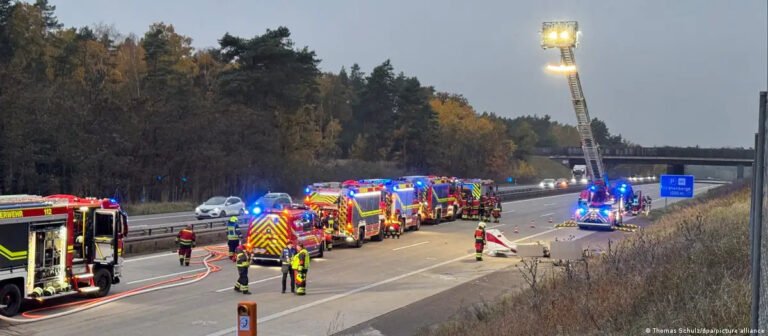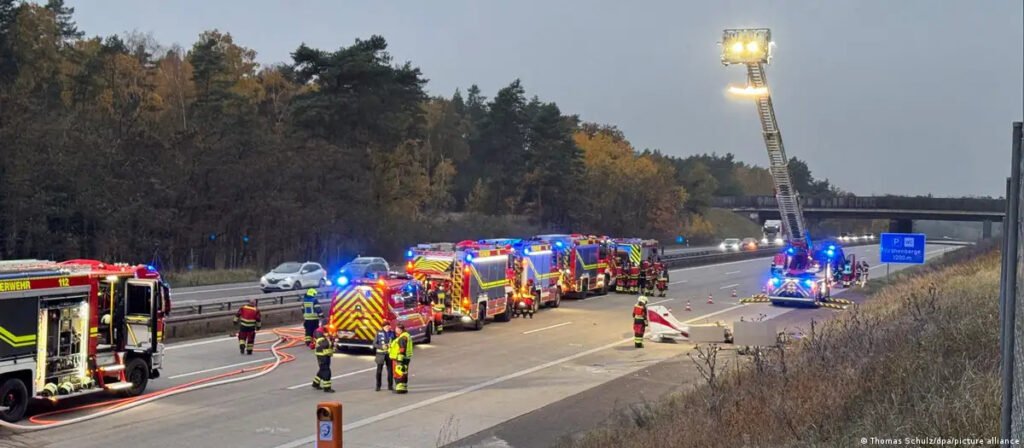
Burg, Germany: Two people were killed after a small aircraft crashed onto the A2 motorway between Burg and the Krähenberge rest area in Saxony-Anhalt, Germany, on 6 November 2026. The accident occurred at approximately 14:48 local time on the Hannover-bound carriageway, according to the Police Inspectorate Magdeburg. The aircraft caught fire during the impact and was completely engulfed in flames. Emergency responders subsequently recovered both occupants dead from the wreckage.
In its official press release, the Police Inspectorate Magdeburg stated: “For reasons that remain unclear, a small aircraft crashed onto the carriageway of the A2 motorway in the direction of Hannover.” Describing the aftermath, police added: “The aircraft caught fire completely during the crash. According to current information, two occupants were recovered dead from the aircraft by emergency responders.”
Following the accident, the Hannover-bound carriageway was closed to traffic to facilitate emergency response and recovery operations. Police, fire and rescue personnel, along with relevant federal authorities, were involved in the response. The initial police statement did not establish what caused the aircraft to crash or provide further details about the circumstances immediately preceding the impact.
Further information about the aircraft emerged through flight-tracking data and reports from German media. Flightradar24 identified the aircraft as a two-seat Aerostyle Breezer, registration D-ESDA, associated with Aero Club Kropp, based in Schleswig-Holstein. The flight-tracking record indicates that the aircraft departed from Schleswig Airport (WBG) at approximately 12:33 local time on the day of the accident. However, its intended destination was not available in the tracking information.
The club’s chairman confirmed to Deutsche Presse-Agentur (dpa), Germany’s national news agency, that the aircraft belonged to the club and had two people onboard: one club member and another person. Neither the police nor the reports reviewed disclosed the identities of the two deceased occupants.
Additional information on the flight was provided by a spokesperson for Deutsche Flugsicherung (DFS), Germany’s air navigation service provider. According to the spokesperson, the aircraft was operating under Visual Flight Rules (VFR), which require pilots to navigate primarily using visual references and comply with prescribed visibility and cloud-clearance conditions.
The DFS spokesperson could not initially confirm whether the aircraft had transmitted a distress call before the crash. The available information did not establish whether the aircraft encountered an emergency, experienced a technical problem or attempted any manoeuvre before reaching the motorway. The precise cause and circumstances of the accident remained undetermined in the initial police statement.