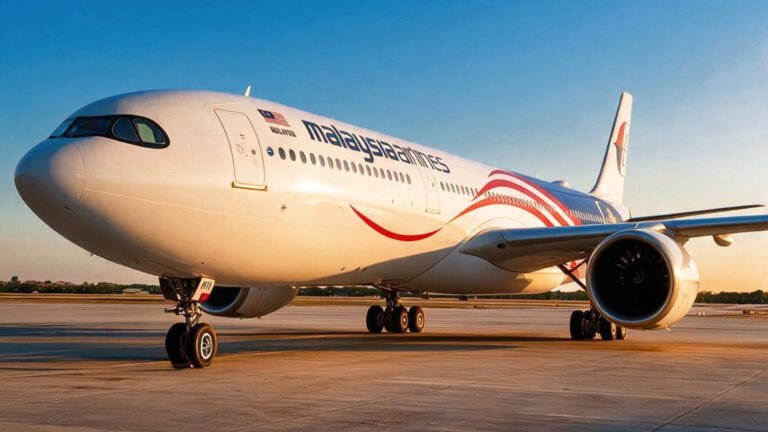
Kuala Lumpur, Malaysia: Malaysia Aviation Group (MAG), the parent company of Malaysia Airlines, has not ruled out imposing a green tax on passengers to help offset the high cost of sustainable aviation fuel (SAF), although no decision has been announced on introducing the levy.
MAG President and Group Chief Executive Officer Capt. Nasaruddin A. Bakar told the Associated Press on Monday that the company was considering different ways to manage the cost of aviation decarbonisation. “We are looking at all options,” Nasaruddin said on the sidelines of an aviation sustainability conference. “Consumers must be able to afford it. The airline must be able to afford to buy it.”
Nasaruddin’s remarks come as airlines face pressure to reduce their carbon emissions while dealing with the high price and limited availability of SAF, a lower-emissions alternative to conventional jet fuel. A passenger levy could help cover some of the additional fuel costs, but it could also increase ticket prices and affect the affordability of air travel.
Nasaruddin did not announce a proposed tax rate, collection mechanism or implementation date. He said the decision on whether to introduce a green tax rests with the government, indicating that MAG’s consideration of the measure should not be interpreted as an approved policy.
The executive also called for governments, fuel suppliers and airlines to work together to make SAF more affordable. He cautioned against transferring the full additional cost to passengers, saying that doing so could make air travel less attractive.
His comments reflect a broader challenge for airlines: meeting environmental targets without placing an unsustainable financial burden on operators or travellers. While a passenger levy could provide a way to distribute some of the cost, its potential effect on fares would depend on the price of the fuel and the share of the expense passed on by airlines.
Nasaruddin also highlighted the pressure from higher conventional jet fuel prices amid the war involving Iran. He said airlines had limited scope to recover fuel-price increases through ticket prices, a constraint that would also apply to the additional expense associated with SAF.
“If the cost is not that high, maybe some more of it can be passed on to the passenger,” he said. “If the cost is just too high, we won’t be able to do that.”
He also left open the possibility of further ticket-price increases, adding: “I don’t have a crystal ball.”
The comments indicate that a green tax is one possible option rather than a final decision on how MAG intends to recover the costs of sustainable aviation fuel. Any future proposal would also need to account for the government’s role in determining whether such a levy could be introduced.
SAF is produced from renewable feedstocks, including used cooking oil, waste fats and agricultural residues. Depending on its production pathway and feedstock, it can reduce lifecycle greenhouse gas emissions compared with conventional jet fuel. It can also be blended with conventional aviation fuel and used in existing aircraft, subject to applicable fuel specifications.
However, SAF remains substantially more expensive than conventional jet fuel, while production capacity and access to suitable sustainable feedstocks continue to constrain wider adoption. The International Air Transport Association has said SAF accounts for less than 1% of global jet fuel use.
The International Energy Agency estimates that aviation contributes about 2.5% of annual global carbon emissions. With air travel demand expected to grow, the United Nations’ International Civil Aviation Organization has established a long-term goal of net-zero carbon emissions from international aviation by 2050.
The transition therefore requires airlines to secure additional supplies of lower-emissions fuel while managing the difference between SAF and conventional fuel costs. Industry collaboration, investment in production capacity and supportive government policies are among the measures being pursued to address the challenge.
The discussion in Malaysia comes as neighbouring Singapore prepares to introduce a government-mandated sustainable aviation fuel levy for flights departing the country from January 1, 2027. Singapore’s Civil Aviation Authority announced the revised implementation schedule on September 3, 2026, following an earlier postponement announced in March.
Under the revised schedule, the levy applies to tickets or services sold from October 1, 2026, for flights departing Singapore from January 1, 2027. It will apply to origin-destination passengers and general and business aviation flights, with charges varying according to destination and cabin class.
The implementation schedule has already been adjusted once. In March 2026, Singapore deferred the levy in view of the impact of the conflict in the Middle East on airlines and passengers. The revised start date reflects the government’s decision to allow additional time before implementation.
Singapore’s scheme offers a regional example of how governments may seek to fund aviation decarbonisation through charges collected from aviation users. However, it remains a separate policy and does not mean Malaysia has adopted a similar system.
Separately on October 19, MAG launched its Mid-Term Sustainability Roadmap 2026–2035, setting a target to reduce emissions intensity by 30–35% by 2030 and 40–45% by 2035, using 2019 as the baseline. The group aims to achieve net-zero carbon emissions by 2050.
According to Bernama’s report on the roadmap launch, the plan supports MAG’s Long-Term Business Plan 3.0 and establishes measurable priorities across its operations, facilities, value chain, workforce and governance.
Nasaruddin said the group’s aviation operations would focus on fleet renewal, fuel efficiency, ground electrification and the use of SAF, alongside eligible carbon credits in line with regulatory requirements.
MAG has already been pursuing SAF initiatives. Its sustainability reporting describes a pilot SAF uplift on the Kuala Lumpur–London route in partnership with PETRONAS, as well as continued SAF use for flights departing the United Kingdom and Europe in line with applicable mandates.
The group has also explored domestic SAF development, including feedstock availability studies and the potential use of used cooking oil. These initiatives form part of a broader effort to reduce emissions while improving operational efficiency.
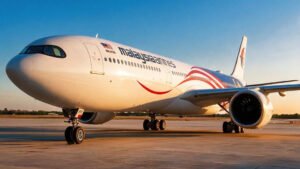
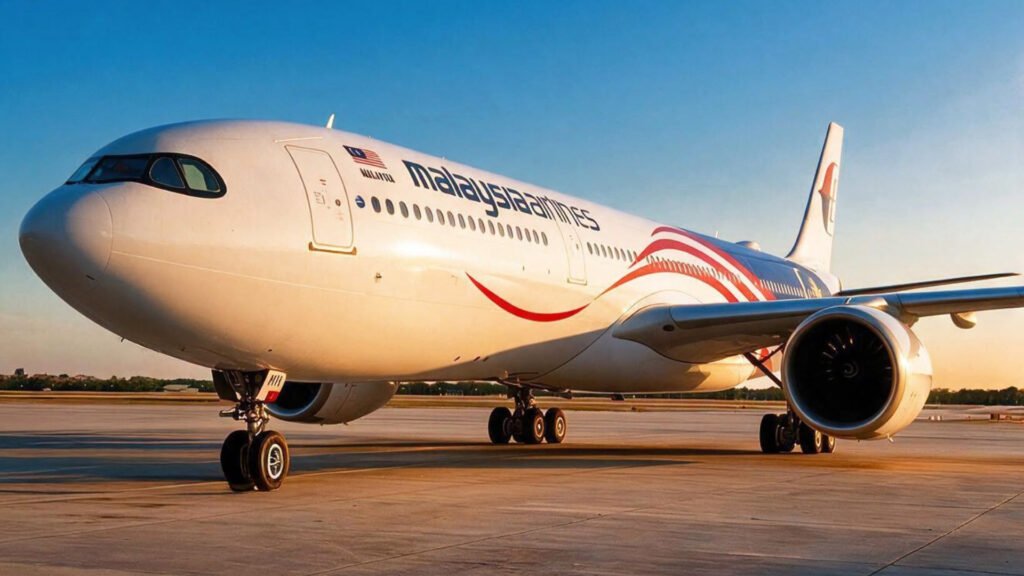
MAG is also modernising its fleet through orders for 40 Airbus A330neo aircraft and 55 Boeing 737 MAX aircraft. Newer aircraft are intended to improve fuel efficiency and reduce emissions compared with older aircraft, although the actual benefit depends on aircraft utilisation, operations and other factors.
Fleet renewal, fuel-efficiency improvements and SAF use are complementary elements of the group’s strategy. SAF can help reduce lifecycle emissions without requiring an entirely new aircraft fleet, while more efficient aircraft can reduce fuel consumption during operations.
The potential green tax discussion therefore sits within a wider financial and operational challenge: reducing aviation emissions while keeping the cost of flying manageable.
For now, MAG has not confirmed a passenger green tax. Nasaruddin’s comments establish that the option is being considered, but any decision on a levy remains subject to further consideration and the government’s role in determining whether such a measure could be introduced.