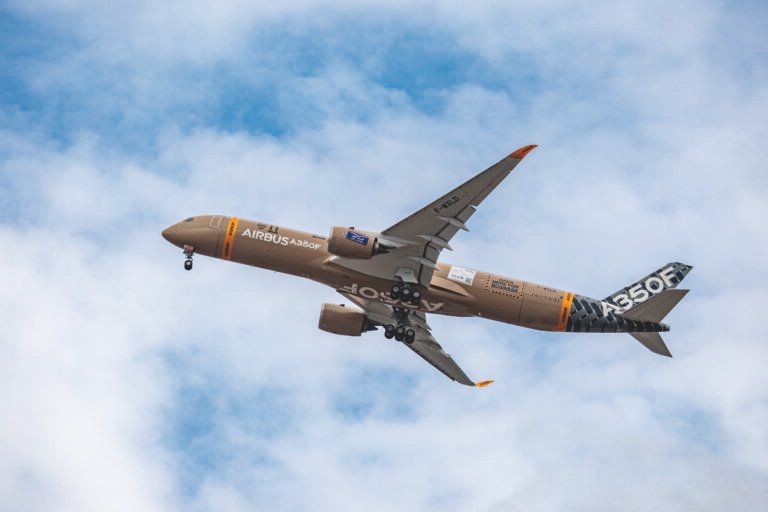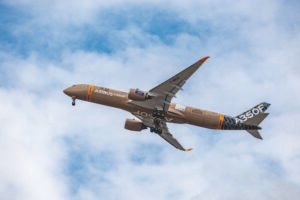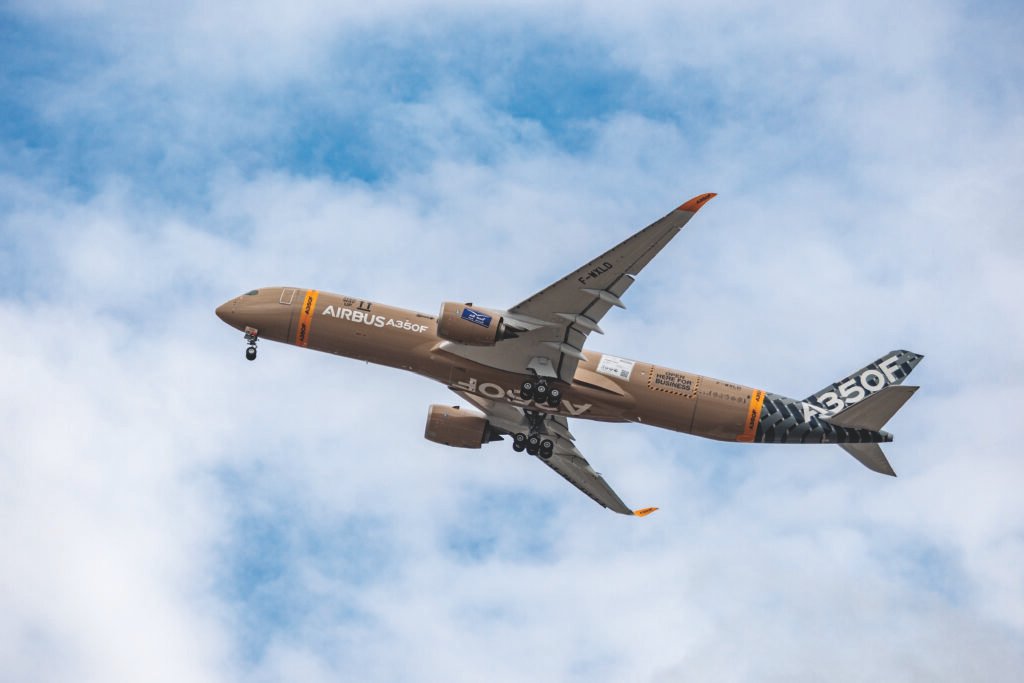
Toulouse, France: Airbus’ A350F freighter completed its maiden flight from Toulouse, France, on 29 September 2026, marking the start of a more than nine-month certification campaign for the company’s new-generation large freighter. The first flight-test aircraft, MSN700, departed Toulouse-Blagnac at around 10:30 a.m. local time and completed a flight lasting 4 hours and 10 minutes before returning to Toulouse.
The aircraft, registered F-WXLD, was flown by a five-member Airbus flight-test crew comprising Experimental Test Pilots Bernardo Saez-Benito Hernandez and Sylvain Guiraud, Test Flight Engineer Ludovic Girard, and Flight Test Engineers Laurent Bussiere and Jaime Angoloti Benavides. The aircraft took off from Runway 14R at Toulouse-Blagnac despite gusting winds and initially flew with the landing gear extended before retracting it. The aircraft then followed a largely north-south flight path west of Toulouse and conducted a low-altitude fly-past before landing.
Airbus said the aircraft reached 25,000 feet and an indicated airspeed of 340 knots during the flight. The crew initially operated the aircraft in “Direct Law”, providing direct manual control, and progressively climbed to 10,000 feet and then 25,000 feet while evaluating its aerodynamic and structural behaviour against models previously assessed in the simulator. After the results remained within acceptable thresholds, the crew activated “Normal Law”, allowing the aircraft to be assessed with its full flight-envelope protections.
The first flight also evaluated the behaviour of the Rolls-Royce Trent XWB-97 engines and core aircraft systems. Airbus said the crew checked pressurisation, including potential leakage rates against ground-test baselines, as well as communications and navigation systems. The aircraft is equipped with specialised Flight Test Instrumentation that records thousands of parameters and transmits telemetry to teams on the ground in real time.
Airbus Commercial Aircraft CEO Lars Wagner said the flight proceeded without problems, telling reporters, “Everything went smoothly in today’s flight.” In the company’s official announcement, Wagner described the first flight as “a major milestone for the A350F and for our customers worldwide”, adding that the aircraft combines operational flexibility, fuel efficiency and range.
Airbus Head of Widebody Programme Julien Puyou described the milestone as the culmination of development work that began with the A350F programme in 2021. “From a bold vision on paper in 2021 to seeing the A350F fly for the first time today, this milestone is a triumph of pioneering spirit and collective determination,” Puyou said. He also highlighted the development of the aircraft’s large main-deck cargo door and the work involved in bringing the freighter through demonstrator testing, final assembly, flight-test instrumentation, ground testing and simulator work.
Lead Flight Test Engineer Laurent Bussiere said after the flight: “We are now starting the flight test campaign and we’re all very proud to be part of today’s mission.” He added that the aircraft’s payload capability, fuel efficiency and flexibility would make it a significant freighter for future operators.
The first flight opens a certification programme involving two dedicated test aircraft. MSN700 will concentrate on aerodynamics, performance, handling qualities and autopilot systems. Airbus has fitted it with a specialised tail skid and bumper for take-off performance testing. The second aircraft, MSN701, will focus on system testing, including air conditioning, water and waste systems, and comprehensive fire and smoke detection tests, along with hot- and cold-weather campaigns and customer visits.
MSN701 has completed final assembly and is undergoing ground testing before entering the paint shop. Airbus expects the overall certification campaign to run for around nine to 10 months and culminate in EASA type certification, with first customer deliveries planned for the second half of 2027. Aviation Week reported that around 300 flight-test hours are allocated to MSN700 and about 100 hours to MSN701, while Airbus describes the overall campaign as approximately 400 flight hours.
The A350F is derived from the A350 family but has been substantially modified for cargo operations. Airbus says its fuselage configuration creates a new aerodynamic model, requiring dedicated flight testing rather than simply relying on testing completed for the passenger A350 variants. The aircraft combines an A350-900-length forward fuselage section with the rear fuselage and wings of the A350-1000, creating a configuration between the two passenger variants.
A major structural change is the removal of passenger windows and doors and passenger-cabin systems, together with the addition of a large main-deck cargo door on the left rear fuselage. Aviation Week reported that the door is the largest in the industry and was identified by Puyou as one of the programme’s biggest development challenges. The cargo deck also has a powered loading system, while the floor and fuselage have been partially reinforced for freight operations.
The A350F is powered by two Rolls-Royce Trent XWB-97 engines. Rolls-Royce said the engine has accumulated more than 4.5 million flying hours across eight years of service and has already secured more than 100 A350F orders. The company said the engine is certified for a 50% Sustainable Aviation Fuel blend and has been demonstrated as compatible with 100% SAF for future use.
Rolls-Royce Director Commercial Aviation, Trent XWB, Adam Davies said, “We are delighted to be part of the next generation of air freighters, and ready to support our customers’ aspirations in this area.” He added that the Trent XWB-97’s established in-service performance could support freight operators seeking additional payload and network opportunities.
Airbus says the A350F will carry up to 111 tonnes of payload and have a range of up to 8,700 kilometres. More than 70% of its airframe uses advanced materials, while Airbus claims up to 40% lower fuel consumption and carbon emissions compared with previous-generation freighters with similar payload-range capability. The company also says the A350F is the first new freighter designed to fully meet the latest ICAO CO₂ emissions standards.
The programme has also built a substantial order book before the aircraft’s first flight. Airbus said that at the end of August 2026, the A350F had accumulated 115 orders from 14 disclosed customers, representing up to 59% of the large-freighter market by orders, according to Airbus. Reuters reported 115 A350F orders compared with 81 orders for Boeing’s forthcoming 777-8F.
Atlas Air became the largest A350F customer in March 2026 with a firm order for 20 aircraft. Air China Cargo subsequently increased its commitment to 10 aircraft, while Cathay Group ordered two additional A350Fs in May. Other customers announced before the maiden flight include Singapore Airlines, Air France, CMA CGM Air Cargo, Etihad Airways, Martinair, Silk Way West Airlines, Turkish Airlines, STARLUX Airlines and Korean Air.
The A350F’s entry into the market comes as Airbus seeks a larger position in the dedicated large-freighter sector, where Boeing has historically held a strong position with the 747 and 777 freighter families. Boeing is developing the 777-8F as its next-generation competitor. Reuters reported that Boeing expects demand for 930 dedicated freighters over the next 20 years, in addition to around 2,000 passenger aircraft that could be converted to freighters.
Airbus is also pointing to continued growth in air cargo demand. Reuters reported that air cargo traffic increased 4.7% during the first half of 2026, with Airbus citing demand for semiconductor and AI-related equipment as one contributor. Airbus’ longer-term market forecast projects a 45% increase in the global freighter fleet by 2044 and demand for 2,605 additional freighters, including 935 new-build aircraft.
The A350F’s first flight therefore moves the programme from development and ground testing into the formal flight-test phase. Airbus will now use MSN700 and MSN701 to validate the aircraft’s flight characteristics, systems, cargo-operation maturity and performance before seeking EASA certification and beginning deliveries to customers in the second half of 2027.