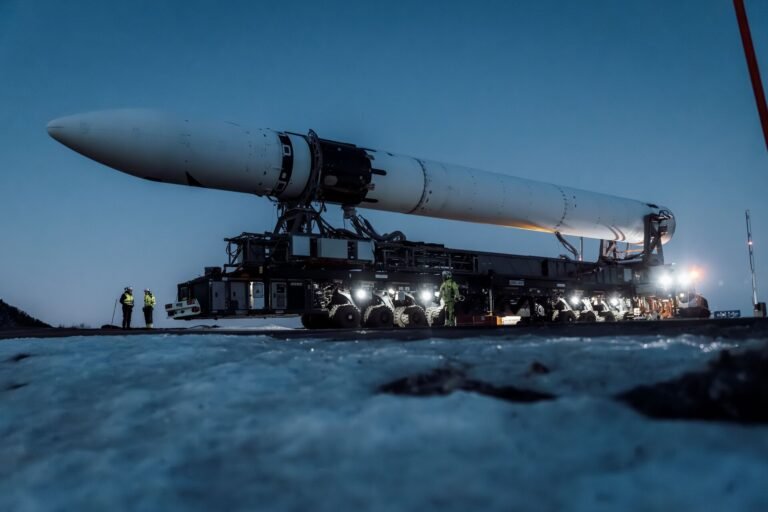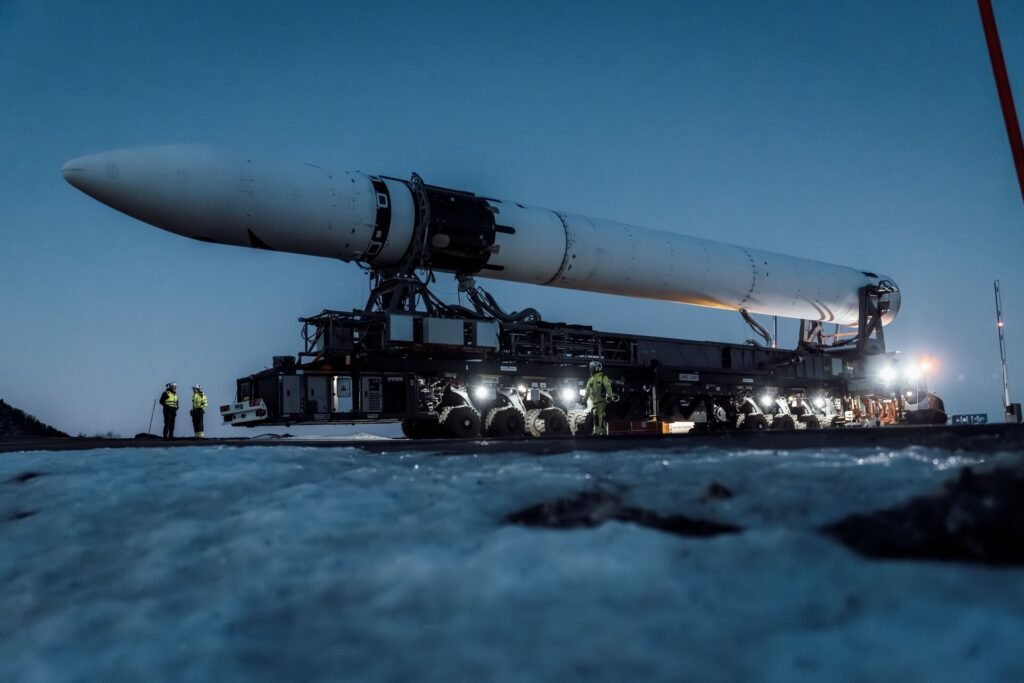
Andenes, Norway: German space startup Isar Aerospace successfully launched its Spectrum rocket into orbit from Andoya Space in northern Norway on September 5, 2026, marking a major milestone for Europe’s commercial space sector. The mission, named “Onward and Upward,” lifted off at 10:12 p.m. CEST and became the first successful commercial orbital launch from continental Europe.
The two-stage Spectrum rocket reached orbit just over seven minutes after liftoff. During the qualification flight, the vehicle passed through maximum aerodynamic pressure, completed main engine cutoff and stage separation, ignited its second stage, crossed the Kármán line at 100 kilometres and later completed a circular burn before releasing its spacecraft. Isar Aerospace subsequently confirmed that the payloads had been deployed in orbit.
The mission carried five CubeSats and one technology experiment. The payloads were CyBEEsat from TU Berlin, TriSat-S from the University of Maribor, Platform 6 from EnduroSat, FramSat-1 from NTNU, SpaceTeamSat1 from TU Wien Space Team and the “Let It Go” experiment from Dcubed. The payloads were selected through the German Space Agency at DLR’s Microlauncher Competition, supported by the European Space Agency’s Boost! programme.
The flight had two purposes: to qualify Spectrum under real operational conditions and to demonstrate the rocket’s ability to carry and deploy payloads for the first time. The European Commission said the mission would generate operational data that could feed directly into the industrialisation of Spectrum and support the emergence of a new European launch service.
Spectrum is designed specifically for small and medium-sized satellites and constellations. The 28-metre-tall rocket has a diameter of two metres and is powered by 10 engines. Isar Aerospace says the launcher is designed to carry payloads of up to 1,000 kilograms to low Earth orbit, positioning it as a potential commercial workhorse for satellite operators seeking dedicated or rideshare launch opportunities.
Isar Aerospace co-founder and CEO Daniel Metzler said the achievement gives commercial and institutional customers an alternative source of launch capacity. “Today, Isar Aerospace opened space from Continental Europe. Launch continues to be the largest bottleneck for the global space industry and from today on, there is a true alternative for commercial and institutional customers,” Metzler said.
Metzler also described the achievement as a turning point for European spaceflight, saying: “We achieved within a few years what had taken the European space industry decades before. Europe now has sovereign access to space.” He added that the company would focus on “rapidly scaling launch vehicle production” and meeting growing global demand.
ESA Director General Josef Aschbacher called the launch historic and highlighted its importance for Europe’s autonomous launch ambitions. “Spectrum quite literally rose to the challenge and delivered its payloads in low Earth orbit,” Aschbacher said, describing the flight as “yet another step towards a more diverse autonomous European launch service sector.”
ESA Director of Space Transportation Géraldine Naja said the achievement represented the first European company reaching orbit with its own launch vehicle. “All launches are special, but what Isar Aerospace achieved today is historic,” Naja said, congratulating the teams and pointing to the launch as the first completed milestone of ESA’s European Launcher Challenge.
The success is particularly significant because Spectrum’s first flight ended unsuccessfully. On March 30, 2025, Isar Aerospace launched the rocket from the same Norwegian site on a mission called “Going Full Spectrum.” The vehicle cleared the pad but suffered an in-flight anomaly roughly 30 seconds into the flight and subsequently fell back toward Earth. An investigation identified an unintended opening of a vent valve and loss of attitude control at the beginning of the roll manoeuvre as the initiating events.
The company then used the experience from that flight to prepare the second Spectrum vehicle. The “Onward and Upward” mission, initially targeted for earlier in 2026, faced several delays. A pressurisation-valve issue affected the original schedule, while later attempts were disrupted by weather, an unauthorised vessel entering the designated sea danger zone and, on April 9, a leak involving a composite overwrapped pressure vessel. Isar Aerospace also stood down from a June 15 attempt after detecting off-nominal behaviour in the vehicle’s fluid systems.
Despite those setbacks, the company continued testing and preparation. Isar Aerospace completed component-level acceptance testing, stage tests and a wet dress rehearsal before returning Spectrum to the launch pad for the September attempt. Before the successful flight, Metzler said the company’s objective was to “learn as much as we can, go as far as we can.”
The launch also carries broader strategic importance for Europe. European governments and institutions have increasingly focused on developing independent access to orbit as demand for satellite launches rises and reliance on non-European launch providers remains a strategic concern. Norway’s Minister of Industry and Commerce Cecilie Myrseth said the ability to launch satellites from Andøya “strengthens Norwegian and European security in the turbulent times we live in.”
EU Defence and Space Commissioner Andrius Kubilius similarly said: “Europe’s independent access to space just got a major boost.” The European Commission described the Spectrum flight as a key step toward strengthening Europe’s autonomous access to space.
Isar Aerospace’s ambitions now extend beyond a single successful flight. The company says Spectrum launch vehicles 3 through 7 are already in production, while a new 40,000-square-metre manufacturing facility near Munich is being developed to support production of up to 40 launch vehicles a year. Isar is also developing a launch complex in Nova Scotia, Canada, which it says could begin operations in 2028.
Reuters reported that Isar already had five additional rockets in production and was targeting roughly 40 launches per year in the long term. CEO Daniel Metzler also said the company remains privately funded and that an initial public offering is “not on the table.”
The company, founded in 2018 and headquartered near Munich, has grown to more than 400 employees across five international locations. Isar Aerospace develops, manufactures and tests its launch vehicles largely in-house and has raised more than €500 million in private capital, according to its current company information.
For Europe’s emerging commercial launch industry, the September 5 flight represents more than a successful second attempt. Spectrum demonstrated that a privately developed European launcher can reach orbit, complete its planned flight sequence and deploy customer payloads from European soil. The immediate challenge for Isar Aerospace will now be turning that qualification success into a reliable, repeatable and scalable commercial launch service.