Citywide Networks Must Be Designed Around Real Travel Patterns
AAM cannot become a meaningful transportation mode through isolated airport shuttles alone. Airport routes will be important, particularly in large metropolitan areas where congestion makes airport access unpredictable.
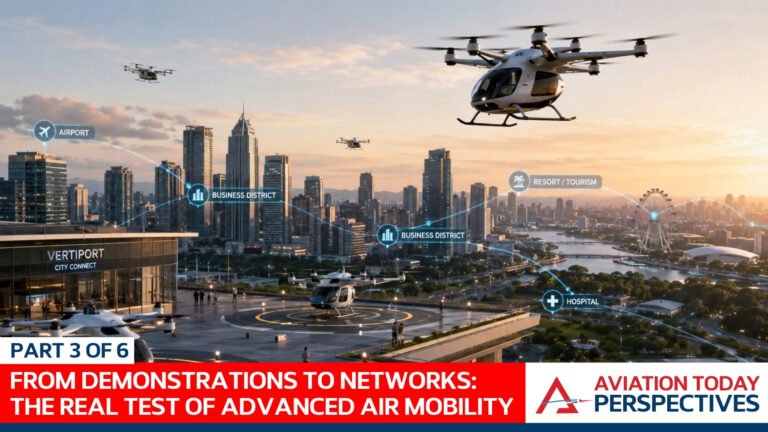
But a durable network requires multiple use cases and a portfolio of connected routes. The strongest early networks will likely combine several types of demand:
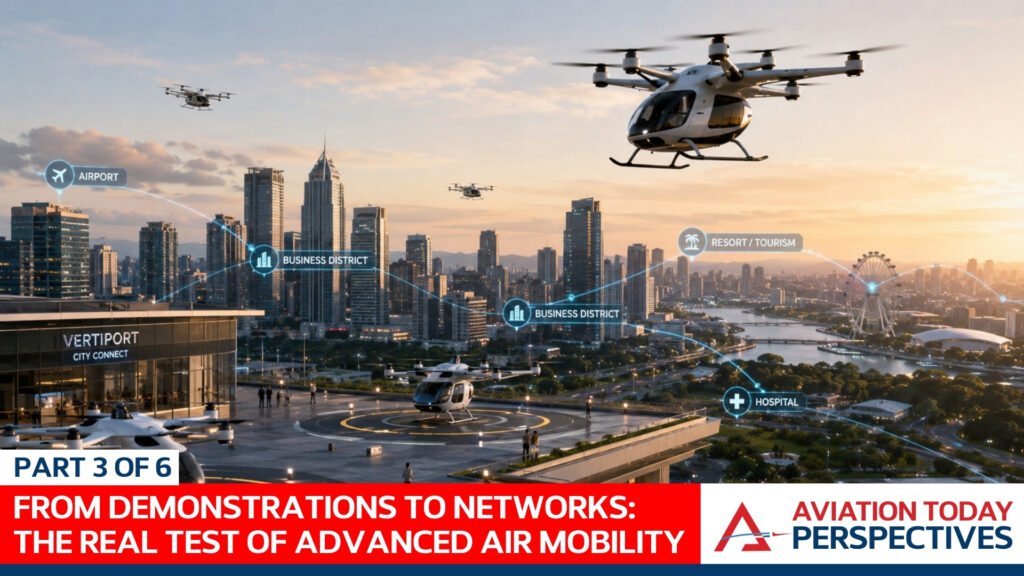
• Airport-to-business district connections for travelers facing unreliable road congestion.
• Business district-to-business district routes across major metropolitan regions.
• Airport-to-resort, convention, cruise terminal, or tourism destinations.
• Intercity services between nearby markets that lack efficient rail or highway connections.
• Medical, emergency-support, and high-value logistics missions that can improve aircraft utilization
• Event-driven demand, including major conventions, sporting events, entertainment districts, and seasonal tourism.
The key is network density. AAM will become more useful as passengers can travel between multiple relevant nodes rather than only between an airport and a single downtown vertiport. A network with four strategically selected destinations may be more valuable than a network with ten convenient but weakly connected sites. Governments should therefore require demand analysis before committing public resources to vertiport construction.
A city should not ask only, “Can we build here?” It should ask, “Who travels here, why do they travel here, what do they pay today in time and money, and what happens if the route becomes reliable?” This requires metropolitan-scale planning, not isolated aviation planning.
Yet even strong demand does not guarantee a viable route. AAM networks will be constrained by vertiport throughput, airspace complexity, weather variability, certification timelines, noise sensitivity, and the need for seamless ground access at both ends of the trip.
A route can look attractive on a map and still fail operationally if the surrounding system cannot support predictable, repeatable service. For that reason, network planning must evaluate operational resilience alongside passenger demand from the start.
Asia Shows the Power of Demand-Linked Ecosystems
Asia provides important evidence that AAM and low-altitude mobility advance fastest when aircraft development, public policy, infrastructure, and identifiable use cases move together. China has been especially active in developing a broader “low-altitude economy” that includes passenger mobility, tourism, logistics, aerial services, and supporting digital infrastructure.
EHang’s operators in Guangzhou and Hefei received China’s first air operator certificates for civil human-carrying pilotless aerial vehicles in 2025, a major step beyond experimental aircraft activity and toward commercial operations.
The significance is not merely regulatory. It is that the aircraft are being tied to defined operating environments and services, including tourism, urban sightseeing, and regional mobility opportunities. In Hefei, the Luogang Central Park operating environment illustrates the logic of demand-led deployment.
The location is not simply an undeveloped area available for aircraft. It is a major urban destination with visitors, hotels, amenities, tourism activity, and potential demand for short-distance aerial services. The operating concept therefore begins with a place where people already have a reason to go.
China’s broader low-altitude strategy also illustrates the importance of building ecosystems rather than waiting for one “perfect” air-taxi route. Passenger AAM, drone logistics, tourism flights, vertiport infrastructure, airspace management, and local economic-development policy can reinforce one another. The lesson for governments elsewhere is not to copy China’s regulatory model. It is to recognize that AAM accelerates when it is treated as a transportation and economic-development system rather than a stand-alone aircraft program.
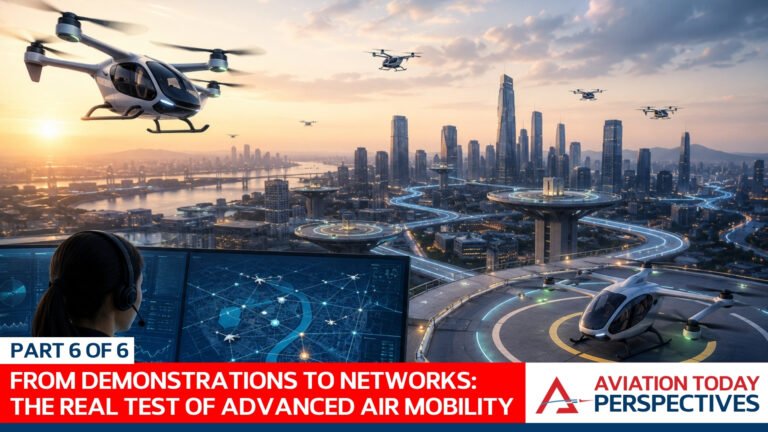
This is the 3rd of a series of 6 articles on: “From Demonstrations to Networks: The Real Test of Advanced Air Mobility”
Read Part 2 of this six-part series here
This article is part of Aviation Today’s Perspectives, a dedicated series that publishes expert viewpoints from aviation authorities and industry leaders on emerging trends, policy developments, and the future of global aviation.
Disclaimer: The views and opinions expressed in this article are solely those of the authors and do not necessarily reflect the views or editorial position of Aviation Today.
About The Authors