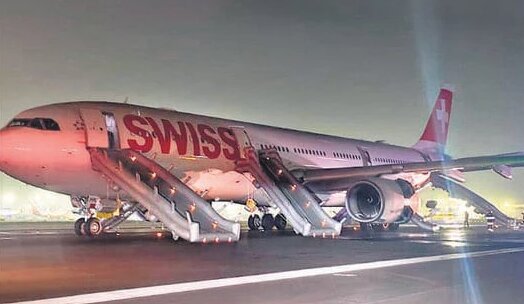
New Delhi, India: India’s Aircraft Accident Investigation Bureau (AAIB) has released its preliminary findings into the serious incident involving a Swiss International Air Lines Airbus A330-343 that suffered a left-engine failure during takeoff at Delhi’s Indira Gandhi International Airport, forcing the crew to reject takeoff and conduct an emergency evacuation.
The incident occurred shortly after 1:27 a.m. local time on April 26, 2026, when Swiss flight LX147 was preparing to depart Delhi for Zurich with 245 people onboard, including 232 passengers and 13 crew members.
According to the AAIB report, the aircraft involved was a 2012-built Airbus A330-343, registered HB-JHK, powered by Rolls-Royce Trent 772B-60 engines. The aircraft had arrived in Delhi earlier that day, operating flight LX146 from Zurich.
Investigators noted that the inbound Zurich–Delhi flight was uneventful. While seven maintenance complaints were logged after arrival, all were described as routine and unrelated to the aircraft’s engines, flight controls, serviceability, or controllability. The reported issues were addressed before the aircraft was cleared for the return flight to Switzerland.
No abnormalities were detected during pre-flight inspections before LX147’s departure from Delhi.
The aircraft, parked at Stand A14, received pushback and startup clearance before taxiing to Runway 28 via taxiway J6. At 01:25:56 IST, air traffic control cleared the flight for takeoff with light winds reported from 210 degrees at one knot.
Moments later, during the takeoff roll, the aircraft accelerated to approximately 106 knots. According to cockpit reports cited by investigators, the crew heard a loud bang as the No. 1 engine experienced a failure. Pilots reported seeing a large flame projecting forward from the left engine and observed the aircraft veering left.
The crew immediately rejected the takeoff and brought the aircraft to a stop on Runway 28 between taxiways G1 and G2.
After stopping, the flight crew informed air traffic controllers of the engine failure and requested emergency services. Communications recorded by investigators show that airport vehicles and crash fire tenders responded rapidly.
Initially, responders observed smoke around the aircraft. As emergency personnel continued assessing the situation, reports indicated smoke near the left landing gear and subsequently fire near the right landing gear area. Fire crews began firefighting operations while coordinating with air traffic controllers and the flight crew.
At approximately 01:35 IST, a full airport emergency was declared.
Following confirmation of smoke and fire indications, both engines were shut down. Emergency evacuation procedures were initiated directly on the runway. Seven of the aircraft’s eight evacuation slides were deployed and used to evacuate passengers and crew.
All occupants successfully exited the aircraft. Four passengers sustained injuries during the evacuation and were transported for medical treatment.
Airport responders reported that the fire had been completely extinguished by approximately 01:50 IST. The aircraft was later towed from the runway and parked at a remote stand. The airport terminated the full emergency status at 04:50 IST.
Data obtained from the aircraft’s post-flight report showed the first recorded warning was an “ENG 1 Stall” message at 01:27 IST during the takeoff roll. This was followed by multiple system messages including “ENG 1 FAIL,” “AIR PACK 1+2 FAULT,” “F/CTL RUD TRIM 1 FAULT,” and “ENG 1 REV UNLOCKED.” An “ENG 1 SHUTDOWN” message was subsequently recorded after the aircraft came to a stop.
Investigators conducted an external inspection of the aircraft and found metallic debris near the exhaust section of the left engine along with soot and burn marks on the engine pylon behind the exhaust area.
Notably, no damage was observed on the engine fan blades, and investigators reported no significant structural damage to the aircraft apart from minor dents likely caused during emergency slide deployment.
A borescope inspection of the failed engine revealed extensive internal damage. Investigators discovered broken bolts and spacers from the high-pressure/intermediate-pressure bearing support assembly within the thrust reverser ducts. High-pressure bleed valves were also partially blocked by debris.
Further examination identified significant damage to components within the engine core, including the High Pressure Turbine, Intermediate Pressure Turbine, Low Pressure Turbine, and High Pressure Compressor sections. Both the high-pressure and intermediate-pressure shafts were seized, preventing complete inspection.
The AAIB stated that although severe internal engine damage was identified, investigators were unable to determine the precise cause of the engine failure during the initial borescope examination because the engine’s rotating assemblies could not be fully inspected.
Importantly, investigators found no evidence of an uncontained engine failure.
The failed Rolls-Royce Trent 772B-60 engine was manufactured in 2009 and had accumulated more than 75,500 operating hours and 11,369 flight cycles. Records show the engine’s last overhaul occurred in May 2016. Since that overhaul, it had accumulated nearly 40,000 additional flight hours before the incident.
Both cockpit crew members were appropriately licensed and qualified on the Airbus A330. The captain had more than 18,600 total flight hours, while the first officer had accumulated more than 2,170 hours.
AAIB investigators have removed and downloaded data from both the cockpit voice recorder and flight data recorder. Analysis of the recorded information is ongoing.
The bureau said the damaged engine will be removed from the aircraft for a detailed examination aimed at identifying the root cause of the failure. Investigators are also reviewing maintenance records, operational documentation, air traffic control recordings, and witness statements.
The investigation includes participation from international authorities and technical experts. France’s Bureau d’Enquêtes et d’Analyses (BEA), Airbus, the European Union Aviation Safety Agency (EASA), Germany’s BFU, the United Kingdom’s AAIB, and Rolls-Royce representatives are assisting the Indian investigation under the provisions of ICAO Annex 13.
The AAIB emphasized that the findings released so far are preliminary and subject to change as the investigation progresses. No interim safety recommendations have been issued at this stage.