

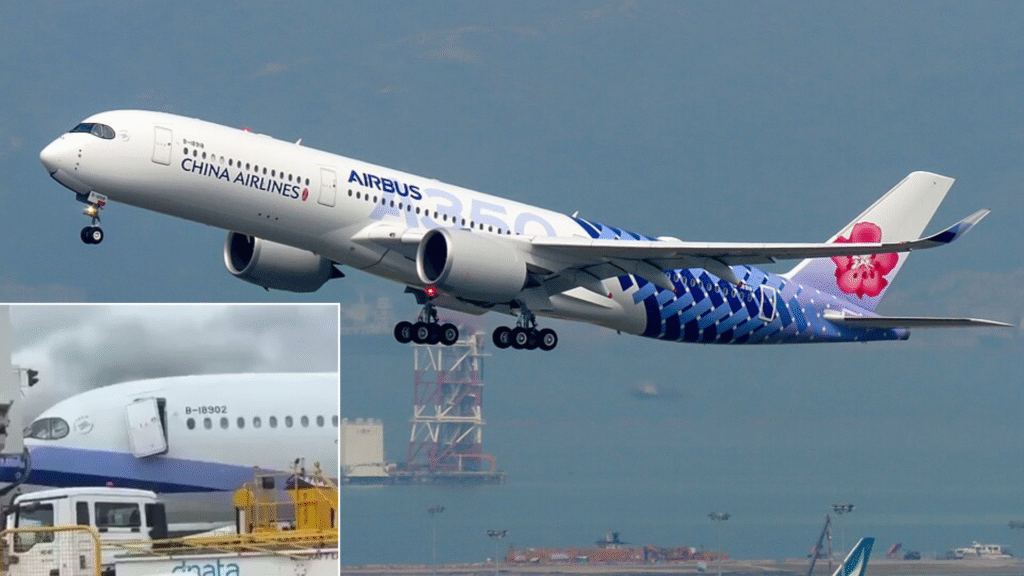
Melbourne, Australia: A China Airlines Airbus A350-900 has been grounded in Melbourne following a rare ground-handling incident that resulted in significant structural damage to the aircraft’s forward passenger door during post-arrival operations.
The aircraft, registered B-18902 and operating flight CI57 from Taipei, had completed its journey and arrived in Melbourne on April 14 when the incident occurred at the gate.
The aircraft unexpectedly rolled backward while still connected to the jet bridge, causing the forward left (L1) door to be partially torn from its hinges and inflicting substantial damage to the aerobridge. All passengers and crew had already disembarked at the time, and no injuries were reported.
Initial findings indicate that the aircraft’s unintended movement while docked led to stress on the door assembly and surrounding fuselage structure. The force of the movement caused the jet bridge to remain fixed while the aircraft shifted, resulting in the door being pulled out of alignment and damaged at the hinge points.
Such damage is considered serious, as passenger doors form part of the aircraft’s pressurized structure and require extensive inspection and certified repairs before returning to service.
Australia’s aviation safety authority has launched an investigation into the occurrence, focusing on ground-handling procedures, equipment usage, and potential human factors that may have contributed to the aircraft’s movement.
The cause of the accident is yet to be confirmed, although initial reports suggest that the chocks had not been placed correctly in front of and behind the tires of the massive widebody aircraft.
It’s believed the aircraft started to roll back with the forward left-hand door still open, causing the door to come into contact with the jetbridge and badly damaging it.
The affected aircraft remains out of service in Melbourne pending repairs and safety clearance. The temporary loss of the widebody jet is expected to have a limited but notable impact on China Airlines’ long-haul scheduling, particularly on routes connecting Asia with Australia and beyond.
The Airbus A350-900 forms a key part of the airline’s long-haul fleet, supporting premium international routes across Europe, North America, and Oceania.






.jpg)