News
Civil Aviation
Pilot Training
Flight School Analysis
Aviation Jobs
Training
Services
About Us
Contact Us

AAIB Preliminary Report Flags Engine Power Loss In December 2025 Redbird Aircraft Crash

Picture of Aviation Today News Desk

Aviation Today News Desk

Delhi, India: India’s Aircraft Accident Investigation Bureau (AAIB) has released its preliminary findings into the crash of a Tecnam P-Mentor trainer aircraft operated by Redbird Flight Training Academy, which went down during a routine training sortie near Suktara Airfield in Madhya Pradesh on December 8, 2025, injuring both occupants. The accident involved aircraft VT-RFO, which was conducting a circuit and landing check when it suffered a sudden loss of engine power on final approach, forcing the instructor to attempt an emergency landing. The aircraft struck a power cable and crash-landed in a field approximately 920 metres from the runway threshold, the report said. The impact snapped a 33 kV power line, triggering an outage across 80–90 nearby villages. According to the AAIB, the aircraft had already completed two touch-and-go landings earlier in the sortie and was on its third approach when the incident occurred. As the aircraft turned onto final approach to Runway 10 at Suktara, the instructor, noting the runway perspective, asked the trainee pilot to increase power. The trainee responded that the engine power was already set at approximately 75 percent. Moments later, both pilots observed a drop in engine RPM, indicating a loss of power. The instructor immediately took control, informed air traffic control of a forced landing, and maneuvered the aircraft to the right of the approach path while maintaining landing configuration. During the descent, the aircraft struck an overhead power cable and crash-landed in an adjacent field. There was no post-impact fire, and the emergency locator transmitter activated automatically The flight instructor sustained minor injuries, while the trainee pilot suffered a serious injury, including a maxillary fracture, the report noted. The aircraft was substantially damaged, with broken propeller blades, bent engine mounts, collapsed landing gear, fuselage structural damage, and damage to the engine oil, coolant, and exhaust systems VT-RFO, manufactured in 2024, was powered by a Rotax 912 iSc3 Sport piston engine and had valid certificates of registration and airworthiness at the time of the accident. Maintenance records reviewed by investigators showed no deferred defects, and the aircraft had completed a 50-hour inspection less than three weeks prior to the crash. The trainee pilot had accumulated 46 hours and 40 minutes of total flight time, with just over three hours on type, while the instructor held more than 2,250 flight hours, including 420 hours on the Tecnam P-Mentor. Both pilots had adequate rest prior to the flight and tested negative in pre-flight breath analyser checks The flight was conducted under day VFR conditions. While Suktara Airfield does not have a formal meteorological facility, local weather observations indicated five kilometres visibility and light winds at the time. The aircraft took off shortly before sunset, which occurred at 1158 UTC, with the crash taking place at approximately 1226 UTC AAIB clarified that the report is preliminary and does not establish a final cause. Investigators have secured the wreckage, retrieved data from the aircraft’s Garmin display memory card, and collected fuel and oil samples for laboratory analysis. The Engine Control Unit (ECU) is also scheduled for detailed examination to assess engine health and performance parameters. The sole objective of the investigation is the prevention of accidents and incidents, the bureau stated, noting that findings remain subject to change pending further analysis.
Image: AAIB

Delhi, India: India’s Aircraft Accident Investigation Bureau (AAIB) has released its preliminary findings into the crash of a Tecnam P-Mentor trainer aircraft operated by Redbird Flight Training Academy, which went down during a routine training sortie near Suktara Airfield in Madhya Pradesh on December 8, 2025, injuring both occupants.

The accident involved aircraft VT-RFO, which was conducting a circuit and landing check when it suffered a sudden loss of engine power on final approach, forcing the instructor to attempt an emergency landing. The aircraft struck a power cable and crash-landed in a field approximately 920 metres from the runway threshold, the report said. The impact snapped a 33 kV power line, triggering an outage across 80–90 nearby villages.
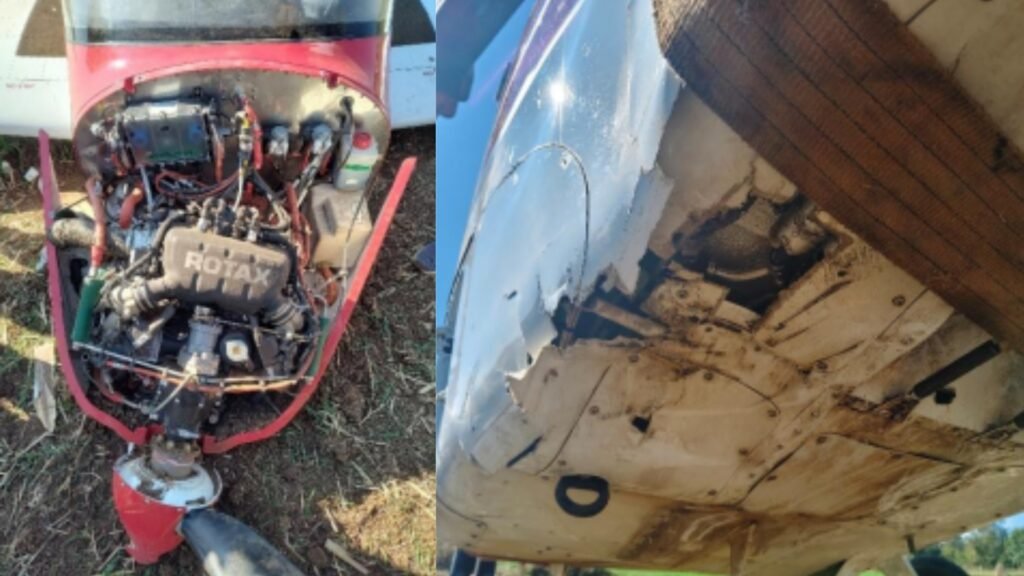
Image: AAIB

According to the AAIB, the aircraft had already completed two touch-and-go landings earlier in the sortie and was on its third approach when the incident occurred. As the aircraft turned onto final approach to Runway 10 at Suktara, the instructor, noting the runway perspective, asked the trainee pilot to increase power. The trainee responded that the engine power was already set at approximately 75 percent.

Moments later, both pilots observed a drop in engine RPM, indicating a loss of power. The instructor immediately took control, informed air traffic control of a forced landing, and maneuvered the aircraft to the right of the approach path while maintaining landing configuration. During the descent, the aircraft struck an overhead power cable and crash-landed in an adjacent field. There was no post-impact fire, and the emergency locator transmitter activated automatically

The flight instructor sustained minor injuries, while the trainee pilot suffered a serious injury, including a maxillary fracture, the report noted. The aircraft was substantially damaged, with broken propeller blades, bent engine mounts, collapsed landing gear, fuselage structural damage, and damage to the engine oil, coolant, and exhaust systems.
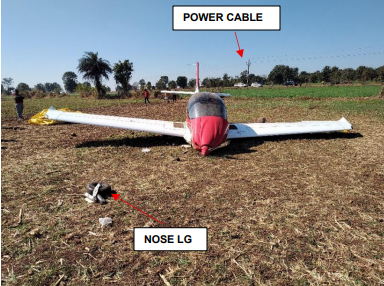
Image: AAIB

VT-RFO, manufactured in 2024, was powered by a Rotax 912 iSc3 Sport piston engine and had valid certificates of registration and airworthiness at the time of the accident. Maintenance records reviewed by investigators showed no deferred defects, and the aircraft had completed a 50-hour inspection less than three weeks prior to the crash.

The trainee pilot had accumulated 46 hours and 40 minutes of total flight time, with just over three hours on type, while the instructor held more than 2,250 flight hours, including 420 hours on the Tecnam P-Mentor. Both pilots had adequate rest prior to the flight and tested negative in pre-flight breath analyser checks

The flight was conducted under day VFR conditions. While Suktara Airfield does not have a formal meteorological facility, local weather observations indicated five kilometres visibility and light winds at the time. The aircraft took off shortly before sunset, which occurred at 1158 UTC, with the crash taking place at approximately 1226 UTC

AAIB clarified that the report is preliminary and does not establish a final cause. Investigators have secured the wreckage, retrieved data from the aircraft’s Garmin display memory card, and collected fuel and oil samples for laboratory analysis. The Engine Control Unit (ECU) is also scheduled for detailed examination to assess engine health and performance parameters.

The sole objective of the investigation is the prevention of accidents and incidents, the bureau stated, noting that findings remain subject to change pending further analysis. 

Leave a Comment

Subscribe to our Newsletter

Recent News

error: Unauthorized copying is not permitted