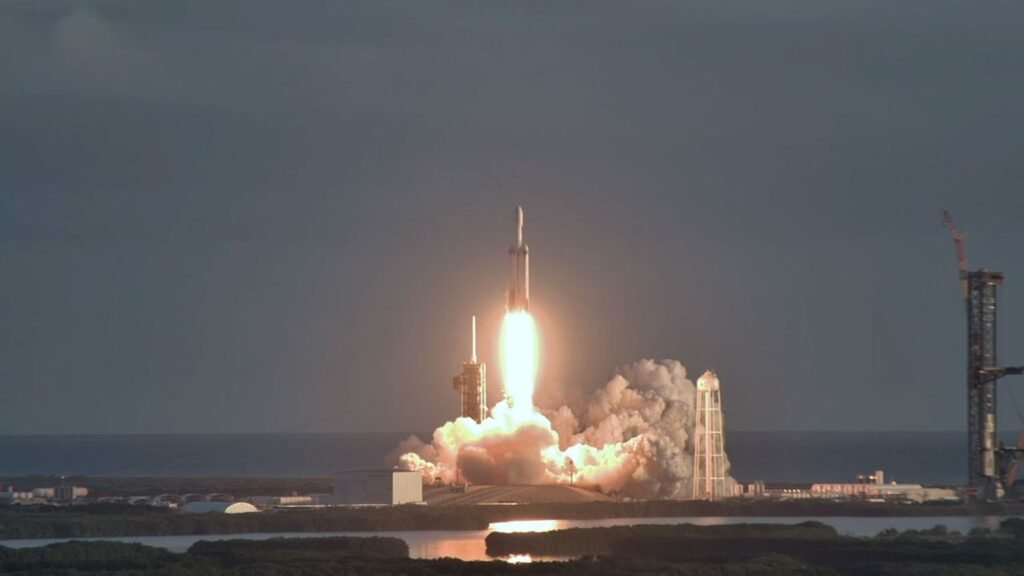
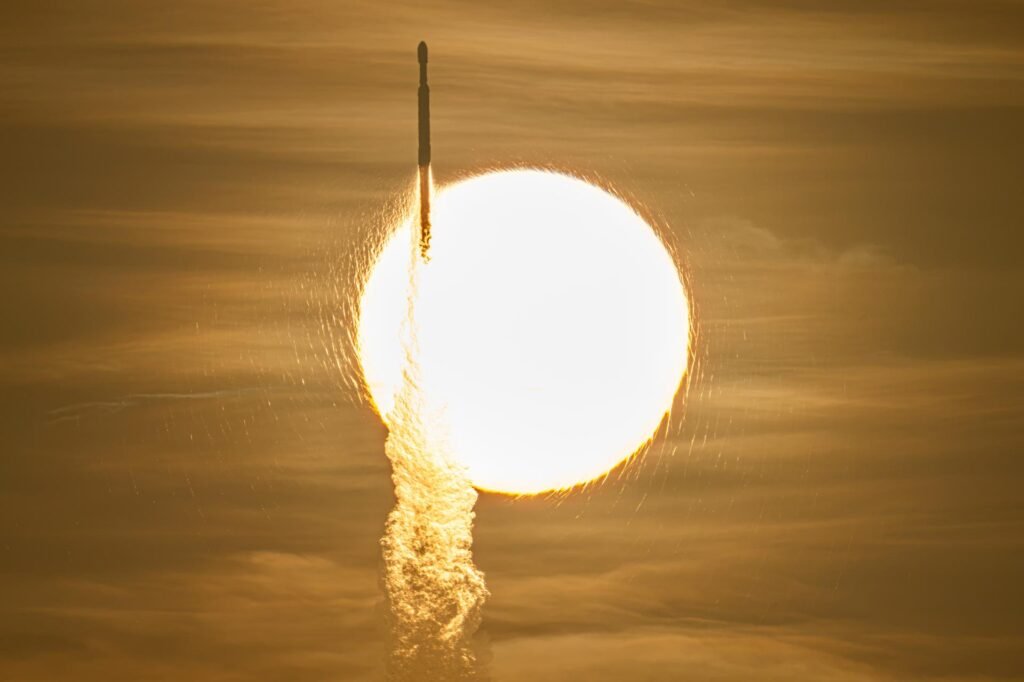
Cape Canaveral, United States: NASA’s Nancy Grace Roman Space Telescope successfully launched on August 30, 2026, beginning a mission designed to investigate some of the biggest unanswered questions in astronomy, including the nature of dark matter and dark energy, the evolution of galaxies and the distribution of planets beyond the Solar System. The $4.3-billion observatory lifted off at 7:26 a.m. EDT aboard a SpaceX Falcon Heavy rocket from Launch Complex 39A at NASA’s Kennedy Space Center in Florida. NASA said Roman is now on a roughly three-month, million-mile journey to its final orbit around the second Sun-Earth Lagrange point, or L2.
The launch marked the beginning of Roman’s transition from a decade-plus development programme to an operational astrophysics mission. NASA said its ground-control team at the Goddard Space Flight Center in Greenbelt, Maryland, began receiving telemetry from the spacecraft about seven minutes after liftoff. The Falcon Heavy separated from Roman approximately 31 minutes into the flight, after which the rocket’s side boosters returned toward the launch site for refurbishment.
The telescope is named after Dr Nancy Grace Roman, NASA’s first chief astronomer, who played a major role in establishing the agency’s space-based astronomy programme. Roman, who died in 2018 aged 93, advocated for space telescopes capable of observing above Earth’s atmosphere and for making astronomical data broadly available. She became widely known as the “mother of Hubble” because of her role in advancing the programme that ultimately produced the Hubble Space Telescope.
NASA Administrator Jared Isaacman described the launch as a major programme milestone, saying, “Delivered ahead of schedule and on budget,” the mission reflects more than a decade of work by NASA employees and industry partners. Isaacman said Roman will provide “a new atlas of the universe” and expand the scope of astronomical discovery.
Nicky Fox, associate administrator of NASA’s Science Mission Directorate at NASA Headquarters in Washington, said Roman would be a “discovery machine” and highlighted its wide field of view and rapid survey capabilities. NASA said the telescope will help make otherwise invisible cosmic phenomena accessible to scientists while providing a foundation for future searches for worlds beyond the Solar System.
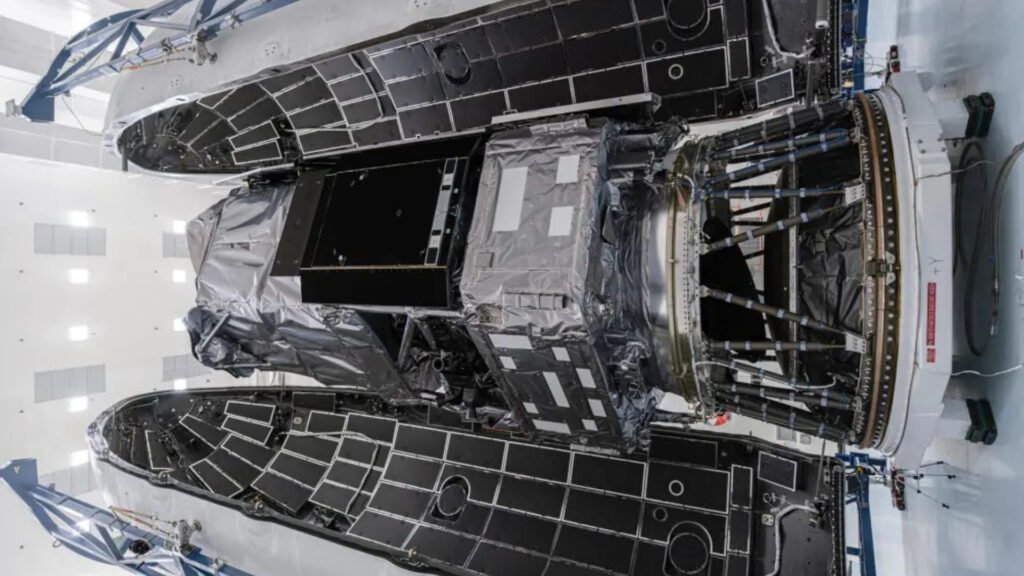
Roman’s biggest advantage over earlier space telescopes is not simply its resolution but the enormous area it can observe in one exposure. Its Wide Field Instrument will provide image quality comparable to Hubble while covering a field of view at least 100 times larger. NASA says Roman can collect astronomical data at speeds up to 1,000 times faster than Hubble, allowing it to conduct surveys that would take Hubble hundreds or thousands of years. Over its first five years, Roman is expected to image more than 50 times as much sky as Hubble has covered during roughly three decades.
The telescope carries a 300-megapixel Wide Field Instrument, an infrared camera capable of capturing an area of sky larger than the apparent size of the full Moon in a single image. Roman will combine wide-field imaging with spectroscopy, enabling scientists not only to locate galaxies and other objects but also to determine information such as their distances and physical properties.
NASA expects Roman to measure light from more than a billion galaxies during its primary mission. Its largest planned survey is expected to cover about 5,100 square degrees, roughly 12% of the sky, with a combination of imaging and spectroscopy. The resulting data will help researchers construct large-scale maps of galaxies and study how cosmic structures evolved.
A central objective is understanding dark matter. Although dark matter cannot be observed directly through emitted light, its gravitational influence can be detected through its effects on visible matter and the bending of light. Roman will use weak gravitational lensing to determine how dark matter is distributed and how its structures have changed over cosmic history. NASA expects the mission to measure the locations and quantities of normal and dark matter across hundreds of millions of galaxies, potentially helping scientists narrow the range of possible dark-matter candidates.
Roman will also investigate dark energy, the poorly understood phenomenon associated with the accelerating expansion of the universe. NASA estimates dark energy accounts for about 68% of the universe’s total contents. The telescope will use several independent techniques, including weak gravitational lensing, observations of Type Ia supernovae and measurements related to baryon acoustic oscillations, to study how the expansion of the universe has changed over time.
The observatory will map galaxies out to roughly 11.5 billion light-years in its dark-energy surveys. By comparing the distances of galaxies with how quickly they are moving away from Earth, astronomers can reconstruct the history of cosmic expansion and investigate whether dark energy has remained constant or changed over time.
Roman is also expected to dramatically expand the search for exoplanets. NASA says the telescope will employ three techniques, gravitational microlensing, planetary transits and direct imaging and could uncover around 100,000 new exoplanets. More than 1,000 of these are expected to be detected through microlensing, a method particularly useful for finding relatively small planets farther from their stars, including worlds comparable in mass to Mars.
For microlensing observations, Roman will monitor hundreds of millions of stars toward the crowded centre of the Milky Way. When the gravity of a foreground star bends and magnifies light from a more distant star, a planet orbiting the foreground star can create a characteristic change in that brightness. This technique can reveal planetary systems that are difficult to detect through conventional methods, including planets in or beyond their stars’ habitable zones.
Roman will simultaneously search for transits, the tiny dips in starlight that occur when a planet crosses in front of its host star. NASA expects this part of the survey to identify around 100,000 large, close-in planets. Scientists may also be able to investigate atmospheric properties, temperatures and climate behaviour for thousands of the planets discovered through transit observations.
The telescope’s second instrument, the Coronagraph Instrument, is designed as a technology demonstration for direct imaging of planets around other stars. It will suppress the overwhelming glare of stars so that faint reflected light from orbiting planets and dusty planetary discs can be detected. NASA says the technology could allow Roman to image smaller, older and colder planets than those commonly accessible through current direct-imaging techniques.
The Coronagraph is particularly significant for future searches for Earth-like worlds. NASA says Roman will provide a technological stepping stone toward the proposed Habitable Worlds Observatory, which is intended to directly image Earth-sized planets in the habitable zones of nearby stars and investigate their atmospheres for potential biosignatures. Roman itself, however, is not a dedicated search-for-life mission.
Beyond its primary objectives, Roman is expected to study a wide range of astronomical phenomena. NASA lists potential research involving rogue planets, isolated black holes, starquakes, kilonova explosions, nebulae, cosmic voids, stellar streams, planet-forming discs, active galaxies and other transient or variable objects. Its repeated observations will effectively allow scientists to construct time-based “movies” of changing regions of the sky.
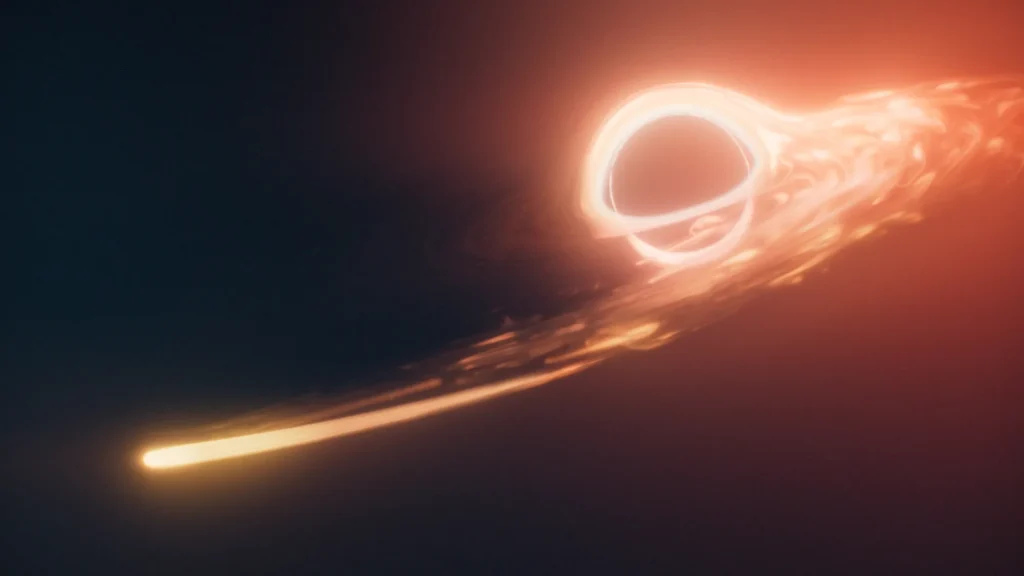
One of Roman’s planned surveys will repeatedly observe the same regions to identify transient events, with NASA expecting roughly 100,000 celestial blasts ranging from exploding stars to feeding black holes. Type Ia supernovae within these observations will serve as distance markers for studying the expansion of the universe. The telescope will also be capable of observing phenomena such as black holes formed during neutron-star mergers and tidal-disruption events involving stars falling toward black holes.
Roman will look inward toward the centre of the Milky Way through its Galactic Bulge Time-Domain Survey. Its infrared capability will allow it to examine hundreds of millions of stars in one of the most crowded regions of the galaxy. The survey could identify planets in wider orbits, rogue planets, brown dwarfs, neutron stars and white dwarfs, while also allowing scientists to study “starquakes” in up to a million giant stars.
Another general astrophysics programme, the Galactic Plane Survey, is designed to map up to 20 billion stars across the Milky Way and reveal structures that have remained difficult to study. NASA says the survey is expected to take only about 29 days of observation time spread across Roman’s first two years, demonstrating the telescope’s ability to survey enormous regions rapidly.
Roman will operate approximately one million miles, or 1.6 million kilometres, from Earth at L2, the same general deep-space region used by the James Webb Space Telescope. At this location, the combined gravitational effects of the Sun and Earth help spacecraft maintain a stable orbit while using relatively little fuel. The location also provides a relatively unobstructed view and reduces the effect of heat from the Sun, Earth and Moon on infrared observations.
The telescope is designed for a primary mission of five years, with NASA planning for the possibility of another five years. Fuel is expected to be a limiting factor, although Roman has been designed with refuelling in mind. NASA currently does not have a servicing capability for observatories at L2.
Roman is more than 42 feet, or 12.7 metres, long and more than 14 feet, or 4.4 metres, wide when fully deployed. It has a dry mass of about 18,000 pounds, or 8,000 kilograms. Its 2.4-metre primary mirror is the same diameter as Hubble’s main mirror but weighs less than one-fourth as much because of advances in mirror technology.
The Wide Field Instrument contains 18 detectors, together providing about 300 million pixels. The detectors are designed to capture huge sections of sky while maintaining fine image detail. Roman also has a 1.7-metre high-gain antenna capable of transmitting data at up to 500 megabits per second. Its six solar panels provide about 4 kilowatts of power.
The scale of Roman’s data output will be unprecedented for a NASA astrophysics mission. NASA expects the observatory to downlink approximately 1.4 terabytes of raw science data every day, accumulating around 20,000 terabytes, or 20 petabytes, of processed data during the five-year primary mission. Unlike many scientific missions, Roman will have no proprietary period for its survey data; NASA plans to make data publicly available as soon as it is processed.
Because of the volume of information, scientists will increasingly work with the data through NASA’s cloud-based Roman Nexus platform rather than downloading entire datasets individually. The open-data approach is intended to allow multiple research groups to work simultaneously on Roman observations and pursue scientific questions beyond the mission’s original objectives.
Roman is intended to complement rather than replace Hubble or James Webb. NASA compares Roman and Webb to wide-angle and zoom lenses: Roman will survey huge areas and identify rare or interesting objects, while Webb can subsequently focus on selected targets for deeper observations. Hubble can similarly provide visible, ultraviolet and infrared follow-up observations that add information to Roman’s panoramic surveys.
The mission will also complement ESA’s Euclid telescope, which is studying dark matter and dark energy through large-scale mapping. While Euclid is designed to cover approximately 15,000 square degrees, Roman will survey a smaller area with greater depth and precision. Roman’s data can also be combined with observations from the ground-based Vera C. Rubin Observatory to improve the identification and separation of closely spaced astronomical objects.
The spacecraft’s development involved NASA’s Goddard Space Flight Center, the Jet Propulsion Laboratory, Caltech/IPAC and the Space Telescope Science Institute, along with industrial partners including BAE Systems, L3Harris Technologies and Teledyne Scientific & Imaging. International contributions came from ESA, France’s CNES, Germany’s Max Planck Institute for Astronomy and Japan’s JAXA, involving spacecraft components, ground stations, precision optics and data-analysis algorithms.
NASA’s JPL built Roman’s Coronagraph Instrument and developed its science capabilities, while Goddard manages the mission and built the Wide Field Instrument. The Space Telescope Science Institute is responsible for science operations, observation scheduling, data processing and the mission archive.
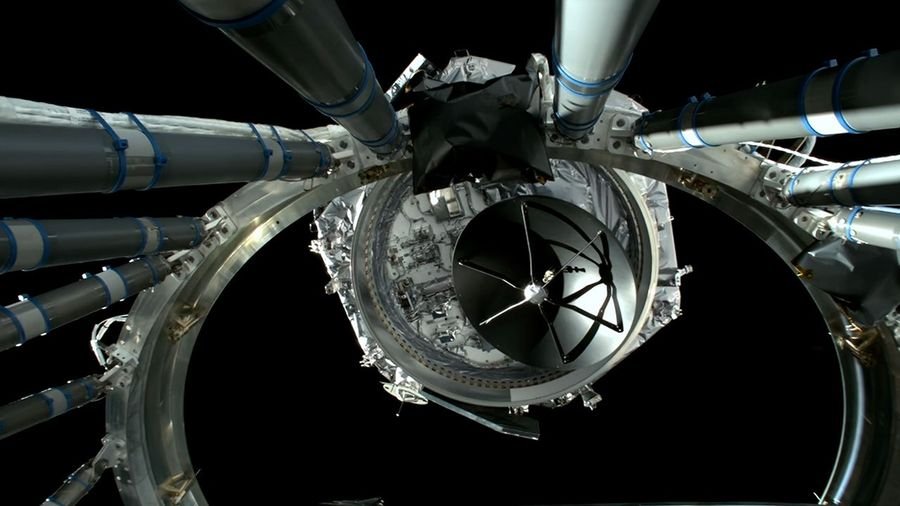
Following launch, Roman must complete a carefully sequenced commissioning process before beginning its main scientific programme. NASA says the spacecraft will deploy its solar panels and sunshade, deploy its communications antenna and aperture cover, perform a mid-course correction and activate the Coronagraph. The Wide Field Instrument is expected to activate a couple of weeks after launch, followed by calibration and testing of both instruments throughout the roughly 90-day commissioning period. NASA anticipates releasing the first new images by early 2027.
The successful August 30 launch therefore represents only the beginning of Roman’s scientific mission. Once it reaches L2 and completes commissioning, the observatory will begin one of NASA’s most ambitious wide-field surveys, combining the image quality associated with Hubble with a dramatically larger field of view and far greater survey speed. Its objective is not merely to produce more images, but to build an unprecedented statistical picture of galaxies, planets, stars and the large-scale structure of the universe potentially providing evidence that could refine, challenge or reshape current models of how the cosmos evolved.