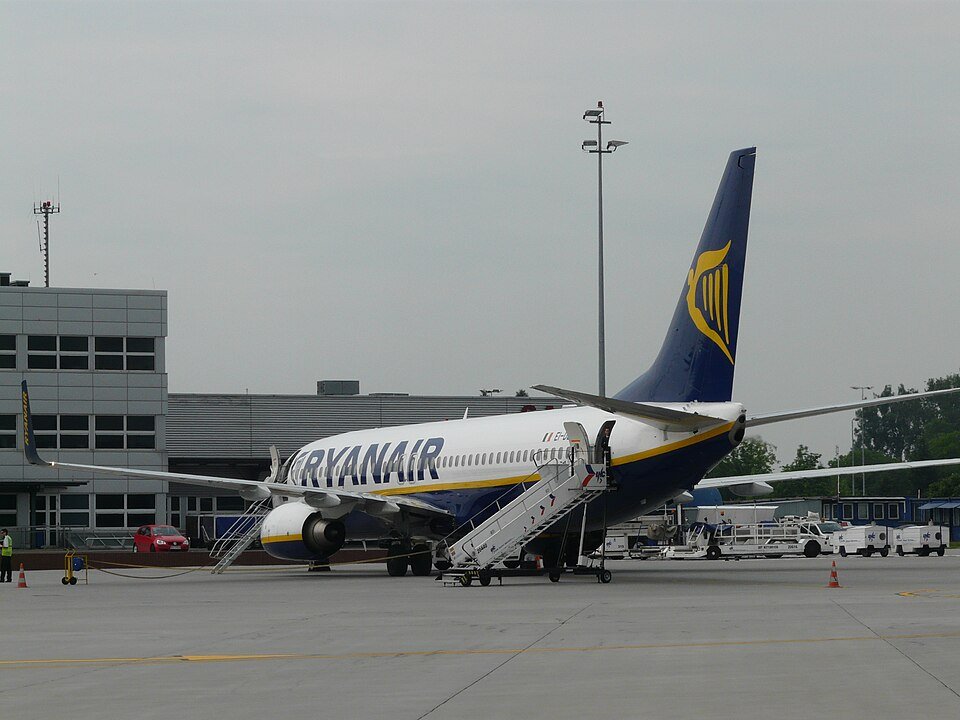
Manchester, United Kingdom: The UK Air Accidents Investigation Branch (AAIB) has published its final investigation report on 24 September, 2026 into a serious incident involving a Ryanair flight FR3418, operated by Malta Air Boeing 737-800, registered 9H-QBD, which landed at Manchester Airport below its final reserve fuel after three windshear escape manoeuvres during Storm Amy on 3 October 2025. The 17-page AAIB report was published on 24 September 2026 following a field investigation. The aircraft was operating Ryanair flight FR3418 from Pisa International Airport, Italy, to Glasgow Prestwick Airport, Scotland, with 171 passengers and six crew. No one was injured and no aircraft damage was reported.
The AAIB found that the aircraft’s three windshear warnings were genuine and that its Enhanced Ground Proximity Warning System (EGPWS) was functioning as designed, with the recorded shear reaching the threshold required to trigger each warning. The investigation also found that Manchester Airport should have accepted the aircraft’s first diversion request, but a “breakdown of communication within the airport” led to it being refused.
The crew had been warned about Storm Amy before departure and had taken additional fuel. The operator had issued a storm pack containing four safety bulletins the previous day and sent another reminder on the day of the flight covering weather disruption and conservative fuel planning. The pilots also selected Manchester as their preferred alternate because its forecast weather was better than the operator-planned alternate, Glasgow.
The aircraft departed Pisa at 15:28 UTC with about 11,671kg of fuel before taxi. The additional fuel included 1,322kg of commander-discretionary fuel, providing approximately 1 hour 12 minutes of additional flight time. However, the amount of fuel that could be carried was constrained because the pilots expected to use Prestwick’s shorter Runway 20, as the forecast crosswind for the longer Runway 30 was outside the aircraft’s limits.
On the first approach to Prestwick, the aircraft encountered severe windshear. At about 264ft above aerodrome level, the warning system announced “windshear, windshear, windshear” and the commander performed a windshear escape manoeuvre before transitioning to a go-around. About 4,608kg of fuel remained. The crew then held for around 20 minutes while waiting to see whether another aircraft of the same type could land.
After another aircraft landed, the crew attempted Prestwick again. They told ATC, “in case of missed approach again, we go straightforward to manchester.” But at about 50ft, a second windshear warning occurred. The crew again performed the escape manoeuvre and went around, with approximately 3,515kg of fuel remaining. Company procedures prohibited a third approach after two abandoned approaches caused by windshear.
The crew’s planned response was to divert to Manchester, but ATC informed them that Manchester was unable to accept the aircraft. The request had reached Manchester at 18:29 UTC, and Airfield Control contacted the relevant parties. At 18:34, Airfield Control told ATC that the handling agent could not accept the diversion. The pilots were informed at 18:37, but no reason for the refusal was given to them.
The AAIB found that Manchester’s own diversion policy stated that aircraft diversions should be accepted when ground capacity was available, while declared emergencies and medical diversions were always to be accepted. The policy also stated that the decision was to be made by Manchester Airfield Operations, not the handling agent.
Manchester had accepted 19 diversions because of Storm Amy that day. The handling agent involved told investigators that its policy was to accept diversions from the operator, but there was no record of the communications between Airfield Control and the handling agent. The AAIB therefore could not establish exactly how the refusal occurred and concluded that it “appeared to have resulted from a breakdown in communication between units within Manchester Airport.”
Following the incident, Manchester Airport reviewed its procedures and reiterated that Airfield Control would make the decision on diversions when parking capacity was available, with handling agents notified but not involved in the decision-making.
With Manchester unavailable and Glasgow reporting windshear on final, the crew requested Edinburgh. The request was made six minutes after being told Manchester had refused the diversion and took another five minutes to be accepted. During this period, the pilots discussed declaring a fuel minimum or MAYDAY to reach Manchester but believed their fuel state did not meet the company’s emergency criteria.
They then headed to Edinburgh, where the reported wind was 240° at 34kt, gusting 46kt. On the approach to Runway 24, the pilots asked whether other aircraft had encountered windshear and were told none had been reported. At approximately 745ft, however, the third windshear warning was triggered. The crew again performed the escape manoeuvre and went around, with 2,164kg of fuel remaining.
The pilots were increasingly concerned about the fuel and the possibility of another windshear warning. They calculated that diverting to Manchester required about 2,800kg to arrive with the 1,101kg final reserve, while they had only around 2,100kg remaining. Their initial estimate was that they would reach Manchester with 500–700kg. Once the Manchester approach was entered into the flight-management computer, it predicted only 300kg on arrival.
The commander then declared, “mayday mayday mayday fuel”. He told Edinburgh ATC, “we are afraid that we will get another windshear here … we would like to divert immediately to Manchester, it was denied before”. The aircraft was cleared towards Manchester.
During the flight to Manchester, the aircraft’s predicted arrival fuel continued to decrease. A low-fuel alert for the left main tank appeared at 19:24:26 UTC, followed by the right-tank low-fuel alert at 19:28:28 UTC. The crew also corrected a fuel imbalance of about 100kg.
The aircraft landed on Runway 23R at 19:51:30 UTC with 363kg of fuel remaining. Just before engine shutdown, the FDR recorded only 240kg. The operator’s final reserve requirement for the flight was 1,101kg. During earlier go-arounds, the engines had consumed fuel at approximately 120kg per minute combined at go-around power.
The AAIB said another go-around at Manchester was unlikely to have been possible with sufficient fuel.
The investigation did not attribute the incident solely to the Manchester diversion refusal. The AAIB examined the crew’s fuel management and decision-making after the third windshear event.
The operator’s manual stated that when final reserve fuel could no longer be protected, a fuel emergency should be declared and “any landing option explored”, including deviating from normal procedures in the interest of safety.
The operator also told investigators that the crew could potentially have declared an emergency earlier if they believed a safe landing at Edinburgh could not be assured because of windshear. However, the crew had based its Edinburgh decision on weather information that reported strong winds but no windshear, while Glasgow was reporting windshear.
After the third windshear escape, the crew considered Manchester the safest option because of its more favourable weather and their concern that another approach at Edinburgh could produce another windshear warning. The AAIB noted that the crew did not consider returning to Edinburgh or using a closer alternative such as Newcastle while heading to Manchester.
The AAIB also noted that Manchester had been the crew’s preferred alternate from the beginning of the flight and said it was “possible that this influenced their decision-making.”
The AAIB concluded that Storm Amy caused the three genuine windshear events, while the refusal of the first Manchester diversion request added another major complication. The investigation found that Manchester’s policies meant the diversion should have been accepted, but a communication breakdown within the airport resulted in the refusal.
The aircraft ultimately diverted through Edinburgh to Manchester and landed with 363kg of fuel, compared with the 1,101kg final reserve requirement. The AAIB recorded no injuries or damage. Following the incident, Manchester Airport reiterated its diversion policy and clarified that the decision to accept an inbound diversion rests with Airfield Control rather than the handling agent.