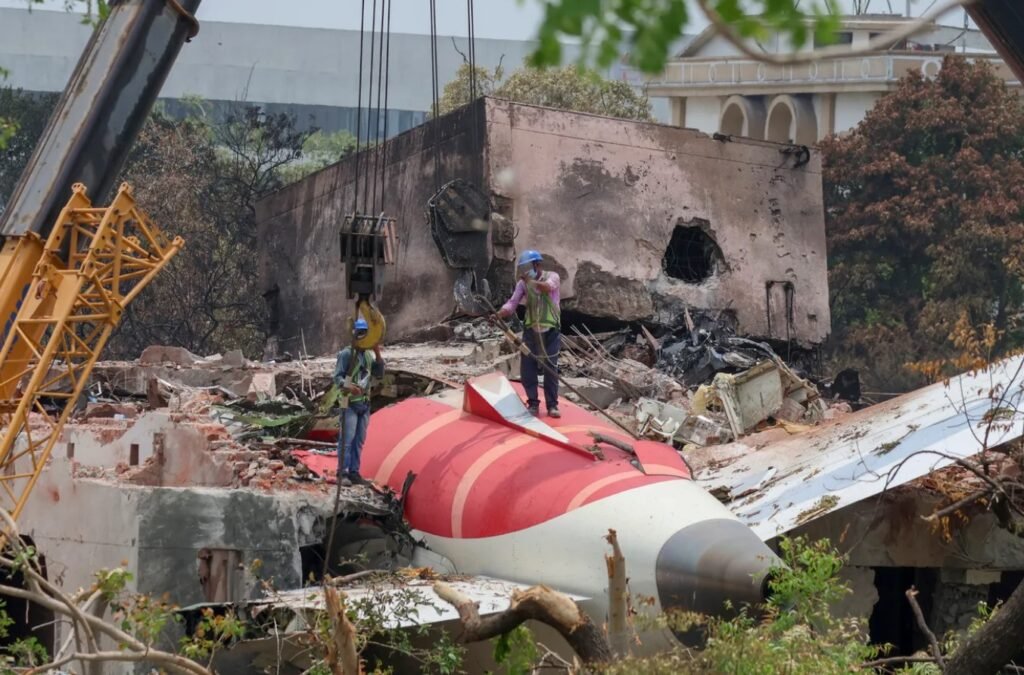
New Delhi, India: Indian authorities are intensifying their investigation into the fatal crash of Air India Flight AI171, with officials confirming that sabotage has not been ruled out as a possible cause. The Boeing 787 Dreamliner, operating on the London-Ahmedabad route, crashed on June 12, resulting in the deaths of 241 people on board and 19 individuals on the ground.
The crash is now considered one of the deadliest aviation disasters in India’s recent history.
Black Box Data Under Analysis
The Aircraft Accident Investigation Bureau (AAIB) confirmed that the cockpit voice recorder (CVR) and flight data recorder (FDR) were recovered from the wreckage and are currently being analyzed at a newly equipped laboratory in New Delhi. Officials reported that data from both recorders has been successfully downloaded and the process of reconstructing the aircraft’s final moments is underway.
The investigation is being carried out with technical assistance from the U.S. National Transportation Safety Board (NTSB), aircraft manufacturer Boeing, and engine maker GE Aerospace.
All Possible Causes Being Investigated
India’s Minister of State for Civil Aviation, Murlidhar Mohol, stated that no potential cause is being ruled out, including mechanical failure, human error, or sabotage. “The government is committed to a transparent investigation. We are examining every angle, including the possibility of sabotage,” Mohol told reporters.
Authorities are scrutinizing CCTV footage from the Ahmedabad airport premises and have questioned several ground-handling personnel. Devices, including mobile phones of certain airport staff, have been seized as part of the probe. Investigators are particularly focusing on any activity near the aircraft in the hours leading up to its departure from London and arrival in Ahmedabad.
Sabotage Considered, But Not Confirmed
While no conclusive evidence of sabotage has yet been found, the Ministry of Civil Aviation has acknowledged that certain anomalies such as a simultaneous failure of both engines are rare and require thorough examination.
Deployment of the aircraft’s emergency Ram Air Turbine (RAT) shortly before impact further supports the theory that the aircraft lost all primary engine power. Officials have not disclosed whether any pre-crash communication indicated a technical or security issue.
Domestic Handling of Investigation
Contrary to earlier speculation, India has decided not to send the black boxes abroad for analysis. According to government officials, all data extraction and analysis are being handled domestically using newly acquired digital forensics infrastructure. India has also declined a request from the United Nations to allow an ICAO-appointed aviation investigator to participate in the probe.
The move has drawn both domestic and international attention, with the government assuring that international best practices under ICAO Annex 13 guidelines are being followed.
Fleet Inspections and Safety Measures
Following the crash, Air India initiated a precautionary inspection of all 33 Boeing 787s in its fleet. As of June 30, 26 aircraft have cleared safety checks, while the remaining seven continue to undergo technical evaluation.
The Directorate General of Civil Aviation (DGCA) has also issued advisories to all Indian carriers to enhance maintenance checks on wide-body aircraft and reinforce pilot training related to engine-out procedures.
Preliminary Report Expected by Mid-July
Under ICAO standards, a preliminary report is due within 30 days of the crash. Officials have indicated that the report is on schedule and should be published by mid-July. A final report, which will include a detailed causal analysis and safety recommendations, is expected within three to six months.
Until then, the AAIB will continue to lead a multi-agency investigation, supported by central aviation authorities, Gujarat Police, counter-terrorism agencies, and technical teams from international aviation partners.
Background
Air India Flight AI171 was approaching Sardar Vallabhbhai Patel International Airport in Ahmedabad when it experienced a sudden and complete loss of engine power. The aircraft crashed in a residential area approximately 8 km from the airport claiming 241 of 242 lives on board and 1 survivor.
This is the first fatal crash involving a Boeing 787 aircraft in Indian aviation history. The incident has prompted widespread scrutiny of Air India’s operational protocols and the broader state of aviation safety oversight in the country.

![Washington, United States: A United Airlines flight bound for Guatemala City made an emergency diversion to Washington Dulles International Airport after a passenger allegedly attempted to open a cabin door at cruising altitude and assaulted another traveler, according to air traffic control communications and federal authorities. The incident involved United Airlines Flight 1551, operated by a Boeing 737 MAX 8, which departed from Newark Liberty International Airport on Thursday evening carrying 145 passengers and six crew members. The aircraft had been en route to Guatemala City when the crew declared an emergency and diverted to Washington Dulles International Airport in Virginia. According to audio between the flight crew and air traffic controllers, the pilot informed controllers that the disruptive passenger attempted to open Door 2L while the aircraft was cruising at approximately 36,000 feet. The pilot also reported that the passenger later assaulted another individual onboard. During the exchange, the tower asked the crew which door the passenger had attempted to access. The pilot responded: “Door 2L at 36,000 feet and then [the passenger] assaulted a fellow passenger.” When controllers asked whether there were any injuries onboard, the pilot replied: “Not to our knowledge.” The aircraft landed safely at Washington Dulles at approximately 8:38 p.m. local time. Law enforcement and emergency personnel met the aircraft upon arrival. The FBI later confirmed that agents responded to the incident at the airport, although the agency did not immediately release additional details regarding the passenger’s identity, possible charges, or whether the individual was taken into federal custody. Flight tracking data showed the aircraft remained airborne for a period before diverting toward the Washington region instead of continuing south toward Guatemala. The diversion temporarily disrupted the scheduled international service but no injuries among passengers or crew were officially reported. United Airlines had not issued a detailed public statement at the time of publication regarding the circumstances surrounding the diversion or the status of the passenger involved. Federal authorities are expected to review crew reports, passenger statements, and onboard evidence as part of the investigation.](https://aviationtoday.in/wp-content/uploads/2026/05/AVIATION-TODAY-UNITEDV-AIRLINES-RUDE-PASSENGER-768x432.jpg)


![Washington, United States: A United Airlines flight bound for Guatemala City made an emergency diversion to Washington Dulles International Airport after a passenger allegedly attempted to open a cabin door at cruising altitude and assaulted another traveler, according to air traffic control communications and federal authorities. The incident involved United Airlines Flight 1551, operated by a Boeing 737 MAX 8, which departed from Newark Liberty International Airport on Thursday evening carrying 145 passengers and six crew members. The aircraft had been en route to Guatemala City when the crew declared an emergency and diverted to Washington Dulles International Airport in Virginia. According to audio between the flight crew and air traffic controllers, the pilot informed controllers that the disruptive passenger attempted to open Door 2L while the aircraft was cruising at approximately 36,000 feet. The pilot also reported that the passenger later assaulted another individual onboard. During the exchange, the tower asked the crew which door the passenger had attempted to access. The pilot responded: “Door 2L at 36,000 feet and then [the passenger] assaulted a fellow passenger.” When controllers asked whether there were any injuries onboard, the pilot replied: “Not to our knowledge.” The aircraft landed safely at Washington Dulles at approximately 8:38 p.m. local time. Law enforcement and emergency personnel met the aircraft upon arrival. The FBI later confirmed that agents responded to the incident at the airport, although the agency did not immediately release additional details regarding the passenger’s identity, possible charges, or whether the individual was taken into federal custody. Flight tracking data showed the aircraft remained airborne for a period before diverting toward the Washington region instead of continuing south toward Guatemala. The diversion temporarily disrupted the scheduled international service but no injuries among passengers or crew were officially reported. United Airlines had not issued a detailed public statement at the time of publication regarding the circumstances surrounding the diversion or the status of the passenger involved. Federal authorities are expected to review crew reports, passenger statements, and onboard evidence as part of the investigation.](https://aviationtoday.in/wp-content/uploads/2026/05/AVIATION-TODAY-UNITEDV-AIRLINES-RUDE-PASSENGER-300x169.jpg)