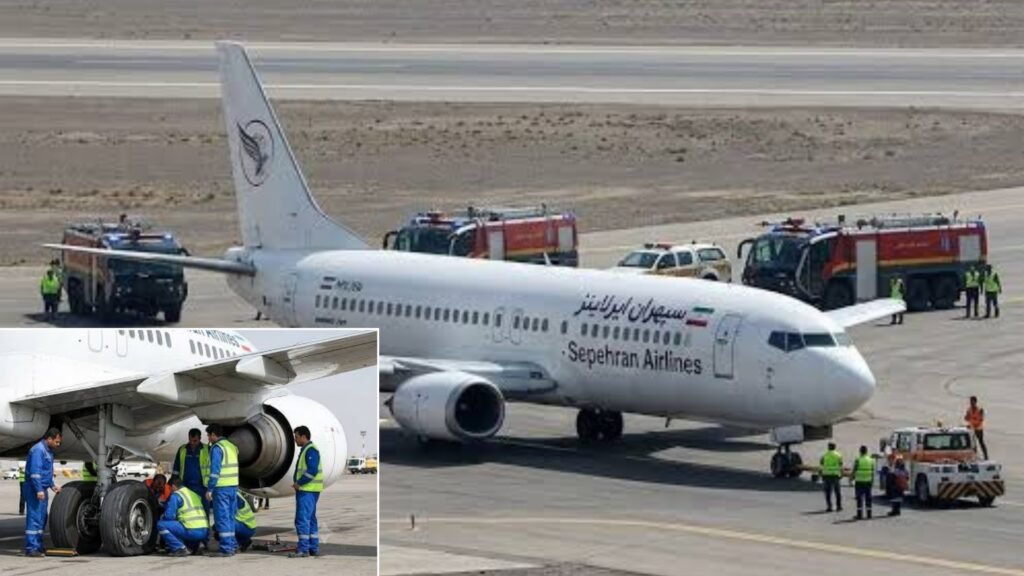
Mashhad, Iran: A Sepehran Airlines Boeing 737 operating a domestic flight from Mashhad to Kermanshah, Iran, returned to Mashhad for an emergency landing on 15 September 2026 after the outer rubber of one landing-gear tyre separated during takeoff and the crew subsequently reported an engine emergency.
The flight departed Shahid Hasheminejad International Airport in Mashhad at around 17:30 local time, with reports putting the emergency at approximately 17:39. According to Hassan Jafari, public relations director of the Razavi Khorasan provincial airports authority, the flight had already been delayed twice earlier in the day before departing for Kermanshah. Jafari said the tyre’s outer surface separated as the aircraft left the runway. He specifically clarified that the tyre itself had not burst.
After becoming airborne, the pilot informed air traffic control that the aircraft’s engine was in an emergency condition and requested to return to Mashhad. The Boeing 737 turned back and landed safely at Shahid Hasheminejad International Airport. Jafari said all passengers safely exited the aircraft and were subsequently transferred to Kermanshah on a replacement flight.
Video recorded inside the aircraft and circulated by Iranian media showed passengers facing a highly alarming situation during the return flight. The cabin can be seen shaking violently, while sections of the overhead ceiling lining became detached and fell into the passenger cabin. Parts of the internal structure above the ceiling were exposed.
Passengers were heard screaming and calling out in fear as the aircraft shook and pieces of the interior came down. Some passengers held on to the seats in front of them or attempted to protect themselves from the falling panels. The footage also shows a section of the ceiling lining hanging down above the seats and into the aisle.
The dramatic cabin footage explains the panic visible among passengers, although reports so far indicate that no passenger or crew member was injured. The footage itself does not establish the technical cause of the cabin interior damage.
Early reports described the incident as a tyre burst followed by engine damage and severe vibrations. However, the more specific statement from the Razavi Khorasan airport authority says that the outer rubber/tread of one tyre separated during takeoff and that the pilot later reported an engine emergency. The precise connection between the tyre problem, the reported engine issue, the severe vibration and the cabin ceiling damage has not yet been established publicly.
Jafari said: “The passengers safely exited the aircraft and were sent to Kermanshah on a replacement flight.”
He also confirmed that the airport runway was temporarily closed for inspection following the incident and later reopened, with flights resuming normally. Iranian reports said both runways were subsequently available for operations.
The Civil Aviation Organisation of Iran is investigating the incident to determine the precise cause of the technical failure and the subsequent damage.
The aircraft was a Boeing 737 operated by Sepehran Airlines on the Mashhad-Kermanshah route. The actual number of passengers and crew onboard has not been reliably disclosed. The aircraft was ultimately able to land safely at its departure airport, and there were no reported fatalities or injuries. Passengers continued their journey to Kermanshah on another aircraft.
The incident came only weeks after another Sepehran Airlines Boeing 737 incident at Mashhad. On 25 August 2026, a Boeing 737-500 operating flight IS4310 from Tehran to Mashhad veered off the runway after landing and stopped with its nose landing gear collapsed. Reports said 127 people were onboard and no injuries were reported. Iran’s Civil Aviation Organisation opened an investigation into that incident as well. The two events are separate incidents, and there is currently no official finding linking them.