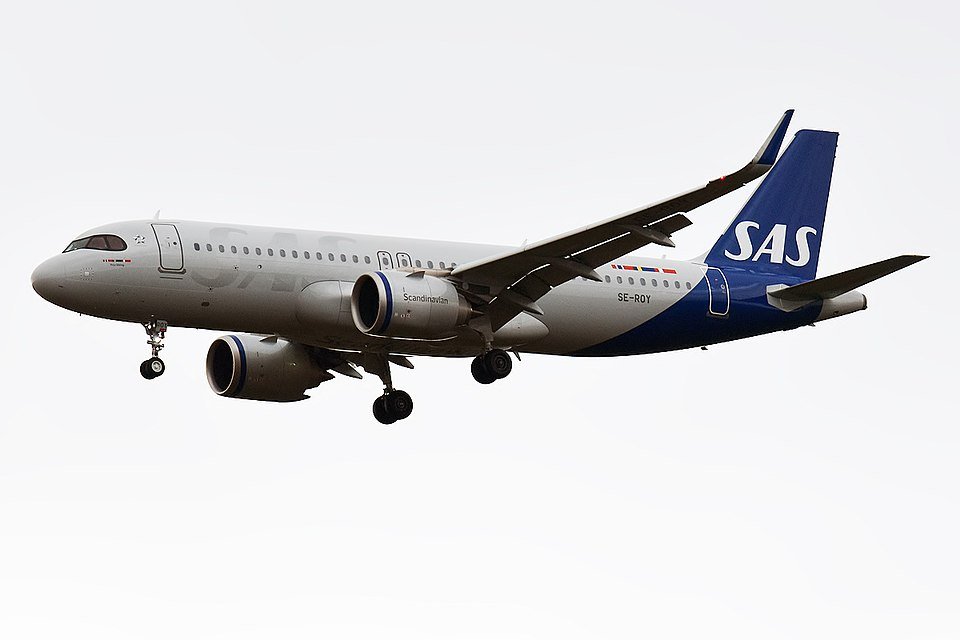
Trondheim, Norway: A Scandinavian Airlines (SAS) domestic flight was forced to make an emergency diversion to Trondheim Airport Værnes on Sunday after smoke from an overheated power bank in the passenger cabin prompted the crew to seek an immediate landing, authorities confirmed.
Flight SK4416, operated by an Airbus A320neo registered SE-RUO, was en route from Oslo Airport Gardermoen to Tromso with 186 passengers on board when the crew reported the presence of smoke in the cabin shortly after midday. The aircraft was cruising at altitude when occupants alerted crew to unusual smoke and heat, leading the pilots to divert to the nearest airport as a precaution.
Local authorities stated that the smoke originated from a passenger’s lithium-ion power bank, which exhibited signs of overheating and could not be cooled by standard in-flight containment procedures. Emergency response teams were activated on arrival at Værnes, where firefighters removed the device and secured the aircraft.
Police operations manager Oystein Sagen said that four to five crew members were exposed to smoke and were evaluated by medical personnel after the aircraft landed safely. All were later discharged. There have been no confirmed injuries among passengers; medical assistance was offered on a precautionary basis.
Initial confusion about the source of the smoke led to early, unverified reports suggesting a cockpit fire, but official statements clarified that the event originated in the main cabin.
Lithium-ion batteries, like those found in portable power banks, are known to pose a fire risk if they experience thermal runaway, a rapid, uncontrollable rise in temperature that can produce smoke and toxic gases. Regulators and airlines globally treat such incidents with the highest priority due to the potential for rapid escalation at altitude.
In recent months, aviation safety authorities have introduced tighter controls on the carriage and use of power banks. For example, India’s Directorate General of Civil Aviation (DGCA) has prohibited the use of power banks during flight and requires that they be carried only in cabin baggage and remain accessible to crew in case of emergency.
SAS’s own luggage guidelines specify that spare batteries and power banks must be transported in carry-on baggage, protected against short circuits, and not placed in overhead bins or used in flight.
Airport operations at Trondheim were not significantly disrupted following the diversion. After inspection and removal of the defective device, the aircraft was reported to remain on the ground for approximately 26 hours before returning to service.

![Washington, United States: A United Airlines flight bound for Guatemala City made an emergency diversion to Washington Dulles International Airport after a passenger allegedly attempted to open a cabin door at cruising altitude and assaulted another traveler, according to air traffic control communications and federal authorities. The incident involved United Airlines Flight 1551, operated by a Boeing 737 MAX 8, which departed from Newark Liberty International Airport on Thursday evening carrying 145 passengers and six crew members. The aircraft had been en route to Guatemala City when the crew declared an emergency and diverted to Washington Dulles International Airport in Virginia. According to audio between the flight crew and air traffic controllers, the pilot informed controllers that the disruptive passenger attempted to open Door 2L while the aircraft was cruising at approximately 36,000 feet. The pilot also reported that the passenger later assaulted another individual onboard. During the exchange, the tower asked the crew which door the passenger had attempted to access. The pilot responded: “Door 2L at 36,000 feet and then [the passenger] assaulted a fellow passenger.” When controllers asked whether there were any injuries onboard, the pilot replied: “Not to our knowledge.” The aircraft landed safely at Washington Dulles at approximately 8:38 p.m. local time. Law enforcement and emergency personnel met the aircraft upon arrival. The FBI later confirmed that agents responded to the incident at the airport, although the agency did not immediately release additional details regarding the passenger’s identity, possible charges, or whether the individual was taken into federal custody. Flight tracking data showed the aircraft remained airborne for a period before diverting toward the Washington region instead of continuing south toward Guatemala. The diversion temporarily disrupted the scheduled international service but no injuries among passengers or crew were officially reported. United Airlines had not issued a detailed public statement at the time of publication regarding the circumstances surrounding the diversion or the status of the passenger involved. Federal authorities are expected to review crew reports, passenger statements, and onboard evidence as part of the investigation.](https://aviationtoday.in/wp-content/uploads/2026/05/AVIATION-TODAY-UNITEDV-AIRLINES-RUDE-PASSENGER-768x432.jpg)


![Washington, United States: A United Airlines flight bound for Guatemala City made an emergency diversion to Washington Dulles International Airport after a passenger allegedly attempted to open a cabin door at cruising altitude and assaulted another traveler, according to air traffic control communications and federal authorities. The incident involved United Airlines Flight 1551, operated by a Boeing 737 MAX 8, which departed from Newark Liberty International Airport on Thursday evening carrying 145 passengers and six crew members. The aircraft had been en route to Guatemala City when the crew declared an emergency and diverted to Washington Dulles International Airport in Virginia. According to audio between the flight crew and air traffic controllers, the pilot informed controllers that the disruptive passenger attempted to open Door 2L while the aircraft was cruising at approximately 36,000 feet. The pilot also reported that the passenger later assaulted another individual onboard. During the exchange, the tower asked the crew which door the passenger had attempted to access. The pilot responded: “Door 2L at 36,000 feet and then [the passenger] assaulted a fellow passenger.” When controllers asked whether there were any injuries onboard, the pilot replied: “Not to our knowledge.” The aircraft landed safely at Washington Dulles at approximately 8:38 p.m. local time. Law enforcement and emergency personnel met the aircraft upon arrival. The FBI later confirmed that agents responded to the incident at the airport, although the agency did not immediately release additional details regarding the passenger’s identity, possible charges, or whether the individual was taken into federal custody. Flight tracking data showed the aircraft remained airborne for a period before diverting toward the Washington region instead of continuing south toward Guatemala. The diversion temporarily disrupted the scheduled international service but no injuries among passengers or crew were officially reported. United Airlines had not issued a detailed public statement at the time of publication regarding the circumstances surrounding the diversion or the status of the passenger involved. Federal authorities are expected to review crew reports, passenger statements, and onboard evidence as part of the investigation.](https://aviationtoday.in/wp-content/uploads/2026/05/AVIATION-TODAY-UNITEDV-AIRLINES-RUDE-PASSENGER-300x169.jpg)