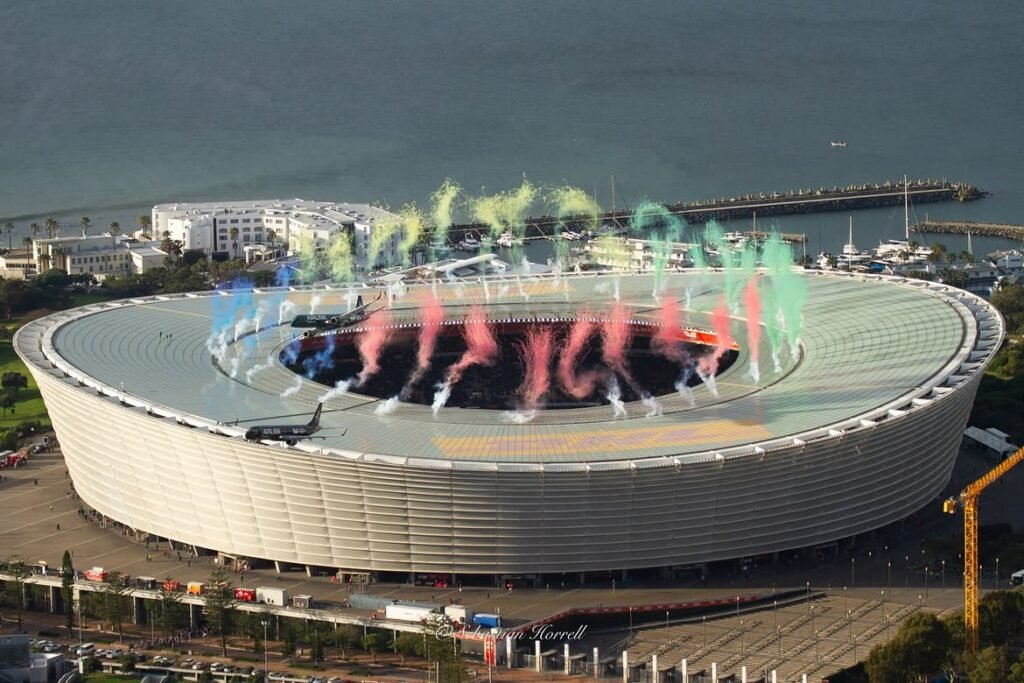
Cape Town, South Africa: Two Airlink Embraer jets flew as close as an estimated 41-46 feet (12.5-14 metres) above the roof of Cape Town’s DHL Stadium during a pre-match formation flypast on August 29, 2026, prompting a South African Civil Aviation Authority (SACAA) compliance review after footage of the manoeuvre went viral.
The flypast took place shortly before the second Test between the Springboks and New Zealand’s All Blacks in the four-match Rugby’s Greatest Rivalry series. About 56,000 spectators were in the stadium as the two aircraft passed overhead before South Africa went on to defeat New Zealand 33-26.
The aircraft involved were an Embraer E195, registration ZS-YDE, flying in a black All Blacks-themed livery, and an Embraer E190, registration ZS-YAE, carrying a green Springboks-themed livery. The E195 was the lead aircraft and was the one that came closest to the stadium roof based on flight-tracking calculations.
Neither aircraft carried passengers. Airlink said each jet was operated by three senior captains serving as commander, co-pilot and safety/technical officer, with the crews having more than 75,000 combined flight hours.
The aircraft flew at about 150 knots during the low-level formation pass. Airlink said the manoeuvre had been extensively planned and rehearsed and was conducted with guidance, approval and support from SACAA and Air Traffic Navigation Services.
Flight-tracking service Flightradar24 later analysed ADS-B data from the operation. It recorded a lowest raw altitude of 50 feet at standard pressure. After correction for Cape Town’s local pressure setting of 1019 hPa, the aircraft were estimated to have been at about 205-210 feet above mean sea level. With DHL Stadium standing approximately 164 feet high, the estimated clearance above the roof was therefore about 41-46 feet.
The low clearance became particularly striking in videos recorded from inside and around the stadium. The trailing aircraft was also seen passing through a cloud of pink dust or smoke generated by the pre-match pyrotechnic display. There has been no confirmed report of either aircraft striking the stadium, pyrotechnics or any other object, and no injuries or aircraft damage have been reported.
Airlink defended the operation after the footage triggered criticism online. In its August 30, 2026 statement, the airline said the flight required “careful planning and rehearsal” because it involved low-altitude navigation at around 150 knots. It said SACAA and Air Traffic Navigation Services had provided guidance, approval and support to ensure a safe flyby.
The airline also said flight data recorded by both aircraft confirmed that the operation was conducted within the altitude and speed limits approved and rehearsed with SACAA.
The regulator subsequently began a compliance review. SACAA said Airlink had submitted three applications for flypasts linked to the rugby matches, with the first operation taking place at Ellis Park in Johannesburg on August 22, 2026 and the second at DHL Stadium on August 29, 2026.
According to SACAA, the Cape Town operation had been formally approved under the regulatory provisions governing non-passenger or cargo-carrying flights under Part 91.06.32. The operator had also submitted supporting documentation, completed a simulator practice flight and conducted a safety briefing before the operation.
The authority said the flypast was approved in accordance with the requirements for Special Air Events. However, after media and public discussion over the unusually low flight path, SACAA initiated compliance verification, engaged Airlink and obtained the aircraft’s Flight Data Recording downloads.
SACAA said it is now analysing the data and has requested additional information from Airlink before reaching an informed position. The authority said a full report containing recommendations will be issued once the assessment is completed.
“It is therefore critical that we interrogate this past weekend’s events to determine if there were any safety concerns which warrant a review,” SACAA said.
The regulator also emphasised South Africa’s commercial aviation safety record, saying the country had maintained a zero fatal-accident record in commercial airline operations for more than four decades. SACAA said that record was one it intended to preserve as it continued to strengthen aviation safety standards.
Airlink CEO de Villiers Engelbrecht later said the airline recognised the public interest generated by the flypast and the questions that followed, adding: “We never intended to become the news or upstage Rugby’s Greatest Rivalry.”
Chris Martinus, president of the Aircraft Owners and Pilots Association South Africa, said the lead aircraft appeared to be manoeuvring over the stadium with very little room for error. He said that if something adverse occurred at such an altitude, the pilots would have few options.
Australian aviation consultant and former military and commercial pilot Keith Tonkin also warned that turbulence or a bird strike could leave a jet with insufficient room to manoeuvre safely at that height. He said the broader concern was the precedent created by an operation that other operators might seek to replicate.
The flypast was part of a long-standing South African rugby tradition. The practice gained particular prominence during the 1995 Rugby World Cup final, when a South African Airways Boeing 747 flew over Ellis Park before the Springboks faced the All Blacks.
Airlink had planned to continue the tradition at the next Rugby’s Greatest Rivalry Test at Johannesburg’s FNB Stadium on September 5, 2026. However, the airline notified SACAA on September 1, 2026 that it was withdrawing its application for the third flypast. Airlink said unfavourable weather conditions meant the planned formation flight could not be safely conducted.
SACAA confirmed the withdrawal but has not yet released a final finding on the Cape Town operation. The authority’s review will determine whether the two aircraft complied fully with the approved flight parameters and whether any additional safety measures or recommendations are required.