Leipzig, Germany: The German government on Tuesday, September 1, 2026, blamed Russia for an attempted explosive-drone attack at Leipzig/Halle Airport on August 4, 2026 saying investigators had established links to Russian state entities and that the incident formed part of a broader campaign of hybrid operations against Europe.
German Interior Minister Alexander Dobrindt said police investigations, the pattern of the incident and intelligence findings pointed to Russian responsibility. “Taken together, the police investigations, the pattern and intelligence findings prove a Russian responsibility for the attempted attack at Leipzig airport,” Dobrindt said. He added that intelligence indicated that people involved in the operation had acted “on behalf of Russian state entities.”
Dobrindt said investigators had identified the drone’s configuration, components, explosives and detonator as elements “known to us from other Russian hybrid operations and its war against Ukraine.” He said the technology found at the scene demonstrated “a high degree of technical expertise” and considerable planning, while suggesting that lower-level operatives may have been used to carry out the operation.
Foreign Minister Johann Wadephul said Germany did not regard the Leipzig incident as an isolated case. “It fits into a broader pattern of Russian hybrid operations in Europe,” he said. Wadephul described Germany as facing the “daily reality of hybrid warfare” and said the government would respond with measures that were “proportionate and measured, yet equally resolute.”
The attribution came after Chancellor Friedrich Merz said on Sunday, August 30, that the investigation was nearing completion. “We are in the process of concluding the investigation,” Merz said, adding that there was broad agreement within the Federal Government on the response and that it would be made clear “in the coming days.” He also said Germany’s European Union and NATO partners had been informed and would be prepared for the government’s announcement.
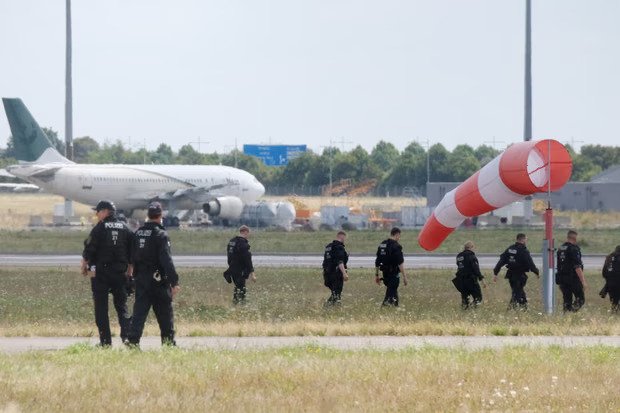
The incident itself occurred on August 4, 2026 when an explosives-laden drone was discovered inside the secure area of Leipzig/Halle Airport near Ukrainian Antonov cargo aircraft. The device was defused by bomb-disposal specialists after its detonator failed to trigger the explosives. Reports have put the explosive load at about 600 grams, with investigators later finding traces of the military explosive hexogen at another location near the airport.
The Ukrainian Antonov aircraft at Leipzig/Halle are used to transport military supplies to Ukraine. Investigators have examined whether the drone was intended to strike one of those aircraft. The failed detonation meant the suspected attack did not cause the potentially catastrophic damage German officials warned could have resulted if the explosives had detonated.
A second drone was also investigated after a DHL cargo aircraft encountered an unidentified object and had to divert. Early reports suggested the object could have been another drone involved in the operation, although investigators later questioned whether the second incident was directly connected to the planned attack. A third drone was subsequently found in a field near the airport, with forensic investigators detecting traces that were initially assessed as possibly being hexogen.
The airport briefly faced operational disruption during the initial incident, while authorities secured the area and carried out explosive-disposal operations. Leipzig/Halle is a major European cargo hub and has become an important logistics location for Ukrainian Antonov aircraft after Russia destroyed the airline’s home base at Hostomel in Ukraine following its 2022 invasion.
Germany has now announced diplomatic and economic measures in response to the attribution. Berlin said Russia’s consulate general in Bonn would be closed, while the agreement covering the Russian House cultural centre in Berlin would be terminated. Germany also plans to push for additional EU sanctions and travel restrictions targeting Russian nationals and increase pressure on Russia’s so-called shadow fleet.
The Russian ambassador was summoned to the German Foreign Ministry following the announcement. Russia rejected the accusation. Kremlin spokesman Dmitry Peskov said the allegations had not been supported by evidence and described Germany’s actions as an escalation, while Russian Foreign Ministry spokeswoman Maria Zakharova said Moscow would respond to what she called Berlin’s “anti-Russian action.”
Germany’s accusation has received support from European allies and NATO. NATO Secretary General Mark Rutte said Berlin had presented clear evidence of Moscow’s role, while European Commission President Ursula von der Leyen expressed solidarity with Germany. Leaders and officials from Poland, Italy, the UK, Sweden, France and Canada also backed Berlin’s response and warned against further Russian hybrid activity in Europe.
Tuesday’s announcement marks the first time the German government has officially and directly identified Russia as responsible for the Leipzig/Halle airport incident. Berlin has linked the case to a wider security concern involving alleged Russian sabotage, espionage, cyber activity, disinformation and attacks on critical infrastructure across Europe.