Busan, South Korea: A former airline co-pilot in South Korea, Kim Dong-hwan, 49, was sentenced to life imprisonment by the Busan District Court on August 21, 2026, after being convicted of murdering a former airline colleague and plotting to kill five other people. The court also ordered him to wear an electronic monitoring device for 30 years. Kim was convicted of murder, attempted murder, preparing to commit murder, trespassing and violating information-network laws.
Kim was a former airline first officer/co-pilot. South Korean reports said he had worked at the same airline as the victims before leaving the company in 2024. He had previously served as an Air Force information officer, rather than as an Air Force pilot. Reports reviewed for this case have not identified the airline by name, describing it only as the airline where Kim and the victims had worked.
The case involved six intended victims, all described as airline captains who were former colleagues or had professional connections with Kim. However, only one person was killed. The victim was a male airline captain in his 50s, identified in court and police reports as “A” because authorities have not publicly disclosed his name. Kim allegedly stabbed him repeatedly at an apartment in Busanjin-gu, Busan, at about 5:30 a.m. on March 17, 2026.
The day before the killing, on March 16, Kim allegedly targeted another former colleague, identified as “B”, also an airline captain. He went to the victim’s residence in Ilsanseo-gu, Goyang, Gyeonggi Province, and attempted to kill him by strangulation. The victim survived and the attack was treated as attempted murder. Reports said Kim had disguised himself as a delivery worker and used the apartment’s circumstances to approach the victim.
After killing the Busan captain on March 17, Kim travelled to Changwon in South Gyeongsang Province, where another former colleague, identified as “C”, lived. Police said he went there intending to carry out another attack, but the planned killing did not take place. He subsequently fled towards Ulsan. Police arrested him at about 8 p.m. on March 17, roughly 14 hours after the Busan killing. He was formally detained on March 20.
The investigation later established that the original four-person target list was actually larger. Police found evidence that Kim had designated six airline captains as targets. The first four were the people for whom investigators found the most detailed preparations, while two additional targets were identified during the investigation. Police said the two additional targets did not appear to have been prepared as meticulously as the original four.
Investigators said Kim had spent months preparing the attacks. Prosecutors later established that he had begun preparing in approximately August 2025, around seven to eight months before the March 2026 attacks. He allegedly followed the intended victims, surveyed their residences and routines, purchased tools for the crimes and attached GPS tracking devices to vehicles to monitor their movements.
Kim also allegedly exploited information from his former workplace. After leaving the airline, he used another former colleague’s account to access the airline’s internal flight-schedule system 17 times. Investigators said he used the information to determine the targets’ flight schedules and movements, allowing him to identify opportunities to approach them. Police said they were also investigating how the account credentials had been obtained and whether anyone had helped him.
Investigators found that Kim had also carried out surveillance around the residences of the six intended victims. Prosecutors said he planned the timing, locations, methods and escape routes for the attacks. He allegedly used cash and prepaid transportation cards in an attempt to make his movements harder to trace and at times disguised himself as a delivery worker.
The motive presented by Kim centred on his belief that former colleagues connected with the Air Force Academy had systematically undermined him. He claimed that Air Force Academy graduates and pilot colleagues had caused professional disadvantages and ultimately contributed to his departure from the airline. Investigators, however, did not find evidence supporting his claims of systematic mistreatment.
Another grievance involved money following his departure from the airline. South Korean reports said Kim had sought a payment from a pilots’ mutual-aid association after leaving the company but received substantially less than he expected. He subsequently pursued legal action and lost part of the dispute. Prosecutors considered the dispute and his perception of professional mistreatment when examining the background to the killings, but the court ultimately rejected his explanation as a sufficient justification for the attacks.
The Busan court said Kim’s explanation for the killings was not convincing. The court stated, “this is merely a one-sided claim,” referring to his allegation that the victims had systematically slandered him and disadvantaged him. The court also noted that some of the victims did not understand why Kim held a grudge against them and that some had only a vague recollection of him.
The court further cited the results of a psychological assessment, saying Kim showed a strong tendency towards egocentric thinking, posed a high risk of reoffending and required psychiatric treatment. The court concluded that he needed to be permanently separated from society.
Police had earlier conducted a psychopathy assessment using the Hare Psychopathy Checklist-Revised. Kim did not meet the criteria for psychopathy, according to police.
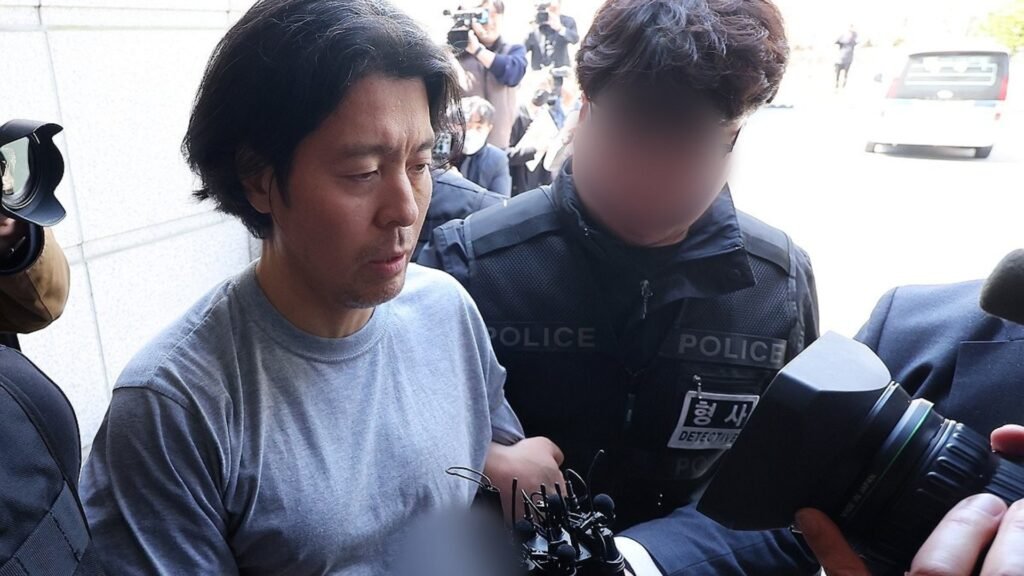
Kim was transferred from police custody to the Busan District Prosecutors’ Office on March 26. Police charged him with murder, attempted murder and preparation for murder, while the eventual indictment also included trespassing and violations of the Information and Communications Network Act.
During the transfer, Kim continued to defend his actions. When reporters questioned him about the motive, he described what he viewed as an entrenched privileged group and said, “It is ‘hubris’ the idea that the vicious privileged class can destroy a life, an individual’s life.” He also referred to the attacks as “a mad ‘nemesis,’ divine punishment.”
In another court appearance in July, Kim claimed that he had become a “Korea Air Force Academy killer” and said he had decided to fight back against what he described as a group linked to the academy. Yonhap reported that Kim said he had become someone who only targets academy graduates. These were Kim’s own claims and were not accepted by investigators or the court.
At trial, Kim initially sought a citizen-participatory trial but later withdrew the request. He acknowledged the prosecution’s factual allegations but continued to dispute aspects of the evidence and sought information about colleagues who had requested police protection.
At the final hearing on August 11, prosecutors sought life imprisonment and requested that Kim be placed under electronic monitoring for 30 years. Prosecutors argued that the case involved multiple intended victims, extensive preparation, brutal methods and a lack of genuine remorse.
Kim also made disturbing remarks about the five people who remained on his target list. According to SBS, he suggested that their fate had already been decided and claimed that if he could not carry out the attacks himself, someone else would do so. When asked whether he regretted or blamed himself for the crimes, he reportedly answered that he had no such feelings. When the judge asked whether he felt remorse toward the victims, Kim replied, “None. It is because they are the perpetrators.”
The Busan District Court ultimately sentenced Kim to life imprisonment on August 21, 2026, along with 30 years of electronic monitoring. The court said the crimes were carefully planned and that his claimed motive was difficult to accept. It concluded that permanent isolation was necessary because of his high risk of reoffending and the danger of further harm.
As of the latest court ruling, Kim Dong-hwan has been convicted of killing one airline captain. He did not kill five other people; rather, five additional people were among the six total intended victims. One survived an attempted killing in Goyang, one additional attack in Changwon was not completed, and four other intended victims were part of the wider murder-preparation case.