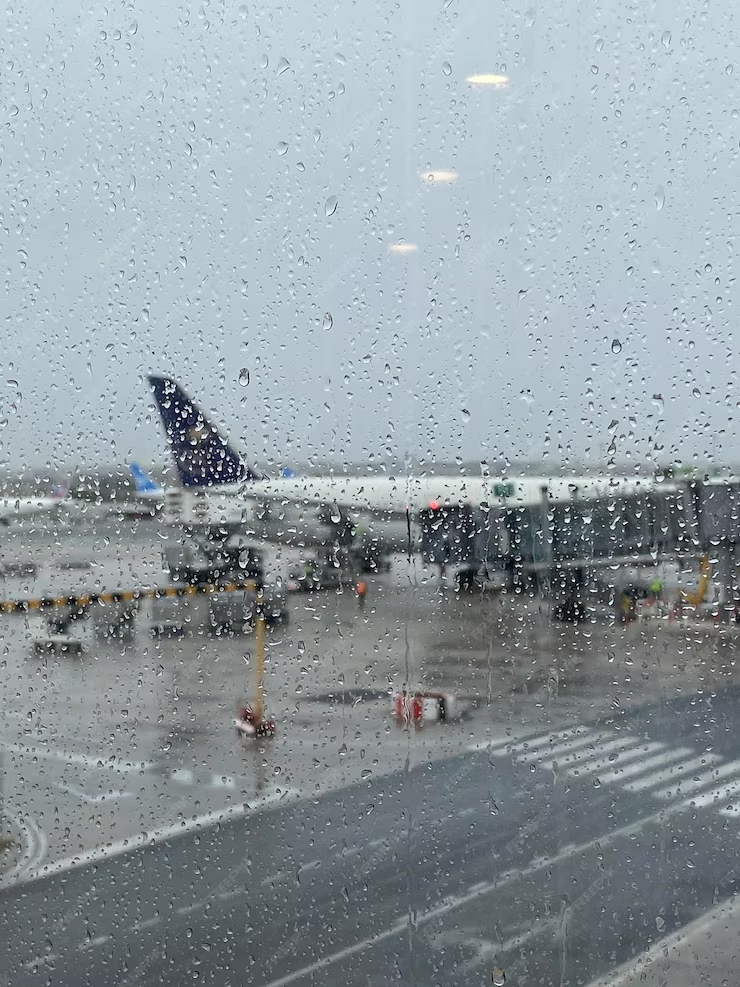
India: Indian domestic airlines may soon be required to provide the India Meteorological Department (IMD) with real-time weather data in an effort to increase meteorological accuracy and aviation safety. By using the information gathered by airlines while they are operating, this action seeks to improve the nation’s weather forecasting systems.
India experiences diverse and extreme weather conditions, from monsoons and cyclones to heat waves and fog. Accurate weather predictions are crucial for safety and efficient flight operations. Currently, the IMD relies on weather stations, satellites, and radars to generate forecasts. Integrating data from aircraft, which traverse various altitudes and regions, could significantly enhance these predictions by filling gaps in the existing network.
M Ravichandran, secretary in the Union Ministry of Earth Sciences, told PTI that his ministry had been in discussions with the civil aviation ministry on the matter, and providing weather data would be “made mandatory for domestic airlines within a year”.
“It has to be mandatory… It will not only be very useful for airline operations but also for weather forecasts everywhere” he said.
He said that with new airports coming up in different parts of the country, the weather office could have access to data from a wider geographical region, leading to better localised predictions.
“The more observations we have, the better our predictions can be. It is similar to an exit poll — if you gather data from more places, you will get a clearer picture. In the same way, we aim to collect information on temperature, humidity, and wind wherever possible” he said.
Vertical weather observations (obtained from aircraft and weather balloons) are more important than ground observations because they provide a complete picture of the atmosphere, not just what is happening at the surface, Ravichandran said.
Weather systems such as storms form and evolve in the atmosphere, where temperature, humidity and wind conditions at different altitudes play a key role, he said.
Aircraft also record weather data during takeoffs and landings. This data is transmitted to the ground in real-time and integrated into forecasting models. Unlike the limited number of weather balloons, thousands of aircraft can relay data.
Ravichandran said all aircraft operating on international routes provided weather data because it was required by law.
However, not all domestic airlines do so as it is not mandatory for them.
He said many countries had made it mandatory for their airlines to provide this data and India needed to have a similar mechanism.
“The aircraft are already gathering the data. It would be a different issue if they were not doing so” he said.
“Air connectivity is increasing tremendously in India, with each state having 10 to 15 airports. Our prediction capability will improve significantly if all domestic airlines start providing this crucial data” he added.
Aircraft provide weather observations using sensors and instruments installed on the plane, which are typically part of onboard systems collectively referred to as Aircraft Meteorological Data Relay (AMDAR) or other advanced systems.
While promising, challenges include expenses of adopting data-sharing methods and maintaining operational secrecy. Strong cybersecurity measures will be required to secure sensitive information. Collaboration among airlines, regulators, and the IMD will be important in addressing these challenges.
Aviation Today brings you latest news and updates in aviation.