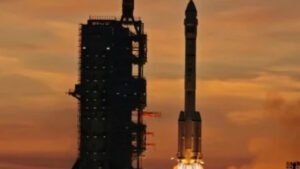
Jiuquan, China: China successfully launched its Shenzhou-24 crewed spacecraft on November 25, 2026 carrying two Chinese astronauts and a Pakistani astronaut to its Tiangong space station. The mission marks the first time a foreign astronaut has visited the Chinese orbital laboratory and the first joint flight involving Chinese and foreign astronauts in China’s human spaceflight programme.
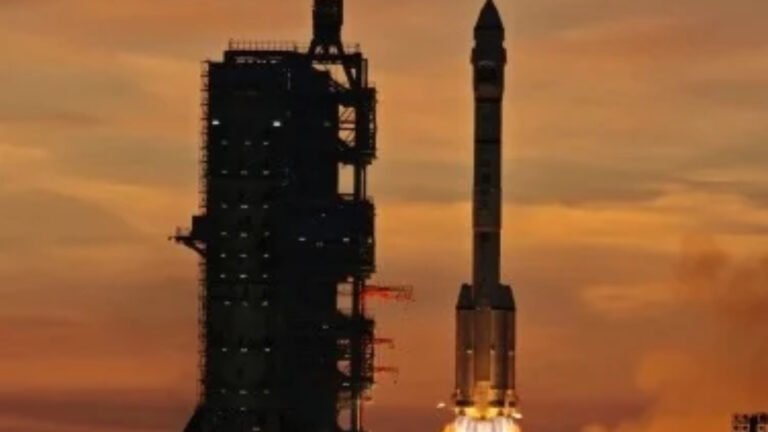
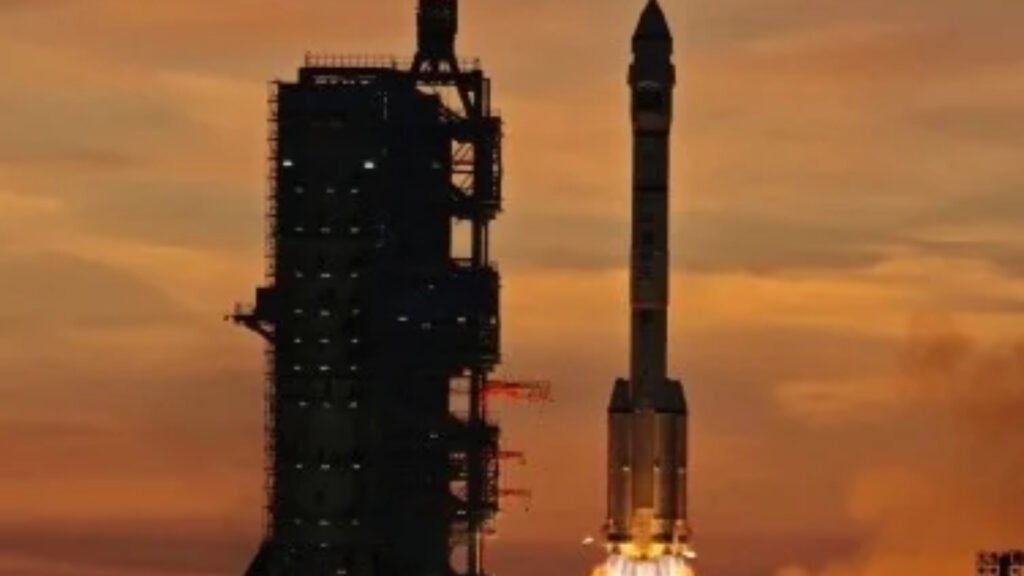
The spacecraft lifted off at 8:18 a.m. Beijing Time aboard a Long March-2F Y24 carrier rocket from the Jiuquan Satellite Launch Center in northwest China. Approximately 10 minutes after liftoff, Shenzhou-24 separated from the rocket and entered its predetermined orbit. The China Manned Space Agency (CMSA) confirmed that the crew was in good condition and declared the launch a complete success.
Shenzhou-24 subsequently completed its rendezvous and docking with the forward port of the Tianhe core module at 11:56 a.m. Beijing Time, with the operation taking approximately three and a half hours. The mission is China’s eighth crewed flight during the application and development phase of its space station programme, its 41st human spaceflight mission and the 680th flight of the Long March rocket family.
The three-member crew comprises Chinese astronauts Tang Hongbo, who serves as mission commander and spacecraft pilot, and Wu Yi, the flight engineer, alongside Pakistani astronaut Muhammad Zeeshan Ali, who is participating as a payload specialist. Tang previously flew on the Shenzhou-12 and Shenzhou-17 missions and is set to become the first astronaut to visit Tiangong three times. Wu, a member of China’s third astronaut batch, is undertaking his first spaceflight.
Ali’s participation represents a milestone in China-Pakistan space cooperation. A former Pakistan Air Force pilot, he is the first foreign astronaut to visit China’s space station. His selection was announced by CMSA spokesperson Zhang Jingbo at a press conference on November 24, as China and Pakistan mark 75 years of diplomatic relations.
During his stay, Ali will participate in routine station operations and joint scientific research, including installing experimental samples and equipment and conducting experiments in orbit. Four China-Pakistan collaborative projects in biotechnology and materials science are planned. One involves photosynthetic cyanobacteria, proposed by Pakistan’s Space and Upper Atmosphere Research Commission (SUPARCO), to investigate their potential applications in oxygen regeneration and biological manufacturing for future space stations and deep-space missions.
Another project will expose 32 quinoa seed samples to the space environment for approximately one year to investigate their stress tolerance and longevity. The other two collaborative experiments will examine multilayer graphene-based hybrid composites and solar-heated self-healing carbon-fibre composites.
Beyond the bilateral research programme, Shenzhou-24 is expected to support more than 90 scientific experiments and technology tests covering space life sciences, materials science, microgravity fluid physics, combustion science, fundamental physics, space medicine and new aerospace technologies. Planned research includes examining the effects of the space environment on vascular aging, advancing multi-omics studies of the human body and testing new technologies for astronaut health and spacecraft propulsion.
The mission will also complete an in-orbit crew rotation with the Shenzhou-23 astronauts and continue the routine operation, maintenance and scientific activities of Tiangong. Following the arrival of the new crew, the outgoing astronauts opened the station hatch at 2:35 p.m. Beijing Time and welcomed the Shenzhou-24 team. Both crews subsequently met aboard the station and began their in-orbit handover.
Ali is expected to return to Earth aboard the Shenzhou-23 spacecraft alongside astronauts Zhang Zhiyuan and Li Jiaying after completing the short-term joint flight. Tang and Wu will remain aboard Tiangong for approximately six months.
The mission also coincides with China’s first planned year-long astronaut stay experiment. Shenzhou-23 astronaut Zhu Yangzhu, who has already spent approximately six months aboard the station, will remain in orbit for a total of one year. The extended stay is intended to advance research into the human body’s adaptation to prolonged spaceflight and improve the technologies and support systems required for long-duration missions.
CMSA spokesperson Zhang Jingbo described the China-Pakistan joint flight as a landmark achievement in bilateral cooperation, reiterating China’s commitment to the peaceful use of outer space and international collaboration. The mission expands China’s human spaceflight programme beyond its national astronaut corps while providing Pakistan with direct participation in orbital scientific research.