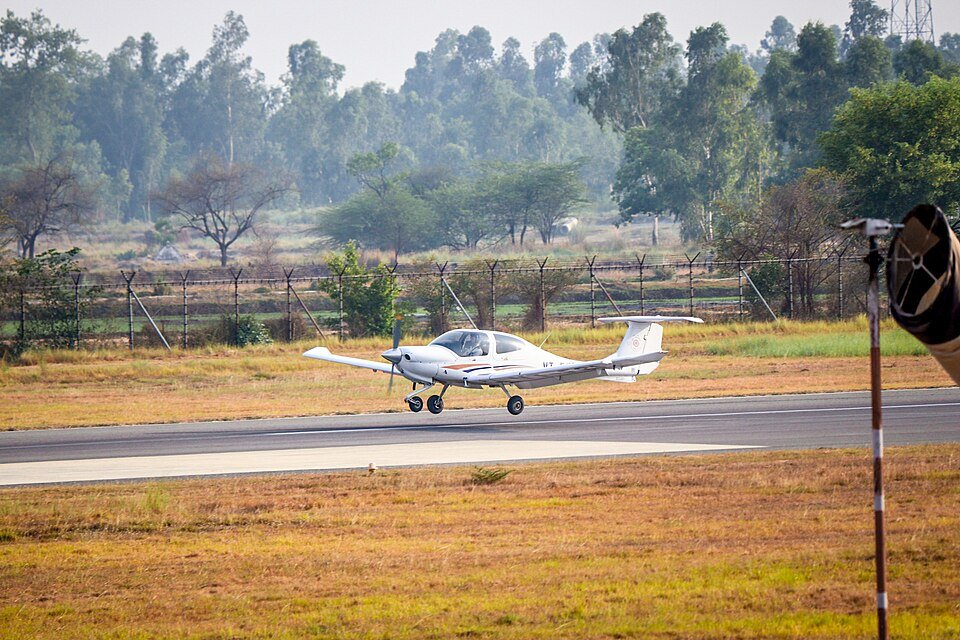
Balaghat, India: India’s Aircraft Accident Investigation Bureau (AAIB), in its final investigation report, has identified non-adherence to standard operating procedures (SOPs) and inadequate organisational supervision of dual training flights as the probable causes of the crash involving an Indira Gandhi Rashtriya Uran Akademi (IGRUA) Diamond DA40 aircraft. The investigation found that the aircraft deviated from its assigned altitude of 5,000 feet, was flown close to the terrain and subsequently struck trees and a hill. The bureau ruled out aircraft serviceability and weather as contributory factors.
The accident occurred on 18 March 2023, involving Diamond DA40 aircraft VT-FGL during a general flying training exercise near Village Bhakkutola in Balaghat district, Madhya Pradesh. Both occupants, a 24-year-old male assistant flight instructor and a 19-year-old female student pilot, sustained fatal injuries. The aircraft was completely destroyed in the crash and subsequent fire. The report does not identify either individual by name.
According to the AAIB, the aircraft was authorised to operate in the eastern sector of Gondia between 15 and 25 nautical miles while maintaining an altitude of 5,000 feet. However, eyewitness accounts indicated that it was subsequently flown at a very low altitude over nearby villages, trees and bushes.
Villagers reported that the aircraft flew so low that they feared it could strike water tanks approximately 40 to 50 feet high. It was also seen making two to three circles around a nearby pond before heading towards the hills where it crashed.
The investigation concluded that the crew had deviated from the assigned altitude without informing air traffic control (ATC) or obtaining permission to descend. The aircraft was also manoeuvred close to the terrain, contrary to the procedures prescribed in the organisation’s Training and Procedure Manual (TPM) and the aircraft’s flight manual.
The AAIB further identified a lack of supervision of dual training flights within the organisation as a contributory factor. Although IGRUA had procedures for analysing flight data recorded by the Garmin G1000 systems installed in its Diamond DA40 aircraft, the investigation found that most of the monitoring was concentrated on solo training flights.
The bureau noted that dual sorties were analysed only when time permitted, with priority given to solo flights. It considered this organisational practice a contributory factor, observing that the absence of effective supervision of dual training flights may have contributed to the crew’s deviation from the assigned altitude and SOPs.
The investigation found no evidence of a technical malfunction contributing to the accident. The aircraft held valid airworthiness documentation, including its Certificate of Airworthiness and Airworthiness Review Certificate, and had been maintained in accordance with the approved maintenance programme.
The aircraft’s maintenance records showed that the required inspections, Airworthiness Directives, Service Bulletins and mandatory modifications had been complied with. No pending defects or snags were recorded before the accident flight, and the aircraft was not operating under any Minimum Equipment List restrictions.
The Lycoming IO-360-M1A engine was recovered from the wreckage and subjected to a detailed strip examination at a DGCA-approved facility. Although its external components and accessories had suffered extensive damage from the impact and subsequent fire, the internal components, including the crankshaft bearings, connecting rods and pistons, were found in good condition.
The strip examination revealed no abnormality that could have contributed to the accident. Investigators established that the engine was delivering the required power at the time of the crash.
Weather was also ruled out. Although poor visibility had prevented flying training activities during the morning of 18 March 2023, conditions improved in the afternoon. At the time of the accident, visibility at Gondia was recorded at 5,000 metres, with winds from 135 degrees at eight knots and a temperature of 28°C.
The AAIB stated that weather conditions at Gondia and nearby stations were conducive to flying training. Eyewitnesses and instructors also confirmed that conditions were suitable for the flight.
Crew Qualifications And Flight Operations
The investigation established that both occupants held valid licences and had adequate rest before the flight.
The instructor held a Commercial Pilot Licence and a valid instructor qualification. He had accumulated 802 hours and 50 minutes of total flying experience, all on the Diamond DA40. He had joined IGRUA as an assistant flight instructor in May 2022 after completing his instructional training at the academy.
The student pilot held a valid Student Pilot Licence and had accumulated 55 hours and five minutes of flying experience, all on the same aircraft type.
Both were familiar with the aircraft and the flying restrictions around Gondia. The report found that the instructor was qualified to conduct the training flight and that the student pilot was authorised to undertake the exercise with an instructor.
The aircraft was released for operations after a pre-flight inspection by the aircraft maintenance engineer at approximately 0845 UTC. No abnormalities were identified. The crew also did not report any technical issues before departure.
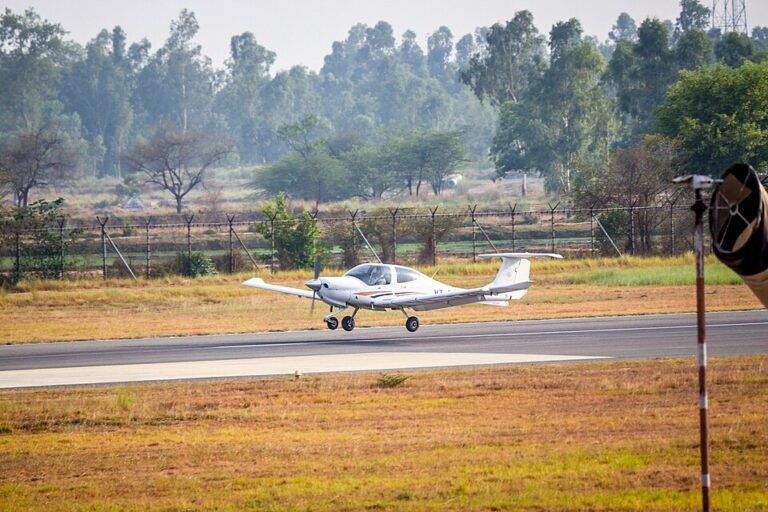
The aircraft was a 2009-built Diamond DA40, registered VT-FGL and owned by IGRUA. It was equipped with a Garmin G1000 system, which recorded aircraft parameters at one-second intervals.
ATC Communication And The Last Recorded Transmission
The aircraft departed Gondia Airport’s runway 04 at approximately 0936 UTC on 18 March 2023 after receiving clearance to operate in the eastern sector while maintaining 5,000 feet.
At 0938 UTC, the crew informed ATC that they were turning right towards the eastern sector. At 0944 UTC, the aircraft reported that it was 10 nautical miles out and maintaining 5,000 feet.
ATC subsequently cleared VT-FGL to operate between 15 and 25 nautical miles in the eastern sector and instructed the crew to report “All Ops Normal” every 10 minutes. The crew acknowledged the instruction at 0944:31 UTC.
However, the aircraft did not make the expected call at approximately 0954 UTC. ATC attempted to establish contact at 0955:32 UTC and again at 0956:18 UTC, but received no response. Further attempts were made on the assigned frequency and the emergency frequency of 121.5 MHz. Another IGRUA aircraft, VT-FGJ, also attempted to contact VT-FGL on the local frequency and the organisation’s company frequency of 129.95 MHz.
When contact could not be established, VT-FGJ was cleared to search for the missing aircraft in the eastern sector while maintaining 6,000 feet. The aircraft could not locate VT-FGL.
At approximately 1022 UTC, Gondia ATC received information from local police about a suspected crash near Balaghat Hills. Local authorities subsequently confirmed the accident at around 1030 UTC. The emergency response plan was activated, and search-and-rescue coordination was initiated.
The aircraft’s Emergency Locator Transmitter activated following the accident, and its distress signal was received by a MEOSAR satellite at 0953 UTC.
Low-Altitude Manoeuvres And Impact With The Hill
The AAIB reconstructed the probable flight path using eyewitness accounts and evidence recovered from the accident site.
According to the investigation, the aircraft flew over Village Bhakkutola at a very low altitude, passing above trees and bushes without striking them. It subsequently made manoeuvres around a nearby pond before heading towards the hills.
The aircraft struck trees shortly before hitting the terrain and impacted the top of a hill. The wreckage then rolled approximately 40 metres down the slope before coming to rest. The accident site was approximately 15 nautical miles from Gondia at an elevation of 497 metres (1,630 feet).
The report considered it highly probable that, while approaching the hill, the crew attempted to pull back sharply on the control stick to climb over the terrain. However, the investigation explained that excessive backward control input could have increased the aircraft’s angle of attack and aerodynamic drag, preventing it from climbing as intended.
The aircraft may consequently have entered a high-drag, high-pitch descent and struck trees immediately before reaching the hilltop.
The investigation also highlighted that the aircraft was not certified for aerobatic manoeuvres. The low-altitude manoeuvring and abrupt changes in attitude were considered violations of the procedures and operational limitations laid down in the TPM and Aircraft Flight Manual.
The aircraft caught fire immediately after the impact and continued burning as it rolled down the hill. Investigators observed burn marks along the path between the initial impact point and the final wreckage position. The cockpit and fuselage were completely burnt, while the propellers remained attached to the engine but had bent tips and burn marks.
The instructor was believed to have been thrown out of the aircraft during the impact and subsequent movement down the hill, while the student pilot was believed to have remained inside the wreckage. Both occupants sustained fatal injuries.
The report also noted that the accident site was located on top of a hill, approximately 600 to 650 feet above ground level, in a densely forested area with difficult access. The impact and subsequent fire rendered the accident unsurvivable.
Flight Data Monitoring And Wider FTO Safety Concerns
The investigation examined IGRUA’s internal flight data monitoring procedures and broader accident trends involving flying training organisations (FTOs) in India.
It found that the organisation had established procedures to download and analyse data from Garmin G1000-equipped aircraft. The information was used to identify deviations from prescribed flight parameters and operational procedures.
However, the investigation found that dual training flights were not receiving the same monitoring priority as solo sorties. The organisation stated that dual-flight data was analysed only when time permitted because most of the available time was spent analysing solo flights.
The report also examined 37 accidents involving FTO aircraft between 2015 and 2025, of which 12 were fatal. It found that approximately 60% of accidents occurred during solo training flights and 40% during dual training exercises. However, around 67% of fatal accidents occurred during dual training flights.
Further analysis found that around 50% of solo training accidents were linked to inadequate training or supervision, while approximately 80% of dual training accidents were attributed to non-adherence to SOPs.
The investigation also highlighted concerns over instructors being inducted into instructional roles soon after obtaining their Commercial Pilot Licences, without sufficient additional flying experience.
DGCA’s Flying Training Circular 01 of 2022, issued on 22 November 2022, had introduced requirements for monitoring training activities and analysing flight data. The circular was amended on 3 September 2025, increasing the flight data analysis requirement from 25% to 100% of training flights and introducing requirements for recording ground-to-air and air-to-ground VHF communications.
However, the AAIB observed that these requirements were not being implemented fully by all FTOs. It also noted that some organisations had yet to implement the required flight data monitoring, VHF recording and CCTV provisions.
AAIB Safety Recommendations
Following the investigation, the AAIB issued three safety recommendations to DGCA.
The bureau recommended that DGCA take necessary steps to ensure all FTOs comply with the requirements of Flying Training Circular 01 of 2022 and explore ways to overcome the limitations preventing full implementation.
It also recommended examining the feasibility of introducing minimum flying experience requirements, based on aircraft type, for newly qualified CPL holders before they are assigned instructional flying duties.
The third recommendation called for DGCA to issue directions to all FTOs to strengthen their safety culture and ensure that personnel involved in flying training operations follow established procedures and guidelines.