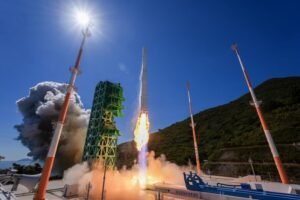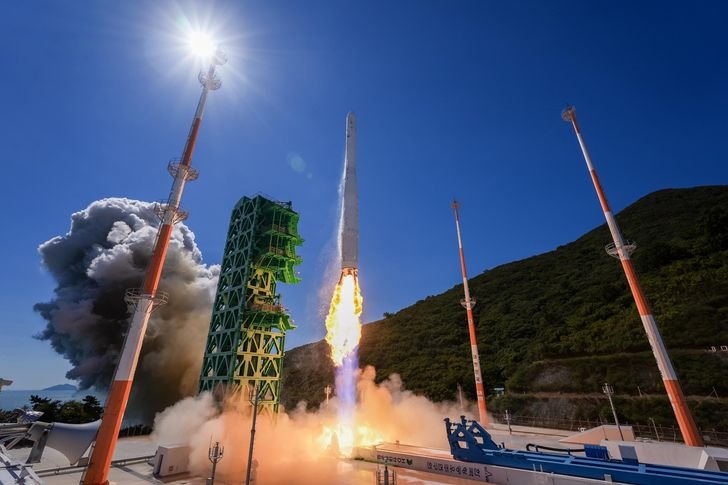
Goheung, South Korea: South Korea successfully launched its homegrown Nuri (KSLV-II) rocket on its fifth mission on October 7, 2026, lifting off at 12:25 p.m. KST from the Naro Space Center in Goheung. The 200-ton, three-stage rocket reached its target orbit at about 570 km and successfully deployed five NEONSAT microsatellites and nine of 10 CubeSats. One CubeSat, PERSAT-02, developed by South Korean startup Quaternion, failed to separate from the rocket.
The mission was formally scheduled on August 27, 2026, when the Korea AeroSpace Administration (KASA), headed by Administrator Oh Tae-seok, held its first Launch Management Committee meeting and selected October 7 as the launch date, with a backup window from October 8 to 14. KASA and the Korea Aerospace Research Institute (KARI) subsequently completed preparations for the mission.
The primary payload was NEONSAT Nos. 2 through 6, part of South Korea’s first domestically launched microsatellite constellation. Developed under the Korea Advanced Institute of Science and Technology (KAIST), the satellites weigh less than 100 kg each and carry electro-optical cameras capable of imaging objects at resolutions of about 1 metre in black and white and 4 metres in colour. The constellation is intended to monitor the Korean Peninsula and surrounding areas for national security and disaster response. Once all 10 satellites are operational, the system is expected to image the Korean Peninsula more than three times a day and revisit the same location within 24 hours during emergencies. Five additional NEONSAT satellites are planned for Nuri’s sixth mission in 2027.
The other payloads were CubeSats developed by South Korean companies, universities, research institutions and local governments. They included SLEDGE, GBSAT, PERSAT-02, UEL-Y-Sys, SD-1 SAT, E3_TESTER-KARI-2, DaejeonSat-1, BEE-1012, JACK-007 and CPSat, covering missions including ionospheric and space-environment observations, Earth imaging, radiation measurements, fine-dust monitoring, component testing and communications technology demonstrations. KARI material also identifies missions involving optical communications, domestic space-component verification and urban-change observation.
The satellites were deployed sequentially after Nuri reached its target altitude. The five NEONSATs were separated at 35–40-second intervals, with the rocket changing its attitude between deployments to prevent collisions, while the CubeSats were released in pairs at roughly 10-second intervals. After the deployment sequence, Nuri performed a collision-avoidance manoeuvre and vented its remaining fuel. Its flight ended roughly 20 minutes after liftoff.
KASA said NEONSAT No. 6 established initial communication with the King Sejong Station in Antarctica at about 1:08 p.m., with communications with the other satellites planned through ground stations in Daejeon, Jeju, Antarctica and Svalbard, Norway.
KASA Administrator Oh Tae-seok said the fifth mission successfully demonstrated the precise deployment of multiple satellites and strengthened Nuri’s reliability. Following the mission, Nuri’s cumulative launch success rate increased from 75% to 80%, marking its fourth consecutive successful launch after its maiden-flight failure in 2021.
The mission also expanded private-sector participation in Nuri operations. KASA said industry participation in launch operations was increased compared with the fourth flight, with Hanwha Aerospace among the companies involved. KASA said the move is intended to build private-sector launch-operation experience and support a future transition to a private-led commercial launch-service system.
Oh Tae-seok said South Korea is preparing for Nuri’s sixth launch in the second half of 2027 and plans to conduct at least one launch every year through 2032, with the longer-term goal of improving Nuri’s reliability and moving toward private-led commercial launch services.
The launch therefore represents more than another successful Nuri flight: it demonstrated South Korea’s ability to deploy a group of primary satellites into a constellation while simultaneously carrying commercial and research CubeSats, strengthening the country’s push toward independent space transportation and a more commercially driven space industry.